Film Production Services in Norway
Norway is a strong Nordic production destination for international crews that need fjords, mountain roads, Arctic coastlines, snow, modern cities, traditional villages, remote landscapes, reliable infrastructure and experienced local production support. It works well for commercials, documentaries, feature films, factual television, automotive shoots, travel campaigns, branded content, photography and location-led productions that need dramatic natural environments with a professional filming framework.
Hoodlum provides Film Production Services in Norway for productions filming across Oslo, Bergen, Tromsø, Lofoten, Svalbard, Western Norway, fjords, mountain roads, Arctic towns, coastal routes, glaciers, forests, villages, private locations and remote northern areas. Our team supports visa planning, Norwegian Directorate of Immigration documentation, film permits, Norwegian Film Commission liaison, local municipality coordination, drone approvals through the Norwegian Civil Aviation Authority, ATA Carnet customs clearance, private location agreements, local fixers, crew sourcing, transport, accommodation, safety planning and on-ground production management.
The country is production-friendly and low-risk, but international crews still need to prepare properly. Depending on the project, filming may involve Schengen entry checks, work or registration requirements, local filming permits, police coordination, municipality approvals, drone permissions, public liability insurance, environmental rules, private property agreements, customs documentation and specialist logistics for mountain, fjord or Arctic locations.
Hoodlum helps productions understand which approvals apply, what documents are needed and how to build a realistic schedule around permits, weather, road access, drones, customs, crew movement and safety.
Why Norway Works for International Productions
Norway works because it offers high-impact landscapes with strong production infrastructure. A crew can base in Oslo for city and interview work, move to Bergen or the western fjords for coastal and mountain visuals, travel north for Tromsø and Arctic content, or use Lofoten for dramatic roads, fishing villages, mountains, beaches and winter light.
The country is especially useful for:
- Commercials and branded content
- Automotive shoots
- Documentaries and factual entertainment
- Travel and tourism campaigns
- Feature films and television drama
- Outdoor apparel campaigns
- Arctic and winter productions
- Photography projects
- Drone-led landscape filming
- Marine and coastal stories
- Mountain and road sequences
- Expedition-style productions
A major advantage is the combination of visual scale and reliable systems. Roads, ferries, airports, hotels, local crew, location managers, drone operators, production suppliers and regional film contacts can make ambitious shoots achievable when the route is planned correctly.
The main production challenge is geography. Fjords, mountains, islands and northern regions can create longer travel times than they appear to on a map. Weather can shift quickly, ferries affect schedules and some locations require specific local approval. Hoodlum helps productions compare creative value against access, permits, cost, weather and transport before locking the route.
Oslo as a Production Base
Oslo is the main urban production base and a practical starting point for many international crews. The city offers airport access, hotels, local crew, suppliers, modern architecture, waterfront areas, offices, residential locations, cultural spaces, roads, forests and nearby coastal access.
Oslo can support:
- Commercials
- Corporate films
- Documentary interviews
- Branded content
- Fashion and photography shoots
- Urban lifestyle campaigns
- Technology and design stories
- Travel films
- Studio-linked work
- Small and medium-size television productions
Public filming in Oslo may require permission from local authorities, property owners or relevant site managers depending on the location and production footprint. A small documentary crew may be able to work with minimal disruption, while a commercial using lighting, vehicles, drones, road impact, crowd control, reserved parking or large equipment will need more formal coordination.
Oslo filming may require:
- Detailed shooting schedule
- Location plans
- Script excerpts or project outline
- Proof of liability insurance
- Completed permit application form
- Crew and equipment list
- Vehicle and parking details
- Traffic or pedestrian management plan, if required
- Drone information, if applicable
- Local authority or property owner approval
Hoodlum helps productions coordinate Oslo filming by identifying the correct approval route, preparing permit documents, securing private locations and arranging local fixer support.
Bergen, Western Norway and Fjord Filming
Bergen and Western Norway are central to fjord-based production. The region can provide harbour visuals, mountain roads, waterfalls, ferry routes, villages, coastal weather, fjords, dramatic viewpoints and strong travel or automotive production value.
Western Norway can support:
- Fjord filming
- Automotive commercials
- Travel campaigns
- Documentary sequences
- Outdoor apparel shoots
- Drone landscape work
- Marine and boat-based filming
- Road sequences
- Village and harbour scenes
- Photography projects
Fjord filming requires careful planning because access can involve ferries, mountain roads, narrow routes, weather windows, public viewpoints, private land, national tourist roads, boat operators or local municipalities. Drone work near fjords may also need separate aviation and landowner permissions.
Productions should account for:
- Ferry schedules
- Mountain weather
- Road closures
- Parking limitations
- Public visitor activity
- Drone restrictions
- Boat safety
- Private property
- Local authority permits
- Accommodation availability
Hoodlum helps crews plan fjord shoots around realistic movement, safe access, correct permits and weather contingency.
Tromsø, Lofoten and Arctic Production
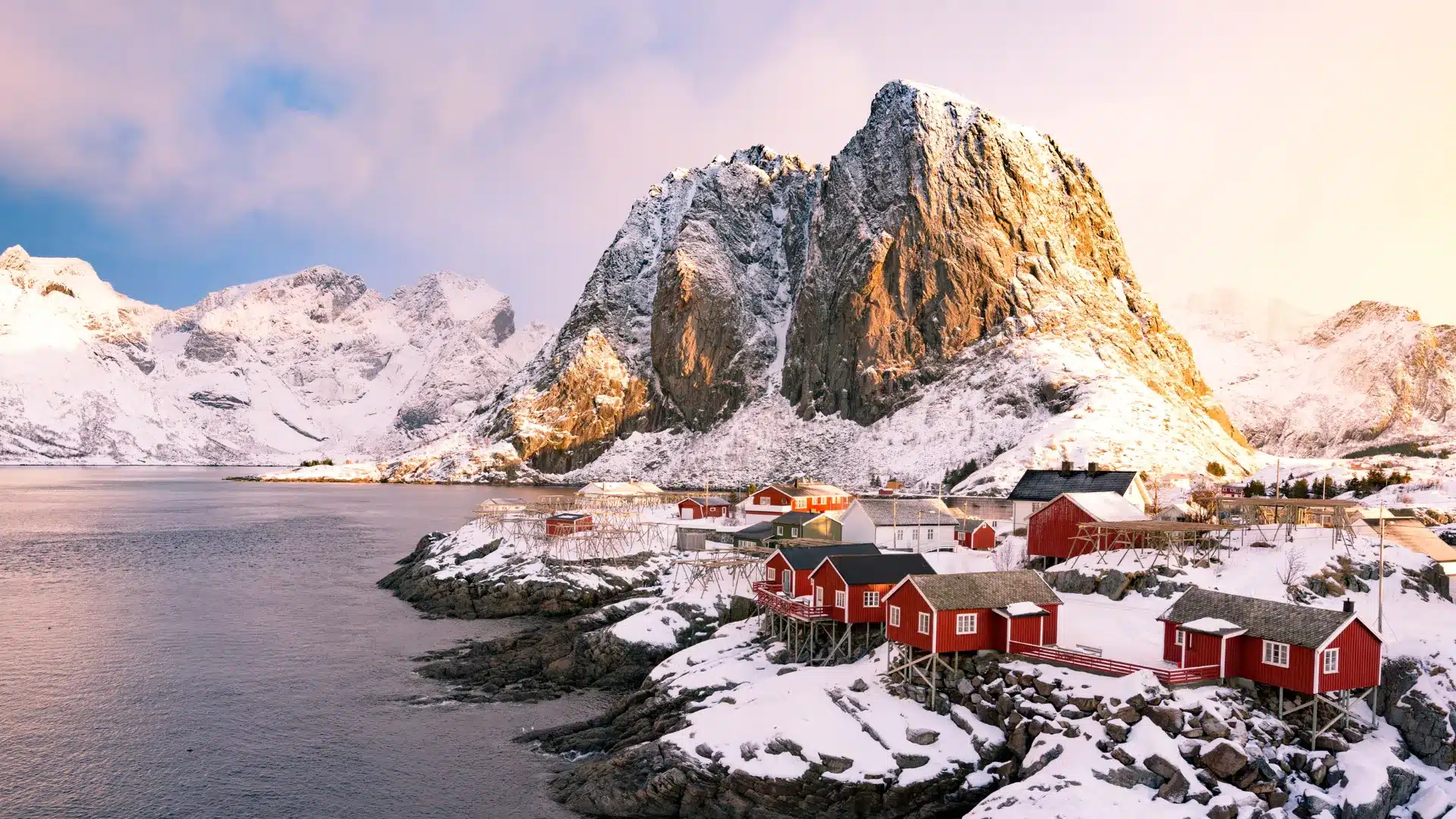
Northern Norway is highly valuable for productions needing Arctic light, snow, mountains, coastal roads, fishing villages, winter atmosphere, northern lights planning and remote natural environments. Tromsø is a practical northern base with airport access, hotels, suppliers and local crew support. Lofoten provides dramatic scenery, beaches, fishing villages, bridges, roads, mountains and strong visual contrast.
These regions can support:
- Winter commercials
- Travel campaigns
- Outdoor apparel shoots
- Arctic documentaries
- Automotive sequences
- Photography
- Drone landscapes
- Northern lights planning
- Marine and coastal stories
- Factual television
- Expedition-style content
Arctic production requires more preparation than a city shoot. Crews should plan around short winter daylight, weather changes, snow roads, ferry routes, accommodation pressure, local transport, equipment protection, safety support and backup days. Northern lights filming cannot be guaranteed and should be treated as a weather-dependent opportunity rather than a fixed deliverable.
Hoodlum helps productions decide whether Tromsø, Lofoten or another northern location is the right base for the brief, and how much contingency should be built into the schedule.
Svalbard and High Arctic Locations
Svalbard offers extreme Arctic production value, but it requires specialist planning. Productions may need polar bear safety, local guides, special permits, environmental rules, transport planning, emergency procedures and a much more detailed field safety approach than mainland filming.
Svalbard can support:
- Polar documentaries
- Climate stories
- Expedition films
- Wildlife and conservation content
- Arctic photography
- Remote factual programming
- Scientific and environmental stories
- Specialist branded content
Svalbard filming may involve government permissions, environmental restrictions, local guide requirements, firearm or polar bear safety protocols, snowmobile or boat logistics, emergency communication and strict field planning. Crews should not treat it as a standard Norwegian location.
Hoodlum helps productions assess whether Svalbard is suitable for the project and what safety, permit and logistics support is required before committing the location to the production schedule.
Roads, Villages and Remote Landscape Filming
Norway is especially strong for road-based and village-based filming. Mountain passes, national tourist routes, coastal bridges, fjord roads, tunnels, ferries, traditional villages and remote viewpoints can all deliver high production value.
Road and remote filming may require:
- Local municipality permission
- Police or road authority coordination
- Traffic management
- Parking and unit base planning
- Drone approval
- Weather monitoring
- Ferry planning
- Vehicle safety
- Local guides
- Public liability insurance
- Private land agreements
- Environmental protection measures
Filming is generally allowed in many public areas as long as the production does not significantly interfere with everyday life, public safety or the preservation of nature. However, permits are required where the production involves street closures, extensive use of public areas, traffic impact, large equipment, drones, or any activity that affects public safety or the environment.
Hoodlum helps productions identify when a simple public-area shoot is possible and when coordination with the Norwegian Film Commission, National Police Directorate, local municipality or road authority is needed.
Visa Requirements and Crew Entry
Film crews travelling to Norway may not need a visa for stays of up to 90 days if they are from visa-exempt countries, but they must still meet entry requirements. These may include holding a valid passport, proof of sufficient funds, health insurance and a clear travel purpose. Depending on nationality, duration, work activity and production structure, crew may also need to register with the Norwegian Directorate of Immigration or apply for the appropriate visa or permit.
Visa application documents may include:
- Valid passport
- Completed application form
- Recent passport photos
- Proof of payment for the application fee
- Proof of sufficient funds
- Health insurance
- Detailed itinerary
- Invitation letter from the Norwegian production company or partner
- Crew list
- Role descriptions
- Production schedule
- Accommodation details
Visa processing typically takes around 15 to 30 days, but timing can vary depending on visa type, application complexity, nationality and the workload of the Norwegian Directorate of Immigration. Productions should allow extra time for larger crews, incomplete documents or applications involving specialist work activity.
The cost of a visa for film crew can be around NOK 5,300, approximately EUR 530 or USD 600. Additional fees may apply for expedited processing or related services, and some nationalities may be exempt from paying the visa fee.
Visa information is available through the Norwegian Directorate of Immigration:
https://www.udi.no/en/want-to-apply/visit-and-holiday/visitors-visa-to-norway/?c=xxx
Hoodlum helps productions prepare consistent visa documents, invitation letters, crew lists, role descriptions, travel itineraries and production schedules.
International Crew Accreditation
Crew accreditation may be required for access to certain locations, events, government-owned properties, controlled sites or official production environments. Accreditation helps confirm who is working on the production, what their role is and whether they have the correct documentation or qualifications.
Crew accreditation documents may include:
- Valid passport
- ID document
- Proof of employment or contract
- Relevant certifications or licences
- Completed accreditation application form
- Photograph
- Personal contact details
- Crew list
- Role descriptions
- Production company letter
- Insurance documentation
- Local production contact
Processing typically takes around 2 to 5 working days, but this can vary depending on the accrediting authority, location, event, complexity of the application and supporting documents required.
Crew accreditation is often free of charge or minimal, usually around NOK 50 to NOK 200, approximately EUR 5 to EUR 20. Some locations, events or controlled sites may charge higher fees.
Hoodlum helps productions organise accreditation files so crew documentation is ready for municipalities, event organisers, property owners, government sites or other controlled locations.
General Film Permits and Local Approvals
Film permits may be issued or coordinated by the Norwegian Film Commission, the National Police Directorate, local municipalities or specific location owners depending on the shoot. The correct approval route depends on where filming takes place and whether the production affects public space, traffic, safety, nature, private property or controlled infrastructure.
A film permit application may require:
- Completed permit application form
- Detailed shooting schedule
- Location plans
- Script excerpts or project outline
- Proof of liability insurance
- Crew list
- Equipment list
- Vehicle and parking plan
- Drone details, if applicable
- Local authority approvals
- Traffic or public safety plan, where required
- Environmental protection plan, where relevant
Processing typically takes around 2 to 6 weeks, depending on complexity, location, season, public impact and authority workload. Shoots involving roads, national parks, public disruption, drones, sensitive infrastructure, large crews or remote environments should allow more lead time.
Permit costs can vary significantly by location and production type. Fees may range from around NOK 500 to NOK 50,000, approximately EUR 50 to EUR 5,000, depending on scale, authority involvement, road use, location services, supervision and production impact.
Hoodlum helps productions identify the correct authority, prepare permit documentation and coordinate with municipalities, police, film commission contacts, location owners or road authorities.
Public Areas and Environmental Rules
Filming is often possible in public areas when the crew is small, the footprint is light and the activity does not interfere significantly with everyday life, public access, safety or the preservation of nature. However, crews should still confirm whether the location is public, private, protected, municipal, road-controlled or environmentally sensitive.
Permits may be required for:
- Street closures
- Extensive use of public areas
- Traffic control
- Road filming
- Large crew setups
- Lighting or generator use
- Drones
- Stunts or special effects
- Filming near sensitive infrastructure
- National parks or protected nature
- Activities that affect public safety
- Activities that may affect fauna or flora
Environmental care is important. Productions should avoid damaging vegetation, disturbing wildlife, blocking trails, leaving waste, creating unsafe public access issues or using vehicles where they are not permitted.
Hoodlum helps productions assess whether public-area filming can be handled lightly or whether formal permissions and environmental safeguards are needed.
Private Locations and Location Agreements
Private locations are arranged directly with owners, managers, businesses, hotels, farms, cabins, estates, commercial properties, industrial sites, tourism operators, road owners or local representatives. A fixer is often essential because location access depends on local communication, negotiation and practical planning.
The private location process usually includes:
- Location scouting
- Ownership research
- Initial approach to the owner or manager
- Explanation of the production
- Review of the shooting schedule
- Fee negotiation
- Crew and equipment approval
- Insurance review
- Access planning
- Written location agreement
A private location agreement should cover:
- Approved filming areas
- Access times
- Crew size
- Equipment access
- Parking
- Vehicle movement
- Overtime
- Cleaning and restoration
- Drone restrictions
- Weather holds
- Cancellation terms
- Public liability insurance
- Environmental restrictions
- Content restrictions, if any
- Payment terms
Private location costs are determined case by case and cannot usually be quoted until the production team submits a detailed shooting schedule. Fees depend on location use, duration, crew size, equipment, public impact, exclusivity, access difficulty and specific production requirements.
Hoodlum helps productions scout, approach, negotiate and manage private locations so the crew has confirmed access and clear shoot-day terms.
Drone Filming and Luftfartstilsynet Permissions
Drone operations are regulated by the Norwegian Civil Aviation Authority, known as Luftfartstilsynet. Operators may need permission depending on the drone, location, airspace, risk category and filming activity. Crews must also comply with rules such as flying below applicable height limits, maintaining safe distance from airports, avoiding unsafe flights over populated areas and respecting sensitive infrastructure.
Drone planning should account for:
- Norwegian Civil Aviation Authority requirements
- EU or EEA drone rules
- Drone registration
- Pilot qualifications and training
- Proof of liability insurance
- Detailed flight plan
- Permit application form
- Airspace restrictions
- Airport distance
- Populated areas
- Sensitive infrastructure
- National parks
- Private land permission
- Weather and wind
- Privacy and consent
A drone permit application may require:
- Detailed flight plan
- Proof of drone registration
- Proof of liability insurance
- Completed permit application form
- Pilot qualification documents
- Training documentation
- Drone specifications
- Location map
- Risk assessment
- Production schedule
- Description of filming purpose
Processing can take around 1 to 3 weeks, depending on the complexity of the application and the workload of the Norwegian Civil Aviation Authority. Productions should allow longer for sensitive locations, controlled airspace, high-risk operations, urban areas, national parks or special requests.
Permit costs vary depending on permit type and complexity. Typical costs can range from NOK 2,500 to NOK 10,000, approximately EUR 250 to EUR 1,000.
For many international productions, hiring a local drone operator is more efficient than bringing a team unfamiliar with local airspace and weather conditions. Hoodlum helps crews decide which route is safer, faster and more practical.
Drone Importation
Drone importation is separate from permission to fly. Drones brought into Norway may require customs clearance and compliance with Norwegian Tax Administration and Norwegian Communications Authority regulations. Drones over 25 kilograms may also require additional permission from the Norwegian Civil Aviation Authority.
Drone import documents may include:
- Commercial invoice
- Bill of lading or air waybill
- Certificate of origin
- Detailed drone description
- Drone specifications
- Proof of ownership
- Customs declaration
- Compliance documents
- Insurance details
- ATA Carnet, if applicable
- Battery transport documents
- Flight permit documents, if available
Importing a drone does not automatically authorise operation. A production may still need drone registration, pilot qualifications, liability insurance, flight permission, local authority approval, landowner permission and risk assessment.
Hoodlum helps productions separate customs importation from flight approval so drone work is not delayed by missing documents or unclear permissions.
Equipment Customs Clearance and ATA Carnets
Norway accepts ATA Carnets, which makes temporary importation practical for professional film equipment. A Carnet allows eligible camera, lighting, sound, grip, drone and production gear to be temporarily imported duty-free and tax-free when the paperwork is prepared correctly and the equipment is re-exported within the permitted timeframe.
The general ATA Carnet process is:
- Obtain the Carnet from a national issuing association before travel
- List all goods to be temporarily imported
- Include values and serial numbers where relevant
- Present the Carnet to customs officials on arrival
- Use the equipment for the production
- Present the Carnet on departure
- Re-export the equipment within the approved period
- Return the Carnet to the issuing association
Customs clearance documents may include:
- ATA Carnet
- Commercial invoices
- Packing lists
- Certificates of origin
- Detailed equipment list
- Proof of insurance
- Customs declaration form
- Serial numbers
- Equipment values
- Freight documents, if applicable
- Drone documents, if relevant
Customs clearance is handled by the Norwegian Customs Authority, known as Tollvesenet. Straightforward clearance can take around 30 minutes to 2 hours when documents are complete. Timing can vary depending on shipment complexity, inspection requirements, entry point and authority workload.
Customs clearance costs typically range from NOK 500 to NOK 2,000, approximately EUR 50 to EUR 200, depending on the type, value and complexity of the equipment.
Hoodlum helps productions prepare Carnet documentation, equipment lists, serial numbers, values, customs declarations and arrival plans so professional film equipment can move efficiently.
Film Rebates and Tax Incentives
Norway offers a production incentive known as the Norwegian Film Incentive Scheme. The scheme can provide a rebate of up to 25% of eligible expenses for qualifying film and television productions that shoot on location in the country.
The incentive may be relevant for larger feature films, television productions and qualifying international projects with meaningful local spend. Eligibility depends on production type, budget, cultural and economic criteria, local expenditure, application timing and current programme rules.
Incentive planning may affect:
- Local production partner selection
- Budget structure
- Qualifying expenditure
- Payroll and contractor treatment
- Local supplier use
- Accommodation and transport spend
- Accounting records
- Audit documentation
- Application timing
- Delivery requirements
Productions should not assume automatic approval. Hoodlum helps crews understand whether the incentive route should be explored and when to involve local producers, accountants, rebate specialists or production service partners.
Safety, Security and Local Risk
Norway is generally considered low-risk for film productions. Standard security measures are usually enough, but crews should still plan for equipment protection, data security, public filming, weather, remote access, mountain roads, coastal environments and sensitive locations.
Security and safety planning may include:
- Securing equipment
- Secure transport
- Encrypted data storage
- Overnight gear storage
- Controlled access to set
- Public filming management
- Crowd awareness
- Weather monitoring
- Road safety planning
- Ferry schedule planning
- First aid planning
- Remote communication
- Drone safety
- Mountain and coastal safety
- Local guide support where needed
For remote or Arctic shoots, the bigger risks are usually environmental rather than security-related. Weather, icy roads, mountains, water, ferries, limited daylight and long travel distances can affect the schedule and crew safety.
Hoodlum helps productions build a location-specific safety plan that matches the actual risk, whether the shoot is a simple Oslo interview, a fjord commercial, a Lofoten winter route or a remote Arctic documentary.
Weather, Roads and Remote Logistics
Weather and road planning are central to production scheduling. Mountain passes, ferries, coastal roads, snow, ice, wind and short winter daylight can all affect filming. A route that looks efficient on a map may require more time once ferry timetables, road conditions and weather changes are included.
Production logistics should account for:
- Ferry schedules
- Mountain road conditions
- Winter closures
- Snow and ice
- Wind and coastal weather
- Short daylight in winter
- Long summer daylight
- Accommodation availability
- Equipment protection
- Fuel and vehicle planning
- Crew fatigue
- Backup locations
- Weather holds
- Local guide support
Hoodlum helps crews build realistic movement days, choose the right production base, plan transport and avoid overloading the schedule with too many distant locations.
When Norway Is the Right Production Choice
Norway is the right choice when a production needs fjords, mountains, Arctic coastlines, snow, modern cities, traditional villages, roads, remote landscapes, experienced crew and a strong Nordic production environment.
It works especially well for commercials, documentaries, feature films, television drama, automotive shoots, travel campaigns, outdoor apparel content, photography, factual entertainment, drone-led landscapes and Arctic stories.
The country may be less suitable for productions that need very low-cost logistics, instant drone permissions, guaranteed weather, simple road access to every location or large public disruption without lead time. It is highly workable when visas, permits, drones, customs, private locations, transport and safety planning are handled early.
Common Production Mistakes
Common mistakes include underestimating travel time between fjords and northern locations, leaving drone approvals too late, assuming all public filming needs no coordination, forgetting ferry schedules, arriving with incomplete Carnet documents, failing to confirm private land access, not allowing for winter road conditions, underestimating public safety requirements and planning too many remote locations in a short schedule.
Another common mistake is choosing the most famous viewpoint when a less crowded road, village, fjord or private location can deliver the same visual value with better control. Hoodlum helps productions compare creative ambition against access, timing, permits, cost, safety and weather.
How Hoodlum Supports Productions in Norway
Hoodlum provides Film Production Services in Norway for international productions that need reliable support from early planning through wrap. Our services include visa guidance, UDI documentation support, crew accreditation coordination, Norwegian Film Commission liaison, local municipality permit support, National Police Directorate coordination where required, location scouting, private location agreements, local fixers, crew sourcing, drone planning, Norwegian Civil Aviation Authority coordination, ATA Carnet and Norwegian Customs preparation, transport, accommodation, safety planning, incentive guidance and on-ground production management.
From Oslo, Bergen, Tromsø and Lofoten to Svalbard, Western Norway, fjords, mountain roads, Arctic coastlines, fishing villages, glaciers and remote northern routes, Hoodlum helps productions access the country with the right paperwork, permissions, crew and logistics in place.
FAQ
Do international film crews need a visa to enter Norway?
Some film crews may not need a visa for stays up to 90 days, depending on nationality. Crews must still meet entry requirements and may need registration or other permissions depending on work activity and stay duration.
What documents are usually needed for a visa?
Common documents include a valid passport, completed application form, passport photos, proof of fee payment, proof of sufficient funds, health insurance, itinerary and invitation letter from a Norwegian production company or partner.
How long does visa processing take?
Visa processing typically takes around 15 to 30 days, depending on visa type, nationality, application complexity and authority workload.
How much does a visa cost?
A visa can cost around NOK 5,300, approximately EUR 530 or USD 600, although fees vary and some nationalities may be exempt.
Is crew accreditation required?
Crew accreditation may be required for access to certain locations, events, government-owned properties or controlled sites. Requirements vary by authority and location.
How long does crew accreditation take?
Crew accreditation usually takes around 2 to 5 working days, depending on the authority and complexity of the application.
How much does crew accreditation cost?
Accreditation is often free or minimal, usually around NOK 50 to NOK 200, although some locations or events may charge more.
Who issues film permits?
Film permits may be issued or coordinated by the Norwegian Film Commission, National Police Directorate, local municipalities or specific location owners depending on the production.
How long do film permits take?
Permit processing typically takes around 2 to 6 weeks, depending on complexity, location and time of year.
How much do film permits cost?
Permit costs can range from around NOK 500 to NOK 50,000 depending on location, production type and authority involvement.
Can productions film in public areas?
Filming is generally possible in many public areas if it does not significantly interfere with everyday life, public safety or nature. Permits are needed for larger impact activity, street closures, traffic control or environmental risk.
Are drones allowed for filming?
Yes, but drone operations must follow Norwegian Civil Aviation Authority rules. Operators may need registration, insurance, pilot qualifications, a flight plan and permission depending on the operation.
How long do drone permits take?
Drone permit processing can take around 1 to 3 weeks, depending on application complexity and authority workload.
Is Norway an ATA Carnet country?
Yes. ATA Carnets can be used for temporary importation of eligible professional filming equipment.
Who handles customs clearance?
Customs clearance is handled by the Norwegian Customs Authority, known as Tollvesenet.
Does Norway offer a film rebate?
Yes. The Norwegian Film Incentive Scheme can provide up to 25% rebate on eligible expenses for qualifying film and television productions.
Is Norway safe for filming?
Yes. It is generally low-risk, but productions should still plan for equipment security, data protection, public filming, weather, road conditions and remote-location safety.
External Authority Links
- Norwegian Directorate of Immigration
- Norwegian Film Commission
- National Police Directorate
- Norwegian Civil Aviation Authority
Planning a shoot in Norway? Contact Hoodlum for visa support, film permits, local fixers, location scouting, ATA Carnet customs planning, drone coordination, crew sourcing, incentive guidance, safety planning and on-ground production management. You can also explore our film production services and learn more about who we are. For more information, you can also visit our Hoodlum Film Fixers Norway Google Business Profile for local production details.