


Introduction
Hoodlum offers expert film fixer services in Indonesia, supporting international productions across the world’s largest archipelago nation — a filming destination of extraordinary scale, visual diversity and logistical complexity.
Indonesia comprises over 16,000 islands stretching 5,100 kilometres across the equator between Asia and Australia. The production environments available within this single country are genuinely incomparable — the ancient Hindu temples of Yogyakarta, the primordial komodo dragon landscapes of Flores, the world-class marine environments of Raja Ampat, the orangutan forests of Kalimantan, the active volcanic landscapes of Sumatra and Java, the highland cultures of Papua, the colonial architecture of Jakarta, and dozens of coastal, jungle and island environments that have no equivalent elsewhere in Southeast Asia.
Indonesia is an ATA Carnet country. Film permits are issued by the Film Development Centre under the Ministry of Tourism and Creative Economy. Drone operations are regulated by the Directorate General of Civil Aviation (DGCA). The country has a well-developed domestic film industry with experienced local crew available across Jakarta, Surabaya, Yogyakarta, Makassar and other major cities.
Hoodlum provides in-country expertise, permit coordination, local crew and the logistics support that makes production across Indonesia’s vast and diverse geography practical and efficient.
For productions specifically focused on Bali, Hoodlum has a dedicated Bali film production guide covering the specific permit, temple access, Nyepi and logistics requirements of the island.
Indonesia Film Production Guide for International Crews
Indonesia is a Southeast Asian filming destination of unmatched geographic scale. The country is served by international airports in Jakarta (Soekarno-Hatta), Surabaya, Bali (Ngurah Rai), Medan, Makassar, Manado, Yogyakarta and numerous domestic hubs that connect to the wider archipelago. Domestic flights, ferries, speedboats and road transport are all required depending on the specific island or region being filmed.
The main production environments beyond Bali include Jakarta and its megacity urban character, Yogyakarta and the Prambanan and Borobudur temple complexes, Komodo National Park and the Flores island chain, Raja Ampat’s marine environments in West Papua, the orangutan habitats of Kalimantan (Borneo), the Tana Toraja highland culture of Sulawesi, the orangutan sanctuaries and rainforest of Sumatra, the highland landscapes of Papua, the ancient temples and volcanic terrain of East Java, and the pristine beaches and reefs of the Maluku Islands and Lombok.
A successful Indonesia production requires early preparation. E-visa arrangements, Film Development Centre permit and crew accreditation (six to eight weeks), DGCA drone approval (four to six weeks), ATA Carnet customs clearance and island-specific logistics must all be confirmed before crew travel. Multi-island productions add inter-island flight, ferry and boat logistics as a distinct planning layer.
Why Film Production Works Well in Indonesia
Indonesia works for productions that need a combination of ancient heritage, tropical nature, marine environments, volcanic landscape, diverse cultural environments and a cost-competitive production base across a vast archipelago geography.
Strong production use cases include:
- Nature and wildlife documentary — orangutans, komodo dragons, bird of paradise, marine biodiversity
- Feature film and television drama
- Commercial and advertising campaigns
- Travel and adventure programming
- Marine and underwater productions — Raja Ampat, Komodo, Banda Sea
- Heritage and cultural documentary — Borobudur, Prambanan, Tana Toraja
- Volcanic and geological documentary
- Conservation and environmental storytelling
- Music videos
- Reality and competition formats
- Still photography and branded content
Indonesia’s domestic film industry produces hundreds of films annually, creating a local crew ecosystem with genuine depth in Jakarta, Surabaya, Yogyakarta and Makassar. For most production requirements, experienced department heads, camera crew, grip, lighting and production vehicles are available locally without the cost and logistics of importing international crew.
English is widely spoken in the tourism, hospitality and production sectors of major cities, which simplifies day-to-day logistics considerably.
Best Time of Year to Film
The dry season from May to September offers the most reliable filming conditions across most of Indonesia — clear skies, lower humidity and minimal rainfall for outdoor and island locations.
The wet season runs October to April. Heavy rainfall, high humidity and reduced visibility for aerial and drone work can affect exterior filming, boat operations and marine locations during this period.
Regional variation is significant:
- Bali and Lombok — drier and sunnier than most of Indonesia year-round. See dedicated Bali guide.
- Java (Jakarta, Yogyakarta, Surabaya) — dry season June to October. Wet season November to May.
- Kalimantan and Sulawesi — hot and humid year-round with significant rainfall. Careful seasonal planning required.
- Sumatra — heavy rainfall year-round in many areas. October to March particularly wet in the west.
- Papua — generally cooler with frequent rain. Detailed location-specific planning required.
- Komodo and Flores — dry season April to November offers the best diving visibility and most reliable exterior conditions.
- Raja Ampat — October to April offers the clearest underwater visibility. May to September has more rainfall but good surface conditions.
Productions working across multiple islands should plan seasonal timing for each specific location individually rather than treating Indonesia as a single climate zone.
Visa and Entry Requirements for Crew
Indonesia operates an e-visa system for most nationalities. Film crews must obtain a valid visa before or on arrival depending on nationality.
Required documentation:
- Photocopies and scans of valid passport
- Completed visa application form
- Two passport-sized photographs
- Flight tickets — arrival and departure
- Accommodation booking
- Letter of invitation from a local Indonesian entity
- Visa fee payment
- Medical card and Yellow Fever certificate, where applicable
Processing time: Approximately five working days.
Estimated cost: Around USD 50.
Visa application: Indonesia e-Visa portal.
Work authorisation for paid professional filming should be confirmed separately from standard tourist or visitor entry for each crew member’s nationality. Hoodlum provides the local entity invitation letter required as part of the visa application.
International Crew Accreditation and Film Commission Registration
International film crews must secure all required filming permits and relevant permissions before beginning production. Accreditation involves registering the production with the relevant Indonesian authorities.
Required documentation:
- Application letter from the production company
- Production company profile
- Synopsis of the film or production
- Flight details — entry and exit
- Crew biodata for each crew member
- Copies of all crew passports
- List of production equipment intended for import
Processing time: Six to eight weeks.
Estimated cost: Approximately USD 50.
The six-to-eight-week accreditation timeline is the binding pre-production constraint for Indonesia. All other approvals should run in parallel from the point of engagement. Productions that start accreditation late will find it delays everything else.
Film Permits and Production Approval
Film permits in Indonesia are issued by the Film Development Centre under the Ministry of Tourism and Creative Economy.
Required documentation:
- Signed application form and statement letter
- Resumes for applicants and key crew members
- Cover letter detailing the production purpose
- Company establishment date and profile
- Crew members’ full names and positions
- Copies of passports for all crew members
- Shooting schedules and location details
- Scenario and synopsis of the film
- List of shooting equipment with a re-exporting statement upon completion
Processing time: Four to six weeks.
Estimated cost: USD 100–300.
Productions filming at national parks, heritage sites, protected areas, military-adjacent zones and nature reserves require additional permissions from the relevant managing authority beyond the Film Development Centre permit. Komodo National Park, Borobudur, Prambanan, Raja Ampat Marine Park, orangutan sanctuaries and other protected environments each have their own access conditions.
Hoodlum identifies the full permission picture for each specific location and manages all parallel approval streams.
Key Filming Locations and What Access Requires
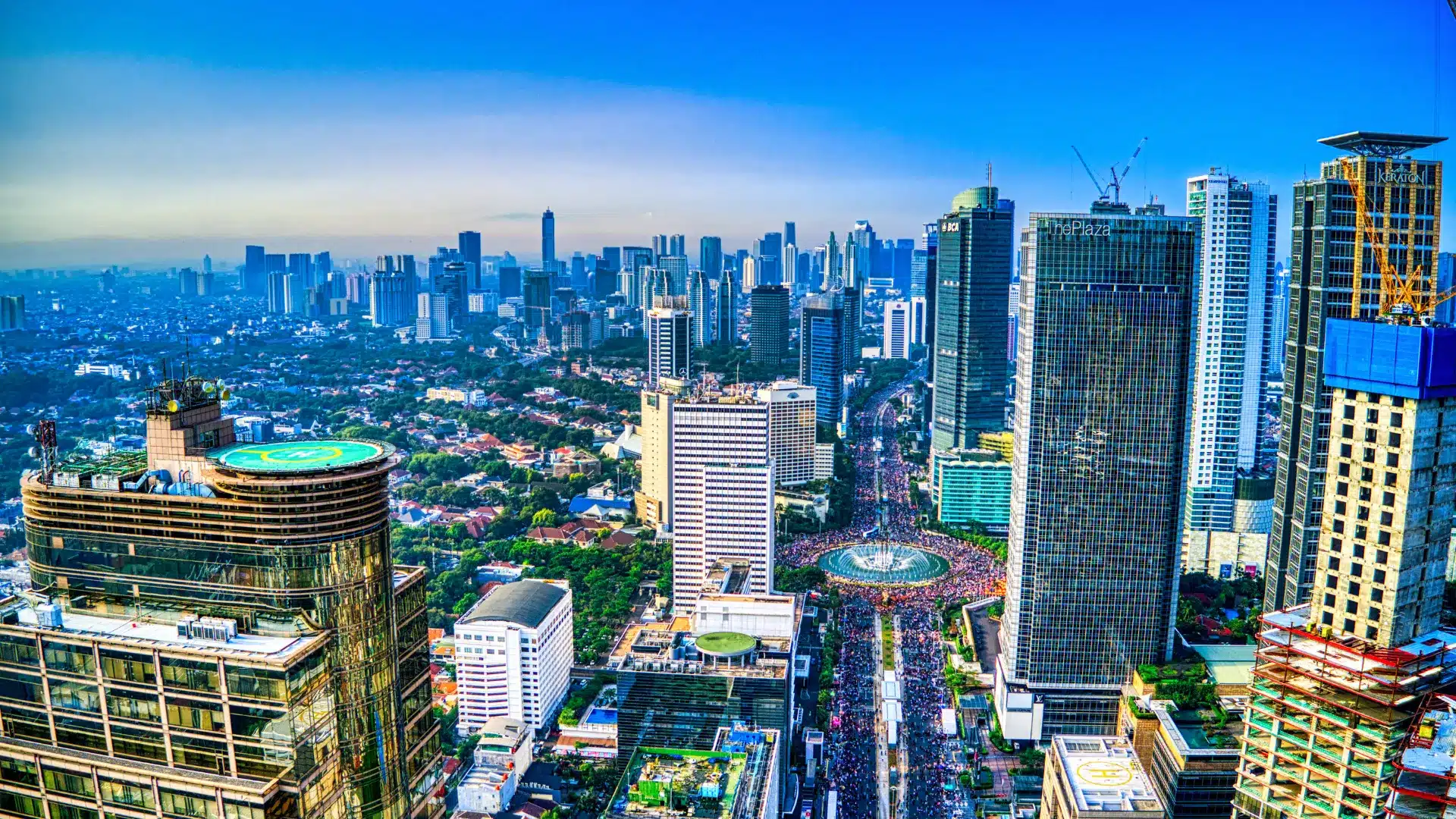
Jakarta — Indonesia’s capital megacity. The colonial Dutch architecture of Kota Tua (Old Batavia), the National Monument (Monas), the harbour and fishing village of Sunda Kelapa, Jakarta’s elevated toll roads and modern commercial district give productions a dense and visually layered urban environment. Film Development Centre permit and Jakarta municipal coordination.
Yogyakarta and Central Java — Borobudur, the ninth-century Buddhist temple complex and UNESCO World Heritage Site, one of the most significant heritage filming locations in Southeast Asia. Prambanan, the ninth-century Hindu temple compound. The kraton (royal palace) of Yogyakarta. Merapi volcano approaches. UNESCO and heritage site authority permissions required for Borobudur and Prambanan in addition to the general permit.
Komodo National Park, East Nusa Tenggara — home to the Komodo dragon, the world’s largest living lizard, and one of the most distinctive wildlife filming environments in Asia. National Park Authority approval required. Boat logistics for island access. Ranger accompaniment mandatory.
Raja Ampat, West Papua — considered the world’s most biodiverse marine environment. Reef, manta ray, whale shark, bird of paradise and extraordinary underwater environments. Remote access requires liveaboard or resort-based logistics. Marine Park Authority permits required.
Tana Toraja, Sulawesi — a highland culture of extraordinary visual distinctiveness, known for elaborate funeral ceremonies, cliff-face burial sites and traditional tongkonan architecture. Local authority and community permissions required. Ceremony filming requires specific cultural protocols.
Kalimantan (Indonesian Borneo) — the orangutan habitats of Tanjung Puting National Park, the longhouse cultures of the Dayak communities, the Mahakam River and the rainforest interior. National Park permits and conservation authority approvals required.
Sumatra — the Gunung Leuser National Park and orangutan sanctuary, Lake Toba (world’s largest volcanic lake), the Minangkabau culture of West Sumatra, the surf environments of the Mentawai Islands. National park permits and conservation authority approvals required.
Papua — the Baliem Valley highland cultures, the Bird of Paradise habitats, the Lorentz National Park (UNESCO World Heritage Site). Foreign nationals require special permits for Papua in addition to standard visa and production documentation.
Lombok and the Gili Islands — beach, reef and coastal filming environments comparable to Bali but with less tourism infrastructure and lower production cost. Film Development Centre permit and local authority coordination.
Drone Filming Requirements
Drone operations in Indonesia are regulated by the Directorate General of Civil Aviation (DGCA). Operators must comply with DGCA regulations and obtain approval before any operation begins.
Key operational rules:
- No flying over crowds or sensitive areas including military facilities
- Daylight flying conditions only
- Maximum altitude 150 metres without a special permit
Required documentation:
- Production company letterhead with operation details
- Drone specifications — make, serial number, value
- Drone operator licence
Issuing authority: Directorate General of Civil Aviation (DGCA).
Processing time: Four to six weeks.
Estimated cost: Approximately USD 1,500.
DGCA drone approval should be initiated in parallel with Film Development Centre accreditation — not after it. Given the four-to-six-week timeline, any production planning aerial work must start the drone application at the same time as the permit application.
Drone importation into Indonesia requires confirmation of airport customs policies before departure. Confirm all importation requirements with Hoodlum before packing drones for travel.
Productions planning drone work above Borobudur, Komodo, national parks, military installations and Papua should confirm specific airspace and location restrictions well before travel.
Equipment Customs Clearance
Indonesia is an ATA Carnet country. Professional filming equipment can be imported under the standard ATA Carnet system.
General process:
- Import requests must specify all filming equipment
- Detailed lists with serial numbers and values are required
Issuing authority: Indonesia Customs Clearance Department.
Processing time: One to two days — one of the fastest clearance timelines in Southeast Asia.
Estimated cost: 0%–150% based on customs value of the equipment. The wide range reflects different equipment categories and temporary versus permanent import classifications. Confirm expected duty rates with Hoodlum before departure.
Every item should be listed with serial numbers and values. The one-to-two-day clearance timeline is contingent on complete and accurate documentation. Incomplete lists extend the process.
Productions arriving through multiple Indonesian airports — Jakarta for some equipment, Bali for others — should ensure documentation reflects the correct arrival location for each item.
Safety and Security for Productions
Indonesia is relatively safe for international film productions. Standard production security precautions are appropriate for most locations. Remote and jungle environments require specific additional planning.
Key safety and security considerations include:
- Include general security personnel and medical support provisions in the production budget
- Hire local security firms for larger productions or those filming in remote areas
- Plan medical access and evacuation for remote island, jungle and highland locations — medical infrastructure varies significantly across the archipelago
- Be aware of natural hazard exposure — Indonesia has more active volcanoes than any other country, plus earthquake and tsunami risk in certain coastal areas
- Follow all national park ranger guidance in conservation areas
- Plan inter-island logistics carefully — boat, ferry and domestic flight schedules and reliability vary significantly
- Protect equipment from high humidity and salt air in coastal and island environments
- Build wet season weather contingency for October to April shoots
- Ensure production insurance covers all Indonesia-specific risks including remote location, evacuation and natural hazard scenarios
Film Incentives and Production Benefits
Indonesia does not currently offer specific film rebates or tax incentives for foreign productions at a national level.
Productions should explore potential partnerships and local funding opportunities through regional film commissions or local government initiatives, which vary by province and city. The primary financial advantage of Indonesia as a production destination is cost-competitive local crew, equipment rental, accommodation and logistics across most of the archipelago.
Confirm current incentive landscape with Hoodlum before building any financial support into the budget.
How the Main Approvals Fit Together
E-visa, Film Development Centre accreditation and film permit, DGCA drone approval, ATA Carnet customs clearance, national park and heritage site permissions, and inter-island access logistics are all separate processes.
A complete production plan connects:
- E-visa for all crew — five working days, initiated first
- Film Development Centre accreditation — six to eight weeks, the binding timeline
- Film Development Centre film permit — four to six weeks, running simultaneously
- DGCA drone approval — four to six weeks, initiated in parallel
- National park, heritage site and conservation area permissions for specific locations
- Papua special permits for foreign nationals where applicable
- ATA Carnet customs clearance — one to two days, initiated after accreditation confirms
- Inter-island flight, ferry and boat logistics planning as a distinct layer
- Safety and medical planning for remote locations
Hoodlum manages all of these as one coordinated workflow.
When Indonesia Is the Right Choice
Indonesia is the right choice when a production needs tropical wildlife, ancient heritage, volcanic landscapes, world-class marine environments, diverse island cultures and a cost-competitive production base across an archipelago geography that offers more visual variety than any other single country in Southeast Asia.
It is especially suitable for:
- Wildlife and nature documentary — komodo dragon, orangutan, bird of paradise, marine biodiversity
- Heritage and cultural documentary — Borobudur, Prambanan, Tana Toraja
- Marine and underwater productions
- Travel and adventure programming
- Feature film and television drama with Southeast Asian settings
- Volcanic and geological documentary
- Conservation and environmental storytelling
- Commercial campaigns needing tropical diversity
- Reality and competition formats
It may be less suitable for productions requiring very rapid permit turnaround, single-authority approval systems, or complete crew and equipment deployment without significant inter-island logistics planning.
Common Mistakes to Avoid
Avoid:
- Starting Film Development Centre accreditation with less than eight weeks before the first filming day
- Treating the general film permit as covering national parks, heritage sites and conservation areas — each requires additional separate approval
- Leaving DGCA drone applications until after accreditation is confirmed — both take four to six weeks and must run in parallel
- Treating Indonesia as a single climate zone — plan seasonal timing for each island individually
- Arriving without confirmed inter-island flight, ferry and boat logistics
- Preparing incomplete equipment lists for customs clearance
- Filming in Papua without confirming special foreign national permit requirements
- Ignoring natural hazard risk — volcanoes, earthquakes, tsunami zones
- Working without a local fixer who knows the specific permit routes and logistics of the islands being filmed
- Assuming one Indonesia production base covers logistics across the full archipelago
How Hoodlum Supports Local Production
Support may include:
- Local fixer coordination across Jakarta, Java, Sulawesi, Kalimantan, Sumatra, East Nusa Tenggara, West Papua and all regional islands
- E-visa invitation letters and documentation support
- Film Development Centre accreditation and permit coordination
- Borobudur, Prambanan and UNESCO heritage site access
- Komodo National Park authority coordination
- Raja Ampat Marine Park access and liveaboard logistics
- Tana Toraja cultural access and ceremony protocol guidance
- Orangutan sanctuary and national park permits in Kalimantan and Sumatra
- Papua special permit coordination
- Location research and RECCE across all Indonesian islands
- DGCA drone permit coordination
- ATA Carnet customs clearance preparation
- Inter-island flight, ferry and boat logistics
- Local crew and talent sourcing
- Equipment rental coordination
- Accommodation sourcing across all islands
- Safety and medical planning for remote locations
- Natural hazard awareness and contingency planning
- On-the-ground production management
FAQ Section
Do international film crews need a visa to film in Indonesia? Most nationalities require an e-visa. Processing takes approximately five working days. Cost: around USD 50. A local entity invitation letter is required — Hoodlum provides this. Work authorisation for paid professional filming should be confirmed separately from standard tourist entry for each crew member’s nationality.
How long should productions allow for film permits and accreditation? Film Development Centre accreditation takes six to eight weeks — the binding timeline. The film permit takes four to six weeks. Both should run in parallel from the point of engagement. DGCA drone approval also takes four to six weeks and should run simultaneously. Allow a minimum of ten weeks from first engagement to first filming day.
Can productions film at Borobudur and Prambanan? Yes, but both UNESCO World Heritage temple complexes require specific heritage authority permissions in addition to the general Film Development Centre permit. These are separate approval streams. Initiate heritage site permissions alongside the main permit application.
Can productions use drones in Indonesia? Yes. DGCA approval is required — four to six weeks processing. Cost: approximately USD 1,500. Operations must stay below 150 metres, avoid crowds and sensitive areas, and be conducted in daylight only. Drone applications must run in parallel with Film Development Centre accreditation. Confirm importation requirements with Hoodlum before travel.
Is Indonesia a Carnet country? Yes — Indonesia is an ATA Carnet country. Customs clearance takes one to two days — among the fastest in Southeast Asia. Cost: 0%–150% based on customs value. Complete equipment lists with serial numbers are required. Confirm expected duty ranges with Hoodlum.
Can productions film in Papua? Yes, but foreign nationals require special permits for Papua in addition to standard visa and production documentation. Papua’s remote logistics — highland terrain, rainforest, limited domestic connections — require significant advance planning. Contact Hoodlum for Papua-specific guidance.
Does Indonesia offer a film rebate? Indonesia does not currently offer a national film rebate or tax incentive for foreign productions. The financial advantage is primarily cost-competitive local crew, equipment and logistics. Explore regional film commission opportunities with Hoodlum for specific location-based support.
Authority Links
- Indonesian Ministry of Tourism and Creative Economy — Film Development Centre
- Directorate General of Civil Aviation Indonesia — DGCA
- Indonesia e-Visa Portal
- Borobudur Authority
- Komodo National Park
- Hoodlum Film Fixers — Contact
Everything You Need to Know About Filming in Indonesia
Filming in Indonesia requires understanding one fundamental fact before pre-production begins: the Film Development Centre accreditation process takes six to eight weeks, and it is the binding constraint on everything else.
The film permit runs simultaneously and takes four to six weeks. The DGCA drone approval takes four to six weeks. National park, heritage site and conservation authority permissions each run as independent parallel processes. Every one of these must be initiated from the moment Hoodlum is engaged — not sequentially, one after another.
Productions that plan around this parallel process reality, with a minimum of ten weeks from first engagement to first filming day, will find Indonesia one of the most rewarding and visually extraordinary filming destinations in the world. Productions that start late will find the accreditation timeline the constraint that compresses everything else.
This section consolidates the practical information for international productions planning an Indonesia shoot.
The Indonesia film permit — Film Development Centre accreditation and approval
The Film Development Centre under the Ministry of Tourism and Creative Economy manages both the crew accreditation and the film permit for international productions in Indonesia. Accreditation takes six to eight weeks. The film permit takes four to six weeks. Both should be submitted simultaneously.
Required documentation covers application letter, production company profile, synopsis, flight details, crew biodata, passport copies and equipment import list. The film permit additionally requires a signed statement letter, key crew resumes, shooting schedule, location details, scenario and a re-exporting statement for all equipment.
The general film permit covers general filming activity in Indonesia. It does not automatically cover filming in national parks, UNESCO World Heritage sites, marine parks, protected conservation areas or Papua. Each of these requires a separate and parallel approval from the relevant managing authority. Productions should identify their complete location list at the outset and initiate all location-specific approvals simultaneously with the Film Development Centre application.
Filming visa Indonesia — the invitation letter requirement
The filming visa Indonesia process is managed through Indonesia’s e-visa system. Most nationalities can apply online. Processing takes approximately five working days at a cost of around USD 50.
A letter of invitation from a local Indonesian entity is a required component of the application. Hoodlum provides this letter as part of the standard pre-production package. Without the local entity invitation, the application process cannot proceed in the standard way.
Work authorisation for paid professional filming should be confirmed separately from standard tourist or visitor entry for each crew member’s nationality. Mixed-nationality productions should confirm requirements individually for each crew member.
Jakarta filming locations — the capital’s megacity range
Jakarta filming locations give productions access to Indonesia’s most complex and layered urban environment.
The colonial Dutch architecture of Kota Tua (Old Batavia) in North Jakarta — the warehouses, offices and public squares of the seventeenth-century Dutch East India Company settlement — offers a period heritage environment unlike any other in Southeast Asia. The National Monument (Monas) and the wide boulevards of Central Jakarta. The fishing harbour and traditional wooden phinisi boats of Sunda Kelapa. The modern commercial towers and elevated highways of the SCBD financial district. The chaos and energy of the traditional markets and street food corridors.
Jakarta state-level and municipal authority coordination applies for public location filming alongside the Film Development Centre permit. Traffic management and crowd logistics are significant considerations for most public shooting environments in the city.
Yogyakarta filming location — Borobudur and Prambanan
The Yogyakarta filming location gives productions access to two of the most significant Buddhist and Hindu monument complexes in the world.
Borobudur — the ninth-century Buddhist mandala temple — is the largest Buddhist monument on earth and a UNESCO World Heritage Site. Its stone reliefs, 504 Buddha statues and 72 stupas set against the forested volcanic landscape of Central Java make it one of the most cinematic heritage environments in Asia. Filming requires specific heritage authority permission from Borobudur Park Authority in addition to the Film Development Centre permit.
Prambanan — the ninth-century Hindu temple compound — is one of Southeast Asia’s most architecturally striking heritage sites, with towering spired towers dedicated to Brahma, Vishnu and Shiva. UNESCO World Heritage designated. Heritage authority permission required separately.
The city of Yogyakarta itself — the kraton (royal palace), Malioboro shopping street, the batik workshops, the active cultural arts scene — gives productions a living Javanese cultural environment of exceptional richness.
Komodo filming location and the Flores island chain
The Komodo filming location in East Nusa Tenggara is one of the most distinctive wildlife filming environments in Asia — the only place on earth where komodo dragons live in the wild.
Komodo National Park encompasses three main islands — Komodo, Rinca and Padar — plus surrounding marine environments of extraordinary biodiversity. Productions filming komodo dragons, manta rays, the pink beach environments and the volcanic island landscapes require National Park Authority approval and mandatory ranger accompaniment throughout filming within the park.
The Flores island chain beyond Komodo offers the volcanic crater lakes of Kelimutu, the traditional villages of Ngada, the surfing environments of Lakey Peak and the fishing village character of Labuan Bajo as a production base. Flores-based productions require inter-island flight or boat logistics from Bali or Lombok as the entry point.
Raja Ampat filming location — the world’s most biodiverse marine environment
Raja Ampat in West Papua is widely considered the world’s most biodiverse marine environment. The archipelago of over 1,500 small islands, with its reef systems, manta ray cleaning stations, whale shark aggregations and bird of paradise habitats, represents the apex of marine and nature production environments in Indonesia.
Marine Park Authority permits are required for all professional filming within the protected marine area. Access is by liveaboard from Sorong or from resort accommodation on the main islands. There is no day-trip infrastructure for professional productions — logistics must be planned around multi-day vessel or resort-based operations.
Raja Ampat’s remoteness — flights from Jakarta to Sorong followed by boat — means inter-island logistics are a significant production planning layer. Weather window planning for crossing conditions is essential.
DGCA drone permit Indonesia — running in parallel from day one
The DGCA drone permit Indonesia takes four to six weeks. This timeline runs in parallel with the Film Development Centre accreditation — not after it. Productions that initiate drone applications after accreditation is confirmed will find the drone approval the constraint that delays aerial shooting days.
DGCA approval covers general drone operations in Indonesia. Operations above national parks, heritage sites, Borobudur, Komodo, Raja Ampat, military installations and Papua require additional location-specific confirmation from the relevant authority. The 150-metre altitude limit applies unless a special higher-altitude permit is obtained.
Drone importation requirements and airport customs policies should be confirmed with Hoodlum before departure. Cost: approximately USD 1,500.
Indonesia customs clearance ATA Carnet — one of the fastest in Southeast Asia
Indonesia customs clearance for filming equipment is supported by Indonesia’s ATA Carnet membership. Processing takes one to two days — one of the fastest clearance timelines in Southeast Asia when documentation is complete.
The wide cost range — 0% to 150% based on customs value — reflects different equipment categories and import classifications. Confirm the expected duty range for the specific equipment list with Hoodlum before departure to avoid budget surprises on arrival.
Complete equipment lists with serial numbers and values are required. Productions bringing equipment through multiple Indonesian airports should ensure documentation reflects the correct arrival location for each item.
Indonesia location scouting — planning across an archipelago of 16,000 islands
Indonesia location scouting at archipelago scale requires a fixer team with genuine regional knowledge across multiple islands, climate zones and administrative systems.
Jakarta’s urban permit routes, Yogyakarta’s Borobudur heritage authority relationships, Komodo’s National Park Authority process, Raja Ampat’s Marine Park coordination, Kalimantan’s conservation authority contacts, Sumatra’s national park permit processes, Sulawesi’s Tana Toraja community protocols and Papua’s special permit requirements are each distinct bodies of local knowledge.
Productions working across multiple Indonesian islands need a fixer who knows the specific permit routes, authority relationships, inter-island logistics and seasonal conditions of each location — not a single-island expert stretched across unfamiliar territory.
Hoodlum’s Indonesia fixer network covers the full archipelago, ensuring location scouting reflects actual access conditions, real permit timelines and honest logistics realities for every Indonesian island and environment on the shot list.
What an Indonesia film fixer actually does
An Indonesia film fixer initiates Film Development Centre accreditation and the film permit simultaneously, runs DGCA drone approval in parallel from day one, manages Borobudur and Prambanan heritage authority permissions as separate streams, coordinates Komodo National Park Authority access and ranger logistics, manages Raja Ampat Marine Park permits and liveaboard logistics, prepares Papua special permits for foreign nationals, coordinates Tana Toraja cultural access protocols, prepares ATA Carnet documentation, manages inter-island flight, ferry and boat scheduling, sources local crew across the relevant production cities, and plans location logistics around the significant regional climate and seasonal variation across the archipelago.
Film production Indonesia works most efficiently when Hoodlum is engaged at least ten weeks before the first filming day — giving accreditation its full six-to-eight-week window while running all other approval streams simultaneously from the same starting point.
Hoodlum provides full production support for international crews across all Indonesia filming locations — from early research and Indonesia location scouting through Film Development Centre coordination, heritage and national park access, drone planning, customs clearance and on-the-ground production management across Jakarta, Java, Sulawesi, Kalimantan, Sumatra, East Nusa Tenggara, West Papua and all regional islands. For enquiries, visit hoodlum.tv/contact-us.
Indonesia in a Southeast Asia film production guide context
For productions building a Southeast Asia film production guide — comparing Indonesia with Thailand, Vietnam, Malaysia, Cambodia and the Philippines — Indonesia occupies a position of unmatched geographic scale and ecological diversity.
It is the only Southeast Asian country that contains Borobudur, komodo dragons, Raja Ampat, orangutan habitats, bird of paradise, the volcanic landscapes of Java and Sumatra, the highland cultures of Papua and Sulawesi, and over 16,000 islands — all within a single production permit framework.
Bali has its own dedicated Hoodlum guide given its specific production requirements. Indonesia beyond Bali gives productions access to environments that no other Southeast Asian destination can offer — and a logistics challenge that requires genuine archipelago expertise rather than a single-city production approach.
The practical groundwork is always the same: engage Hoodlum at least ten weeks before the first filming day, initiate Film Development Centre accreditation and all parallel approval streams simultaneously, run drone applications from day one, confirm Papua special permit requirements early, plan inter-island logistics as a core production layer, prepare complete ATA Carnet documentation before departure, build wet season contingency for the relevant islands, and have a local fixer team with genuine regional knowledge across every island on the shot list.