- Hire experienced local guides and mountain experts
- Conduct advance recce for terrain and altitude risks
- Use safety officers for remote locations
- Prepare for weather changes
- Maintain communication plans in isolated regions
Thimphu
Paro, Punakha, Phuentsholing
Dzongkha
Ngultrum (BTN)
Tropical Climate
Visa Application Link
For more details and to apply, visit:
https://immi.gov.bt/tourist/apply/
Film crew members require accreditation from the Royal Government of Bhutan's Ministry of Information and Communications. This involves registering with the Ministry and obtaining an accreditation permit or ID card for each crew member.
Note: Filming at sacred sites — Tiger's Nest, Punakha Dzong, Trongsa Dzong, Rinpung Dzong and other active religious sites — requires specific additional permission from the religious authority or dzong administration beyond the Ministry permit. National park and conservation area filming requires additional conservation authority approval.
Ministry of Information and Communications — Department of Information and Media, Royal Government of Bhutan.
A local Bhutanese fixer/tour operator handles:
Private location costs vary and cannot be quoted without:
Drone use in Bhutan is strictly controlled.
All drone filming requires prior approval from:
Rules include:
Regulated by:
Importation requires:
Bhutan Civil Aviation Authority (BCAA)
7–10 working days
Nu 5,000–10,000 (USD ~65–130)
Bhutan is NOT a Carnet country.
Department of Revenue and Customs
Bhutan offers stunning Himalayan scenery, pristine nature, and culturally rich environments.
However, productions must plan for:
Bhutan offers up to 25% rebate on eligible local production expenses, subject to:
Bhutan
Fill in our client brief and we’ll get back to you with everything you need to start filming in this region.

















Bhutan is one of the most visually distinctive and tightly regulated filming destinations…
Hoodlum offers expert film fixer services in Bhutan, supporting international productions across one of the most distinctive and tightly managed filming destinations in Asia.
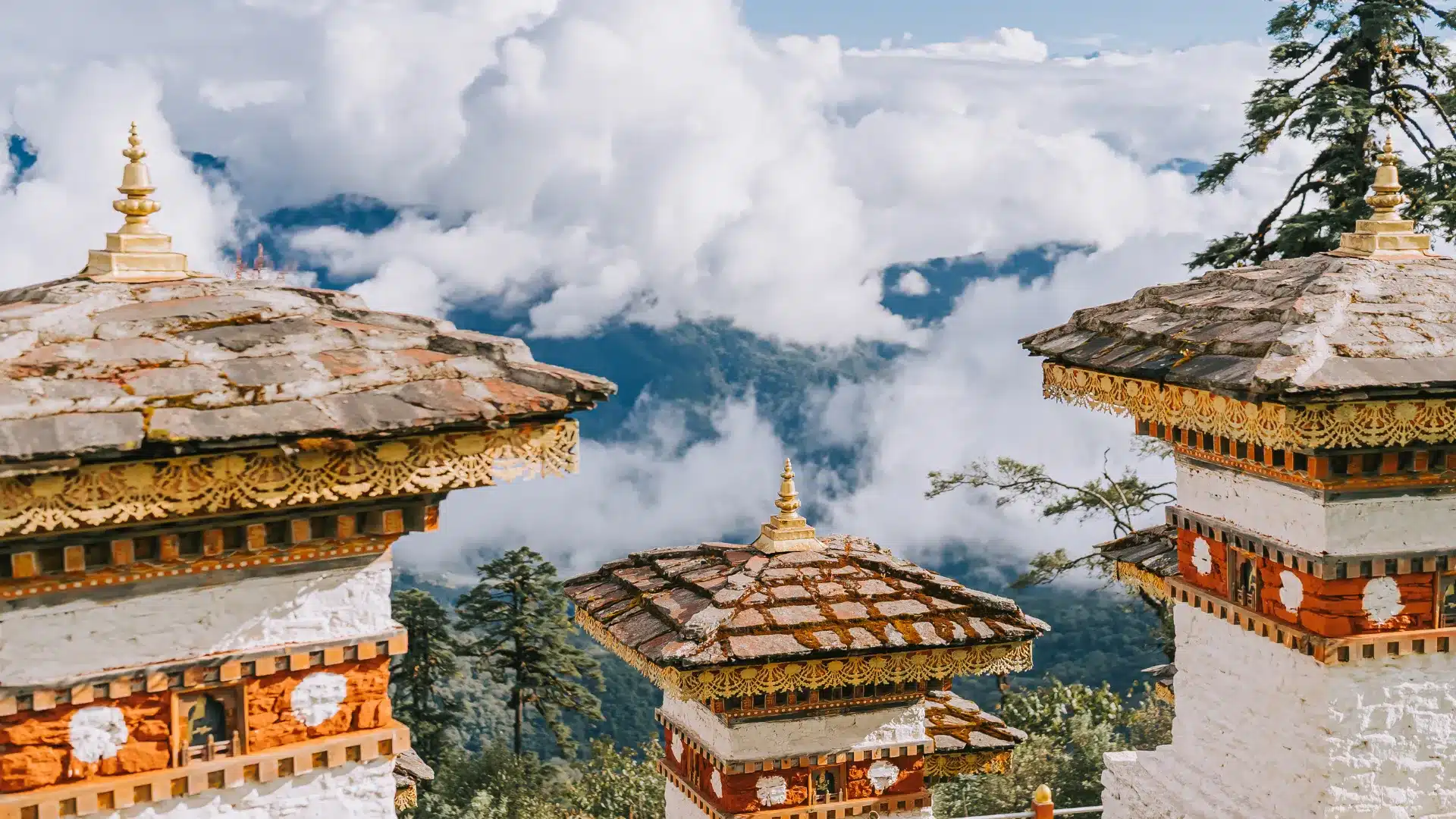
Bhutan is a landlocked kingdom in the Eastern Himalayas — a country of snow-capped peaks, deep river valleys, ancient monastery fortresses, and a cultural fabric of Tantric Buddhist tradition that has no equivalent anywhere else in the world. The Tiger’s Nest Monastery clinging to a 3,000-metre cliff face above Paro valley, the white-washed river fortress of Punakha Dzong at the confluence of two rivers, the highland crane sanctuary of Phobjikha, the spiritual heart of Bumthang valley — these are not interchangeable with any other filming environment on earth.
Bhutan is also one of the most deliberately controlled filming destinations in the world. Entry requires a licensed Bhutanese tour operator. A film permit from the Ministry of Information and Communications takes four to six weeks. The daily tariff of USD 250 per person applies throughout the stay. Drone operations require Bhutan Civil Aviation Authority approval. And every aspect of production — from location access to crew movement — operates within a framework that Bhutan has designed specifically to protect its cultural and environmental integrity.
The result is a filming environment of extraordinary authenticity and visual quality, available to productions that plan properly and engage the right local expertise from the start.
Bhutan is a South Asian filming destination that serves a specific and serious production brief — documentary and factual work on Himalayan culture, Buddhism and ecology, feature films and commercial campaigns requiring an authentic and unmodified Himalayan aesthetic, nature and wildlife productions, and projects that specifically need the visual character of a country where traditional architecture, Buddhist ceremony and mountain landscape exist together without commercial dilution.
The country is served by Paro International Airport — Bhutan’s only international airport — with connections to a small number of regional hubs including Delhi, Kathmandu, Mumbai, Bangkok and Singapore. All international productions must work through a licensed Bhutanese tour operator. There is no self-directed production pathway.
The main production environments include Paro valley and the Tiger’s Nest Monastery, Punakha valley and Punakha Dzong, Thimphu and its traditional urban architecture, Trongsa and its historic dzong, Bumthang’s valley monastery landscape, and the high-altitude environments of the Himalayan interior accessible from multiple valleys.
A successful Bhutan production is built entirely on the quality of the local fixer and tour operator relationship. Every approval — visa, film permit, drone, customs, location — flows through that relationship.
Bhutan works for productions that need a visual environment of complete cultural and ecological authenticity — a Himalayan kingdom that has never been opened to mass tourism, where traditional architecture, religious ceremony and mountain landscape have been preserved with a deliberateness found nowhere else in Asia.
Strong production use cases include:
The 25% film rebate on qualifying in-country production costs makes Bhutan financially competitive for qualifying productions, partially offsetting the USD 250 daily tariff that applies to all visitors.
The English language is widely used in government, tourism and professional contexts, which simplifies communication with permit authorities, location managers and tour operator contacts.
Spring (March to May) and autumn (September to November) are the optimal filming windows. Both offer mild temperatures, clear skies and the best visibility of the Himalayan peaks.
Spring brings blooming rhododendron forests across the mid-altitude zones and is the season for several major religious festivals, including Paro Tsechu — one of the most visually extraordinary Buddhist festivals in the Himalayas and one of the most requested filming events in the country.
Autumn brings clear post-monsoon air, excellent mountain visibility and some of the most vivid light of the year across the valley landscapes.
Avoid or plan carefully for:
All international visitors to Bhutan, including film crews, must obtain a visa arranged through a licensed Bhutanese tour operator. There is no independent visa pathway. The visa and film permit processes are managed together through the tour operator.
The daily tariff of USD 250 per person applies throughout the production stay. This covers accommodation, food, a licensed guide and other in-country services. It is not a production cost that can be waived or reduced.
Required documentation:
Processing time: Two to four weeks for visa and film permit combined.
Visa cost: USD 40–50 non-refundable processing fee per person, plus the USD 250 daily tariff.
Visa application: https://immi.gov.bt/tourist/apply/
All visa and permit applications must be submitted through a licensed Bhutanese tour operator — direct applications are not accepted. Hoodlum’s in-country partners manage the full application process.i
Film crew members require accreditation from the Royal Government of Bhutan’s Ministry of Information and Communications. This involves registering with the Ministry and obtaining a permit or accreditation ID for each crew member.
Required documentation:
Processing time: Three to five working days.
Accreditation should run in parallel with the film permit process — not sequentially after it. Hoodlum’s in-country team coordinates both simultaneously to avoid extending the pre-production timeline.
Film permits in Bhutan are issued by the Ministry of Information and Communications, specifically the Department of Information and Media. This is the central production approval authority for all international films, documentaries, commercials and television productions.
Required documentation:
Processing time: Four to six weeks. This is one of the longer film permit timelines in Asia and must be fully factored into the pre-production calendar.
Estimated cost: USD 1,000–3,000 depending on production type, locations and duration. Non-refundable.
Filming at specific sacred sites — Tiger’s Nest Monastery (Paro Taktsang), Punakha Dzong, Trongsa Dzong, Rinpung Dzong and other active religious sites — requires specific permissions from the religious authority or dzong administration in addition to the Ministry permit.
Filming within national parks and wildlife reserves requires additional conservation authority approval. Bhutan’s national parks cover approximately 51% of the country’s land area and are connected by biological corridors — most dramatic landscape environments will involve park or conservation area considerations.
Tiger’s Nest Monastery (Paro Taktsang) — the most iconic filming location in Bhutan. A sacred Buddhist monastery built into a cliff face at 3,120 metres above sea level, approximately 900 metres above Paro valley. Access requires the Ministry film permit, specific religious authority permission, and the physical ability to hike the two-to-three-hour ascent. No vehicles. Limited equipment. Hoodlum helps productions plan the technical approach for this location well in advance.
Punakha Dzong — the former capital’s fortress monastery at the confluence of the Pho Chhu and Mo Chhu rivers. One of the most photographed structures in Bhutan. Requires Ministry permit and dzong administration approval. Seasonal flooding affects river access during monsoon.
Paro Valley — the most accessible major valley for international productions, containing the international airport, Rinpung Dzong, rice field landscapes and traditional village environments. The main logistics base for most Bhutan productions.
Bumthang Valley — considered the spiritual heart of Bhutan, with a high concentration of ancient monasteries and a more remote, quieter atmosphere than the Paro-Punakha corridor. Requires road travel from Paro or Thimphu — approximately six to eight hours depending on road conditions.
Phobjikha Valley — a glacial valley and wetland conservation area, winter habitat of the endangered black-necked crane. National park area. Requires conservation authority approval for filming. Extraordinary for wildlife and nature documentary work.
Himalayan High-Altitude Environments — accessible via multiple valleys for expeditions, trekking and mountain documentary work. Requires trekking permits, national park permits and detailed logistics planning. Altitude above 4,000 metres requires acclimatisation planning and medical preparedness.
Drone operations in Bhutan are regulated by the Bhutan Civil Aviation Authority (BCAA) and require prior approval from the BCAA before any operation begins.
This is separate from the Ministry film permit. One does not cover the other.
Required documentation (local drone permit):
Required documentation (drone importation):
Issuing authority: Bhutan Civil Aviation Authority (BCAA).
Processing time: Seven to ten working days.
Bhutan has significant airspace restrictions given its proximity to Chinese and Indian military boundaries, its numerous sacred sites and its national park coverage. Drone operations near Tiger’s Nest, dzongs, national parks, military installations and border areas require specific confirmation of approval before those sequences are scheduled.
Production teams should never assume drone approval for any Bhutan location without explicit BCAA confirmation. Hoodlum integrates drone planning into the permit application from the outset.
Bhutan is an ATA Carnet country. Professional filming equipment can be imported under the standard ATA Carnet system, which is the most straightforward importation route.
Required documentation:
Issuing authority: Department of Revenue and Customs, Ministry of Finance.
Processing time: Two to three working days with complete documentation.
Estimated cost: Nu 5,000–20,000 (approximately USD 65–260) depending on equipment type and value.
The Ministry of Information and Communications permit is a required document for customs clearance. This means customs clearance cannot be completed until the film permit is confirmed. Productions should plan the sequence accordingly — film permit first, then customs preparation.
All items should be listed with serial numbers and values. Carnet documentation must match exactly what arrives at Paro airport.
Bhutan is one of the safest countries in Asia for international productions. Crime rates are extremely low, the political environment is stable, and the Bhutanese government and tour operator framework provides a structured support network throughout the production.
The primary production risks are environmental and logistical rather than security-related.
Key safety and risk considerations include:
Bhutan offers a film rebate of up to 25% of total qualifying production costs incurred in the country, subject to specific conditions and approval from the Royal Government of Bhutan.
This is a meaningful incentive for qualifying productions given the cost structure of filming in Bhutan — the daily tariff, local guides, accommodation, transport and local services all represent significant in-country spend that can qualify for the rebate.
Before budgeting the rebate, confirm:
Hoodlum helps productions structure local spend to maximise rebate eligibility and ensures documentation is built into the production process from day one.
Visa and film permit (both through the licensed tour operator), Ministry accreditation for crew, BCAA drone approval, customs clearance and sacred site permissions are all separate processes. None covers the others.
The film permit is the binding timeline — four to six weeks — and the customs clearance requires the permit as a supporting document. Everything else should run in parallel with the permit process.
A complete production plan connects:
Hoodlum’s in-country team manages all of these as one integrated workflow.
Bhutan is the right choice when a production needs a Himalayan filming environment of complete authenticity — Buddhist monasteries, dzong architecture, mountain landscape and traditional culture that is genuinely unaffected by commercial tourism development.
It is especially suitable for:
It is less suitable for productions that need rapid permit turnaround, unrestricted location access, large crew logistics, heavy equipment freight or a destination without a mandatory daily tariff structure.
Avoid:
Support may include:
Do international film crews need a visa to film in Bhutan? Yes. All international crews require a visa arranged through a licensed Bhutanese tour operator. There is no independent visa pathway. A film permit from the Ministry of Information and Communications is also required separately. Both are processed through the tour operator. Apply at https://immi.gov.bt/tourist/apply/.
How long should productions allow for the film permit? Four to six weeks from submission of a complete application. This is the binding timeline in the Bhutan pre-production calendar. Visa, crew accreditation, drone approvals and customs preparation should all run in parallel. Allow a minimum of eight weeks from first engagement to first filming day.
What is the daily tariff and does it apply to film crews? Yes. The USD 250 daily tariff applies to all international visitors including film crews. It covers accommodation, food, a licensed guide and other in-country services. It is not a production cost that can be waived. It applies for the full duration of the stay and should be budgeted accurately across all crew days.
Can productions film at Tiger’s Nest Monastery? Yes, but filming at Paro Taktsang requires the Ministry film permit and specific religious authority permission. The location is a two-to-three-hour hike at high altitude. No vehicles and limited equipment can access the site. Productions should discuss technical requirements with Hoodlum before scheduling this location.
Can productions use drones in Bhutan? Yes, but drone operations require separate approval from the Bhutan Civil Aviation Authority (BCAA), independent of the Ministry film permit. Drone importation also requires separate customs clearance. Allow seven to ten working days. Significant restrictions apply near sacred sites, national parks and border areas.
Is Bhutan a Carnet country? Yes — Bhutan is an ATA Carnet country. Processing takes two to three working days. Cost: approximately USD 65–260. The Ministry of Information and Communications film permit is required as a supporting document for customs clearance — customs cannot be completed until the permit is confirmed.
Does Bhutan offer a film rebate? Yes — up to 25% of qualifying in-country production costs, subject to Royal Government approval. Confirm current eligibility criteria, qualifying expenditure categories and payment timelines with Hoodlum before budgeting the rebate.
What is the best time to film in Bhutan? Spring (March to May) and autumn (September to November). Spring offers rhododendron bloom, festival access including Paro Tsechu, and excellent mountain visibility. Autumn offers clear post-monsoon air and exceptional light. Avoid the summer monsoon (June to August) and harsh winter months (December to February).
Filming in Bhutan is unlike any other production experience in Asia.
The country has deliberately limited international access to protect its cultural and environmental integrity. The daily tariff, the licensed tour operator requirement, the four-to-six-week Ministry permit and the specific permissions required for sacred sites are not administrative obstacles. They are the framework within which Bhutan allows its monasteries, dzongs and landscapes to be filmed without the damage that uncontrolled production access would cause.
Productions that understand and plan within that framework will find Bhutan delivers a visual authenticity that is simply unavailable anywhere else.
This section consolidates the practical information for international productions planning a Bhutan shoot.
The Bhutan film permit is issued by the Ministry of Information and Communications through the Department of Information and Media. It is the central production approval for all international film, documentary, commercial and television work in Bhutan.
Processing takes four to six weeks from submission of a complete application. The documentation package — completed application form, script, storyboard, filming itinerary, equipment list, crew list and letter of intent — must be submitted through a licensed Bhutanese tour operator. Direct applications are not accepted.
The Ministry permit covers general filming activity in Bhutan. It does not automatically cover filming at specific sacred sites, dzongs and monasteries, which require separate permissions from the relevant religious authority or dzong administration. It does not cover drone operations, which require separate BCAA approval. And it is a required supporting document for ATA Carnet customs clearance — meaning customs cannot be completed until the permit is in hand.
Plan the permit process first. Everything else flows from it.
The filming visa Bhutan process is unique among international filming destinations in one important respect: all visas must be arranged through a licensed Bhutanese tour operator. There is no independent or self-directed pathway.
The USD 250 daily tariff applies to every international visitor in Bhutan, including every crew member, for every day of the stay. It is not a production-specific fee. It is Bhutan’s Sustainable Development Fee, designed to limit visitor volume and fund environmental and cultural conservation. It covers accommodation, food, a licensed guide and other in-country services.
For a production budgeting a ten-day shoot with a crew of fifteen, the daily tariff alone represents USD 37,500 before any other production cost is accounted for. This should be calculated precisely and early — not estimated — and should feed directly into the decision about crew size and stay duration.
Visa processing takes two to four weeks and runs in parallel with the film permit application. Both are submitted through the tour operator at the same time.
The Tiger’s Nest filming location — Paro Taktsang — is the most requested and most visually iconic filming environment in Bhutan.
The monastery clings to a granite cliff face at 3,120 metres above sea level, approximately 900 metres above the Paro valley floor. It is one of the most sacred Buddhist sites in the Himalayan world and has been a place of religious pilgrimage and retreat for over a millennium.
Filming at Tiger’s Nest requires the Ministry film permit and specific permission from the religious authority managing the monastery — separate processes. No vehicles reach the site. The access trail takes two to three hours each way at high altitude. Equipment must be carried by hand or by horse to the lower levels.
Productions should discuss the Tiger’s Nest filming location technical approach with Hoodlum before scheduling the location. Camera systems, lighting, sound and any specialist equipment need to be assessed against the physical access reality and the religious site protocols that apply throughout.
Punakha Dzong filming is among the most visually rewarding production work available in Bhutan.
The fortress monastery sits at the confluence of the Pho Chhu and Mo Chhu rivers, its white walls and golden roof visible from the valley approaches in a setting that combines religious architecture, river landscape and mountain backdrop in a single frame. It served as Bhutan’s capital and the seat of government until 1955 and remains an active monastic centre.
Filming at Punakha Dzong requires Ministry permit approval and dzong administration permission. Seasonal flooding of the Punakha valley floor during monsoon season affects river access and some angles. The spring season — when the jacaranda trees within the dzong courtyard are in bloom — is the most visually extraordinary window for Punakha filming.
Trongsa Dzong, Rinpung Dzong in Paro and the dzong complexes of Wangdue Phodrang and Bumthang each offer comparable architectural and historical significance with their own access requirements and visual characters.
The drone permit Bhutan process requires approval from the Bhutan Civil Aviation Authority (BCAA) before any drone operation begins. This is entirely separate from the Ministry of Information and Communications film permit.
Processing takes seven to ten working days. Required documentation includes drone specifications and serial number, flight plan, pilot’s licence and credentials, insurance and BCAA certificate of registration. Drone importation requires separate customs authority clearance with commercial invoice, bill of lading, packing list and certificate of origin.
Bhutan has specific airspace sensitivities that make drone approval more complex than in many other filming destinations. The proximity of the northern border with China’s Tibet Autonomous Region creates military airspace restrictions across the northern valleys. The active religious status of Tiger’s Nest, the dzong complexes and most monastery sites means that drone operations above or adjacent to these locations require specific BCAA confirmation — not just general permit coverage.
Productions should include all proposed drone locations in the BCAA application with specific coordinates and altitudes, and should not commit drone sequences to the schedule without explicit BCAA approval for each location.
Bhutan customs clearance for filming equipment operates through the ATA Carnet system. Bhutan is a Carnet country. Standard clearance with complete documentation takes two to three working days at an estimated cost of USD 65–260 depending on equipment volume and value.
The critical planning point for Bhutan customs clearance is the permit dependency. The Ministry of Information and Communications film permit is a required supporting document for customs clearance at Paro airport. Productions cannot complete customs clearance without the permit in hand.
This creates a clear sequencing requirement — film permit confirmed first, then Carnet preparation and customs clearance. Productions that attempt to arrive before permit confirmation will face clearance delays regardless of how well their Carnet documentation is prepared.
Carnet documentation must match exactly what arrives. All items — cameras, lenses, drones, batteries, lighting, grip, sound equipment, monitors and specialist gear — should be listed with serial numbers and values before departure.
The Bhutan film rebate of up to 25% of qualifying in-country production costs is one of the more significant incentive structures available in South Asia, particularly given the mandatory nature of many in-country costs — the daily tariff, licensed guides, approved accommodation and local transport all represent spend that can qualify for the rebate.
Register for the rebate before qualifying production spend begins. Confirm current eligibility criteria, qualifying expenditure categories, minimum spend thresholds and payment timelines with Hoodlum and the Royal Government before budgeting the rebate into the production plan.
Bhutan location scouting requires a fixer with genuine knowledge of the full national geography across a country where each major valley — Paro, Punakha, Thimphu, Trongsa, Bumthang, Phobjikha — has its own character, its own access conditions, its own road logistics and its own specific permit considerations.
The country is long and narrow east to west. Road travel between valleys can take significantly longer than map distances suggest. The main Paro-Thimphu-Punakha corridor is the most accessible and the most logistically manageable. Moving east to Trongsa and Bumthang adds a full day’s travel each way. Phobjikha is a detour off the main eastern highway.
Productions should plan their geographic ambitions against realistic road travel times, weather windows, permit timelines for each location and crew day budgets that accurately reflect the daily tariff across every travel and preparation day.
Hoodlum’s in-country partners conduct location scouting that assesses each location against the creative brief, the permit requirements, the physical access reality and the daily tariff implications before recommendations are made.
A Bhutan film fixer manages the tour operator relationship that is the gateway to every approval in the country, coordinates the simultaneous submission of the filming visa and Ministry film permit, runs crew accreditation through the Ministry in parallel, initiates BCAA drone approval as a separate process, identifies and pursues sacred site and dzong administration permissions for each specific location, prepares ATA Carnet documentation for submission after permit confirmation, manages the daily tariff logistics including accommodation, guides and transport, plans altitude acclimatisation for highland locations, coordinates festival access and timing, registers the production for the Bhutan film rebate, and manages the geographic logistics of a multi-valley production across road travel times that have real budget implications.
Film production Bhutan works most efficiently when Hoodlum is engaged at least eight weeks before the first filming day — giving the Ministry permit its full four-to-six-week window while running all parallel processes simultaneously.
Hoodlum provides full production support for international crews across all Bhutan filming locations — from early research and Bhutan location scouting through Ministry permit coordination, sacred site access, drone planning, customs clearance, rebate registration and on-the-ground production management. For enquiries, visit hoodlum.tv/contact-us.
For productions building a South Asia film production guide — comparing Bhutan with India, Nepal, Sri Lanka and Bangladesh — Bhutan occupies a position that no other destination in the region can replicate.
It is the only Himalayan kingdom that has remained closed to mass tourism, preserving an authenticity of culture, architecture and landscape that has been lost in neighbouring regions. The Tiger’s Nest filming location, Punakha Dzong filming, the Bumthang valley monasteries and the high-altitude Himalayan environments accessible from Bhutan’s eastern valleys are simply not available in any equivalent form elsewhere.
The trade-off is a production framework that requires more lead time, more local expertise and more careful budget planning than any other South Asian filming destination. The USD 250 daily tariff, the four-to-six-week Ministry permit, the tour operator requirement and the specific sacred site permissions all add complexity that must be planned for rather than discovered.
Productions that plan correctly — eight weeks minimum, licensed tour operator engaged from day one, all approval streams running in parallel, rebate registration before spend, altitude planning built into the schedule and Bhutan location scouting conducted with a fixer who knows every valley’s specific conditions — will find Bhutan delivers production value that is unavailable anywhere else in Asia.
Planning a shoot in Bhutan? Contact Hoodlum for film permits, tourism approvals, Sustainable Development Fee planning, monastery and dzong authorisations, local fixers, customs clearance, drone coordination, licensed guides, high-altitude support and full on-ground production management. You can also view the Hoodlum Film Fixers Bhutan Google Business Profile for local production details.