

















Filming in Colombia
Colombia gives a production more range per kilometre than almost anywhere in the Americas. Caribbean colonial streets in Cartagena, a high-altitude capital in Bogotá, the coffee region’s green hills, Medellín’s transformed valley, Pacific rainforest, Amazon river systems, Andean páramo and desert in La Guajira — all reachable within one country and, with sensible routing, within one schedule. Behind that sits a mature crew base, real studio and post infrastructure, and one of the most competitive incentive frameworks in Latin America.
Hoodlum provides Film Production Services in Colombia for commercials, documentaries, factual and reality television, branded content, music videos, fashion and lifestyle campaigns, feature films and television drama. Our team handles visa categorisation and crew documentation, Colombian Film Commission liaison, municipal and site permits, national park and Indigenous territory access, Aerocivil drone approvals, temporary import and customs brokerage, local crew sourcing, transport, accommodation, security planning, incentive registration and full on-ground production management. You can see the wider scope of what we do and the team behind it on our who we are page.
Colombia rewards productions that arrive properly structured. Both incentives require a registered Colombian production services company, most permissions are issued locally rather than nationally, and the temporary import route runs through a broker appointed before the gear ships. None of it is difficult, but very little of it can be solved on arrival.
Why Colombia Works for Range, Crew and Incentives
Colombia’s core strength is compression. A schedule that would require three countries elsewhere can be built inside one, with a single production services partner, one customs process and one incentive application covering the whole thing. That reduces cost and administrative load in ways that don’t show up in a rebate percentage but change a budget materially.
The second strength is the crew base. Colombia has been a working production destination for long enough that local departments are deep and experienced, particularly in Bogotá and Medellín. Equipment rental is solid, studio space exists, and post-production is genuinely capable — which matters, because post carried out locally counts toward qualifying spend.
The third is the incentive framework, and specifically its breadth. Colombia’s CINA covers advertising and video games alongside film and series, where most national schemes exclude commercial work outright. For a production company doing significant branded and commercial volume, that is unusual and underexploited.
Colombia is especially well suited to:
- Commercials and branded content
- Documentary and factual television
- Feature films and television drama
- Music videos and fashion campaigns
- Reality and unscripted formats
- Travel, lifestyle and automotive work
- Animation, VFX and post-production
- Productions needing multiple distinct environments in one schedule
Filming in Bogotá
Bogotá is the production hub and the natural base for most international shoots. It’s where the crews, equipment houses, studios, post facilities, customs brokers and the Colombian Film Commission all sit, and where the majority of visa and registration work is done.
As a location it offers a dense modern capital: business districts and glass towers, the colonial streets and museums of La Candelaria, the graffiti districts, Monserrate above the city, brick residential neighbourhoods, markets, universities, transport infrastructure and the surrounding Andean páramo within reach for exteriors.
The practical variable is altitude. At 2,600m, crews arriving from sea level will feel it — expect reduced output on the first day, plan physically demanding setups later in the block, and factor acclimatisation into the schedule rather than treating it as a footnote. Weather is cool and frequently wet, which is a different proposition from what most people expect of a tropical country and needs to be in the shot planning.
Filming in Cartagena and the Caribbean Coast
Cartagena is Colombia’s most internationally recognisable location and the reason a significant share of foreign productions come. The walled city delivers Spanish colonial architecture, balconied streets, plazas, fortifications and Caribbean light in a compact, walkable footprint, with Getsemaní adding texture and the islands and beaches within reach.
It is also the most managed. The walled city is a UNESCO World Heritage property, which brings heritage approval alongside the municipal permit, restrictions on rigging and vehicle access, and conditions on crew size within the historic centre. Tourism density is high, and street occupation in peak season needs planning and often police coordination.
Beyond Cartagena, the coast opens up — Santa Marta and Tayrona’s jungle-meets-beach, the desert of La Guajira, Barranquilla’s carnival culture and industrial port. These are hot, humid, sun-heavy environments where equipment protection and crew welfare planning matter more than permits.
Filming in Medellín, the Coffee Region and the Andes
Medellín offers something Bogotá and Cartagena don’t: a temperate valley city at 1,500m with year-round spring climate, dramatic hillside topography, modern architecture, the metro and cable car system, and a well-documented urban transformation story that documentary and factual productions return to repeatedly. Crew and equipment are available locally, making it a viable secondary base rather than only a location.
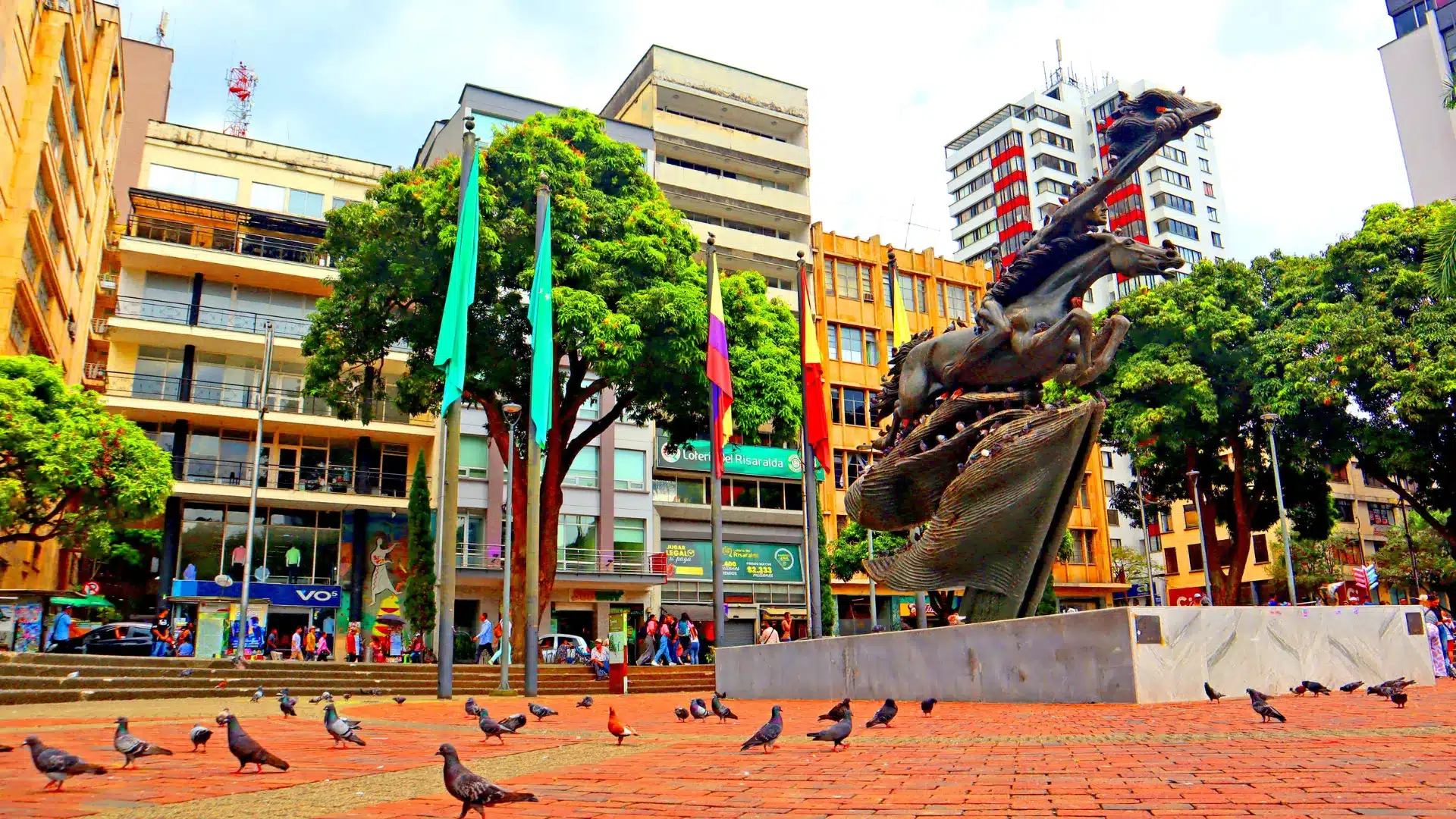
The coffee region — Quindío, Risaralda and Caldas — provides the green terraced hills, plantations, colonial towns like Salento, the wax palms of the Cocora Valley and rural working landscapes. It photographs exceptionally and suits lifestyle, food, travel, documentary and commercial work.
The wider Andes give altitude, páramo, lakes, colonial towns like Villa de Leyva and Barichara, and the archaeological sites of San Agustín and Tierradentro, which carry heritage approval requirements through ICANH.
Filming in the Amazon, the Pacific and Protected Areas
Colombia’s Amazon around Leticia, the Pacific coast around Nuquí and Bahía Solano, and the national park system offer environments few destinations can match — rainforest, river systems, whale migration on the Pacific, and biodiversity that makes Colombia a serious natural-history destination.
These are the locations that need the most lead time and the most care. National Natural Parks of Colombia issues authorisation for protected areas and attaches conditions on crew size, access routes, vehicles and filming activity. Filming in Indigenous territories or Afro-Colombian collective territories is not a permit process at all — it requires consultation with the community authority and their consent, which cannot be bought or accelerated and must be approached properly and early.
Logistics are the other constraint. Access is often by river or charter air, payload limits apply, communications are limited, and medical evacuation planning is not optional. Hoodlum plans these routes against realistic equipment packages rather than the full truck.
Crew Visas and Entry Requirements for Colombia
Entry itself is easy for most crews. Nationals of most European countries, the UK, US, Canada, Australia and much of Latin America enter visa-free as visitors for up to 90 days, extendable to a maximum of 180 days in any calendar year. That covers scouting, meetings and preparatory work without complication.
Paid production work is a different question. Visitor status is not work authorisation, and the correct visa category depends on the role, the duration, whether the crew member is being paid and whether the production is registered under Law 1556. Colombia operates a visa route for foreign audiovisual production personnel, and the Colombian Film Commission publishes guidance and coordinates with the Ministry of Foreign Affairs for registered productions.
The most common compliance failure on Colombian shoots is entering as a visitor and working. It is easy to do, because entry is frictionless and nobody stops you at the airport. It becomes a problem when the production is registering for an incentive, when an insurance claim arises, or when a crew member needs to return.
Applications go through the Cancillería’s online platform. Processing typically runs 5 to 15 working days depending on category and completeness — begin four to six weeks ahead for a full crew, and longer where the production is registering under Law 1556. Yellow fever vaccination is required for travel to Amazon, Pacific and certain jungle regions, and should be arranged at least ten days before entry.
Hoodlum assigns each crew member to the correct category, prepares the supporting production documentation and makes sure the visa position matches what the crew are actually doing on the ground.
Film Permits and Location Permissions in Colombia
There is no single national filming permit in Colombia. The Colombian Film Commission is the national coordinating body and the right first point of contact, but the permissions themselves are issued locally and by site — and understanding that structure is most of the battle.
Municipal film offices and mayoralties handle public space, streets, squares and road use, with Bogotá, Medellín, Cartagena, Cali and Barranquilla each running their own procedures. Regional film commissions coordinate in their territories. National Natural Parks of Colombia authorises filming in protected areas. The Ministry of Culture and ICANH cover archaeological and heritage sites. Indigenous authorities and Afro-Colombian community councils govern access to their territories. Aerocivil handles anything airborne. Private owners and venue management handle their own properties.
Applications generally require a project synopsis, production and local partner details, shooting schedule, exact location list, crew list, equipment and vehicle lists, insurance, and security or traffic plans where public space is affected. Basic filming permits are low-cost or free in some municipalities, depending on local regulation and the production’s impact on public space — fees climb with road closures, police support, park entry, heritage access and venue hire.
Municipal permits in the main cities are often issued within one to two weeks for straightforward requests. National parks, archaeological sites and Indigenous territories need substantially longer, and where community consultation is involved, six weeks is a realistic floor rather than a cautious estimate.
Private permission covers the property and nothing else. It does not replace the municipal permit, the park authorisation, heritage approval or any road consent the location separately requires. Hoodlum maps the full permission stack per location before the schedule is locked, which is when it’s cheap to change.
Drone Filming and Aviation Rules in Colombia
Aerial work is regulated by Aerocivil under the Colombian Aeronautical Regulations governing unmanned aircraft. Commercial drone filming requires a registered aircraft, an authorised operator and operational authorisation — and the operator credential is the part a foreign production cannot solve on arrival.
Engaging an Aerocivil-registered Colombian operator with approved aircraft is the practical route. Allow three to four weeks for the full approval cycle, longer for urban centres, national parks and anything near controlled airspace. Restricted and controlled areas include airports and their surrounds, densely populated urban areas, government and military installations, strategic infrastructure, national parks and border regions.
Authorisation is location-specific and does not transfer between shoots. A filming permit does not include permission to fly, and aviation approval does not deliver municipal, park or community consent — urban flights need the municipality, park flights need PNN, and community territories need the community.
Importing the aircraft is separate again. Drones are declared with the rest of the equipment manifest under the temporary import procedure, with specifications and serial numbers stated rather than discovered at inspection.
Equipment Customs Clearance in Colombia
Colombia is not an ATA Carnet country, and a carnet will not clear equipment on arrival. This catches productions out regularly, because a carnet is the default assumption for most international crews arriving from Europe or North America.
The route is Colombia’s temporary importation procedure under Decree 1165 of 2019, which gives audiovisual equipment preferential treatment — temporary admission without full duties, conditional on Film Commission authorisation being in place and the equipment being re-exported within the authorised period. DIAN administers it, and in practice it runs through a licensed Colombian customs broker appointed before the equipment travels.
The manifest should identify every camera, lens, sound recorder, radio, monitor, light, battery, grip item, laptop, storage device, drone and specialist accessory by make, model, serial number, quantity, value and country of origin. Invoices, packing lists, rental or ownership documentation, insurance and a written re-export commitment support it. Radio, satellite and drone equipment should be flagged early rather than discovered during inspection.
There are no fees for the customs declaration process itself. The costs are the broker’s fee, any guarantee lodged against declared value, and handling. The declaration can take several hours at the airport, particularly on connecting flights, so build clearance time in before the first critical filming day.
On departure, the temporary import list must be reconciled to demonstrate that every item has been re-exported. Failure to re-export or to comply with the authorisation conditions can result in duties, penalties or confiscation — the unreconciled list is where liability attaches.
Colombia Film Incentives: the FFC Cash Rebate and CINA Tax Credit
Colombia’s incentive framework is among the most competitive in Latin America, administered by Proimágenes Colombia under Law 1556, whose sunset date has been extended to 2032 — which gives producers unusual planning certainty for the region.
There are two mechanisms and a production chooses one; they don’t stack.
The Colombia Film Fund, the FFC, is a cash rebate paying 40% on audiovisual services and 20% on logistical services carried out in the country, disbursed once expenses are audited and certified by the FFC Committee. Audiovisual services means local crew and cast, equipment rental, studios, location fees and post-production. Logistical services means transport, catering and accommodation. It’s worth being precise here, because those percentages cannot be added together — they apply to different halves of the budget. Blended across total qualifying spend, the net return averages 30 to 32%. That’s still excellent. A production that has budgeted against 60% has a serious problem.
The Audiovisual Investment Certificate, CINA, is a transferable tax credit worth 35% of eligible audiovisual and logistical expenditure. It is issued as a negotiable security which the foreign producer sells to Colombian income taxpayers through the stock market, converting it to cash. A 5% fee goes to the Colombian Film Commission on issued certificates, so the net return is 33.25% of total qualifying spend. CINA’s minimum is 1,800 statutory monthly minimum wages, roughly COP 2.563 billion or USD 641,000, for both features and series, and series must additionally average 450 SMLMV per episode, around USD 160,000 — both conditions have to be met.
CINA’s format coverage is where Colombia genuinely separates itself. It extends to film, series, music videos, video games, advertising and animation. Advertising is excluded from most incentive programmes internationally, which makes Colombia unusually strong for commercial work and is the least-known thing about the scheme.
The constraint that matters most is allocation. The 2026 CINA fund was raised to a record USD 90 million after 32 projects exhausted the 2025 budget across film, series, unscripted, video games, post and animation. The FFC pot is very much smaller. Funds are assigned first-come, and both were fully allocated during 2025 — so applying early in the fiscal year is not general advice, it’s the difference between receiving the incentive and not.
Both routes require a registered Colombian production services company. Hoodlum can engage the right partner, model which mechanism suits your structure and cashflow, structure qualifying spend and get the application filed before the pot empties. You can compare Colombia against other territories on our film incentives hub.
Safety, Security and Practical Logistics in Colombia
Colombia has been a mainstream production destination for years, and the major cities and established filming regions are workable with standard professional practice. That said, conditions vary sharply by region, and the difference between Bogotá, Cartagena, the coffee region and parts of the Pacific and border departments is real. Some areas require formal risk assessment and are not routine.
Practical planning matters more than security theatre. Vetted local drivers and fixers, secure equipment custody, sensible urban precautions with visible gear, and clear unit management cover most of it. Formal risk assessment applies to rural, border and specific departments where conditions require it.
Health planning is region-specific. Yellow fever vaccination is required for Amazon, Pacific and jungle regions and should be arranged at least ten days before entry; malaria prophylaxis depends on the filming area. Altitude is the underrated one — Bogotá at 2,600m reduces crew output for the first day or two, and high-Andean locations compound it.
Hoodlum builds regional risk assessment, health planning, transport and medical access into the schedule before the crew is moving between coast, capital and jungle.
When Colombia Is the Right Production Choice
Colombia is the right choice when a production needs genuine environmental range within one country, an experienced local crew base, real post-production capability and a competitive incentive — particularly for advertising, music video or video game work that most incentive schemes shut out.
It is especially strong for commercials and branded content, documentary and factual television, features and drama, music videos and fashion, travel and lifestyle work, and animation and post.
It is less suitable for productions that cannot work through a registered local company, need a single national permit rather than a per-site permission stack, are relying on an incentive but can only apply late in the fiscal year, or need protected-area and Indigenous-territory access on short notice. Those shoots are possible, but they need lead time and a local partner who starts early.
Common Production Mistakes to Avoid in Colombia
- Assuming an ATA Carnet will clear equipment — Colombia is not a carnet country
- Entering as a visitor and working, when the role requires a proper visa category
- Adding the FFC’s 40% and 20% together and budgeting against 60%
- Applying for an incentive late in the fiscal year, after the allocation is exhausted
- Treating the Film Commission as the issuer of every permit, when permissions are local and site-specific
- Assuming a filming permit includes drone permission
- Planning to fly your own drone, when an Aerocivil-registered local operator is required
- Treating Indigenous and Afro-Colombian territories as a permit process rather than a consent process
- Underestimating the lead time for national parks and community locations
- Ignoring altitude when scheduling the first days in Bogotá
- Appointing a customs broker after the equipment has shipped
- Failing to reconcile the temporary import list on departure
How Hoodlum Supports Productions in Colombia
Hoodlum provides Film Production Services in Colombia for international crews needing experienced local coordination from first planning through wrap. Our support covers visa categorisation and crew documentation, Colombian Film Commission liaison, municipal and site permits, national park and community territory access, Aerocivil drone coordination, temporary import and customs brokerage, local crew and equipment sourcing, studio and post coordination, transport, accommodation, security and risk planning, FFC and CINA incentive registration and full on-ground production management.
From Cartagena’s walled city and the Caribbean coast to Bogotá’s Andean capital, Medellín’s valley, the coffee region’s hills and the Amazon and Pacific beyond, we help productions reach the strongest environments in Colombia with the permits, fixers, customs planning and logistics already in place. Planning a shoot? Contact us to talk through permits, visas, local fixers, location scouting, customs coordination, drone planning, incentive registration and full production management.
Frequently Asked Questions
Do international crews need a visa to film in Colombia?
Most nationalities — including the EU, UK, US, Canada and Australia — enter visa-free as visitors for up to 90 days, extendable to 180 days per calendar year. That covers scouting and prep. Paid production work generally requires the appropriate visa category, which depends on role, duration and whether the production is registered under Law 1556. Entering as a visitor and working is the most common compliance failure here.
Who issues filming permits in Colombia?
There is no single national permit. The Colombian Film Commission coordinates nationally, but permissions are issued locally: municipal film offices for public space, National Natural Parks for protected areas, the Ministry of Culture and ICANH for heritage and archaeological sites, Indigenous and community authorities for their territories, and Aerocivil for aerial work.
Is Colombia an ATA Carnet country?
No. A carnet will not clear equipment on arrival. Production gear enters under Colombia’s temporary importation procedure governed by Decree 1165 of 2019, which gives audiovisual equipment preferential treatment, administered by DIAN through a licensed customs broker appointed before the equipment ships.
What film incentives does Colombia offer?
Two, and you choose between them. The FFC cash rebate pays 40% on audiovisual services and 20% on logistical services — different expense categories, so the blended return averages 30–32%, not 60%. CINA is a 35% transferable tax credit netting 33.25% after the commission’s 5% fee, and uniquely covers advertising and video games. Both need a registered Colombian company and a minimum spend. Compare territories on our film incentives hub.
When should a production apply for a Colombian incentive?
As early in the fiscal year as possible. Funds are allocated first-come, and both the FFC and CINA budgets were fully allocated during 2025 — 32 CINA projects exhausted that year’s fund. The 2026 CINA allocation is a record USD 90 million, but it is still finite. Late applications can be fully eligible and receive nothing.
Can foreign productions fly drones in Colombia?
Yes, with an Aerocivil-registered aircraft, an authorised operator and operational authorisation. Engaging a registered Colombian operator is the practical route — the operator credential cannot be obtained on arrival. Allow three to four weeks, longer for urban centres and national parks, and note that authorisation is location-specific and a filming permit does not include permission to fly.
Can productions film in Colombia’s national parks and Indigenous territories?
National parks require authorisation from National Natural Parks of Colombia, with conditions on crew size, access and activity. Indigenous territories and Afro-Colombian collective territories are not a permit process — they require consultation with the community authority and their consent, which cannot be expedited or purchased. Both need substantially more lead time than urban permits.
When is the best time to film in Colombia?
It depends on the region more than the calendar, since Colombia’s climate varies by altitude rather than season. Wetter periods run roughly April–May and October–November, varying regionally. The Caribbean coast is driest December to April. Bogotá is cool and often wet year-round. Plan by location, not nationally.
Useful Authority Links
- Colombian Film Commission
- Proimágenes Colombia
- Ministry of Foreign Affairs – Visas
- Aerocivil – Civil Aviation Authority
- DIAN – Tax and Customs Authority
- National Natural Parks of Colombia
Ready to bring your production to Colombia? Hoodlum handles the permits, visa guidance, location scouting, customs and temporary import coordination, drone planning, local crew, incentive registration and full on-ground production management. Get in touch with our team to start planning.
For more information, view our Hoodlum Film Fixers Colombia Google Business Profile.