Productions may hire local security personnel or engage reputable local companies, especially when filming in public areas or guarding high-value camera equipment. Low-profile security is generally sufficient due to Brunei’s safe environment.
Thimphu
Paro, Punakha, Phuentsholing
Malay
Brunei dollar (BND)
Tropical
Film crews visiting Brunei must have a valid passport, a visa (obtainable on arrival or in advance), and a permit from the Prime Minister’s Office, Information Department.
International crews must secure accreditation through the Prime Minister’s Office, Information Department. This process confirms professional intent and ensures compliance with Brunei’s media regulations. Accreditation typically requires proof of identity, visa status, insurance coverage, project details, and payment of a registration fee.
The Prime Minister’s Office – Information Department oversees and issues all film-related permits.
Fixers in Brunei secure access to private homes, businesses, estates, and controlled environments by liaising with owners, negotiating fees, arranging permissions, and coordinating compliance with local regulations.
Location fees cannot be confirmed until the production provides a detailed schedule and filming requirements.
Drone operations require prior approval from both the Brunei Department of Civil Aviation (DCA) and the Prime Minister’s Office, Information Department. Flights over mosques, palaces, government buildings, or military zones are heavily restricted. Operators must comply with safety rules, flight-height limits, and no-fly zones.
Importing drones requires permits from the DCA and the Royal Customs and Excise Department, with restrictions based on drone type, weight, and intended use.
Brunei Department of Civil Aviation (DCA)
7–14 working days, depending on complexity.
Approx. BND 100–500 (USD 75–375), depending on permit type and flight duration.
Yes — Brunei fully accepts ATA Carnets.
Crews must present a valid Carnet upon entry and exit, listing all equipment and securing necessary customs stamps to avoid duties or taxes.
Royal Customs and Excise Department of Brunei
Brunei is one of Southeast Asia’s safest nations, with very low crime, strong law enforcement, and a calm social environment. English is widely spoken, and the regulatory environment is clear and predictable. The country welcomes foreign productions but expects strict respect for cultural norms, religious sites, and modest conduct.
Productions may hire local security personnel or engage reputable local companies, especially when filming in public areas or guarding high-value camera equipment. Low-profile security is generally sufficient due to Brunei’s safe environment.
Brunei offers a film rebate of up to 30% of qualifying local production expenditure through the Brunei Tourism Board. Eligible categories include film, TV, and streaming productions that meet the expenditure and cultural criteria.
Brunei
Bandar Seri Bagawan
Fill in our client brief and we’ll get back to you with everything you need to start filming in this region.

















Brunei Darussalam is one of Southeast Asia’s most controlled and visually distinctive filming…
Brunei is a small, oil-rich sovereign state on the north coast of the island of Borneo — a country of extraordinary visual contrasts. The Sultan Omar Ali Saifuddien Mosque sits on an artificial lagoon in the heart of Bandar Seri Begawan, its golden dome reflected in still water against a backdrop of tropical forest. Kampong Ayer — the world’s largest water village — extends across the Brunei River on hundreds of years of interlocking stilt houses, home to over 30,000 people. Ulu Temburong National Park in the Temburong district covers some of the most pristine primary rainforest in Southeast Asia, accessible only by longboat up a river winding through the jungle.
For productions that need a combination of Islamic architectural grandeur, traditional water village culture, untouched tropical rainforest and a politically stable, safe, English-speaking filming environment, Brunei offers a visual range that no other single destination in the region can replicate at this level of preservation and accessibility.
Brunei offers a 30% film rebate on qualifying production expenditure and a film permit process managed through the Prime Minister’s Office, Information Department.
Brunei is a Southeast Asian filming destination that works for productions needing Islamic architectural heritage, water village culture, pristine rainforest, coastal and river environments, and a safe, English-speaking logistics base within a compact and well-connected geography.
The country is served by Brunei International Airport near Bandar Seri Begawan, with connections to regional hubs including Kuala Lumpur, Singapore and Kota Kinabalu. The country is physically small — approximately 5,765 square kilometres — but divided into four districts. Three districts adjoin each other on the main coast: Brunei-Muara (the capital area), Tutong and Belait. The Temburong district is separated from the others by Malaysian territory and accessed by express ferry or, since 2020, the Temburong Bridge.
The main production environments include Bandar Seri Begawan and its mosques, palaces and waterfront, Kampong Ayer across the Brunei River, the coastal environments of Muara and Jerudong, the river and forest environments approaching Temburong, and Ulu Temburong National Park for rainforest and canopy work.
A successful Brunei production requires early preparation. Visa and permit coordination through the Prime Minister’s Office, Information Department, drone approvals from the DCA, ATA Carnet customs clearance, and private and sensitive location permissions should all be confirmed before crew travel.
Brunei works for productions that need a combination of Islamic architectural landmarks, traditional Southeast Asian water village environments, untouched primary rainforest, river and coastal settings and a stable, English-capable, low-crime filming base.
Strong production use cases include:
The Omar Ali Saifuddien Mosque is one of the most visually distinctive Islamic architectural landmarks in Southeast Asia. Kampong Ayer gives productions a water village environment of genuine historical scale — not a reconstructed cultural attraction, but a living community that has existed on the water for centuries.
The 30% Brunei film rebate makes the country financially competitive for qualifying productions alongside its visual strengths.
English is widely spoken in government, professional and business contexts, which simplifies communication with permit authorities, location contacts and logistics partners considerably.
Brunei has a tropical climate with a wet season and a dry season. The dry season — January to June and September to November — offers the most reliable conditions for exterior filming across all location types.
The wet season runs July to August and December, bringing heavy rainfall and high humidity that can disrupt outdoor filming, drone operations, river and coastal work, and equipment management.
Productions should plan for:
Visa requirements for Brunei depend on nationality. Many nationalities can obtain a visa on arrival; others require advance application. Film crews must also obtain a permit from the Prime Minister’s Office, Information Department, in addition to the standard visa.
Required documentation:
Processing time: Three to five working days. Apply at least two weeks in advance.
Estimated cost: BND 20–30 (approximately USD 15–22) for a single-entry visa.
Work authorisation for paid professional filming should be confirmed separately from standard visitor or tourist entry for each crew member’s nationality. Hoodlum helps productions confirm requirements by nationality and prepare supporting documentation.
International film crews working in Brunei must obtain accreditation from the Prime Minister’s Office, Information Department. Accreditation confirms the crew’s professional status and authorises filming activity in Brunei.
Required documentation:
Processing time: Five to seven working days. Apply at least two to three weeks in advance.
Estimated cost: BND 50–100 (approximately USD 37–74) per person.
Accreditation should run in parallel with the film permit process. Hoodlum coordinates both simultaneously to avoid extending the pre-production timeline.
Film permits in Brunei are issued by the Prime Minister’s Office, Information Department, which oversees and regulates all film productions in the country.
Required documentation:
Processing time: Two to four weeks. Apply six to eight weeks in advance to ensure timely approval.
Cost: No cost for a general film permit for filming in public areas where there is no obstruction of traffic.
Productions involving the Sultan Omar Ali Saifuddien Mosque, Istana Nurul Iman (the royal palace), Kampong Ayer, government buildings, military installations and other sensitive sites require specific additional permissions from the relevant managing authority beyond the general Prime Minister’s Office permit.
Filming near or within mosques, palaces and royal estates requires strict dress code and behavioural compliance throughout the production. No exceptions.
Hoodlum helps productions identify the correct permission route for each location and prepare documentation accordingly.
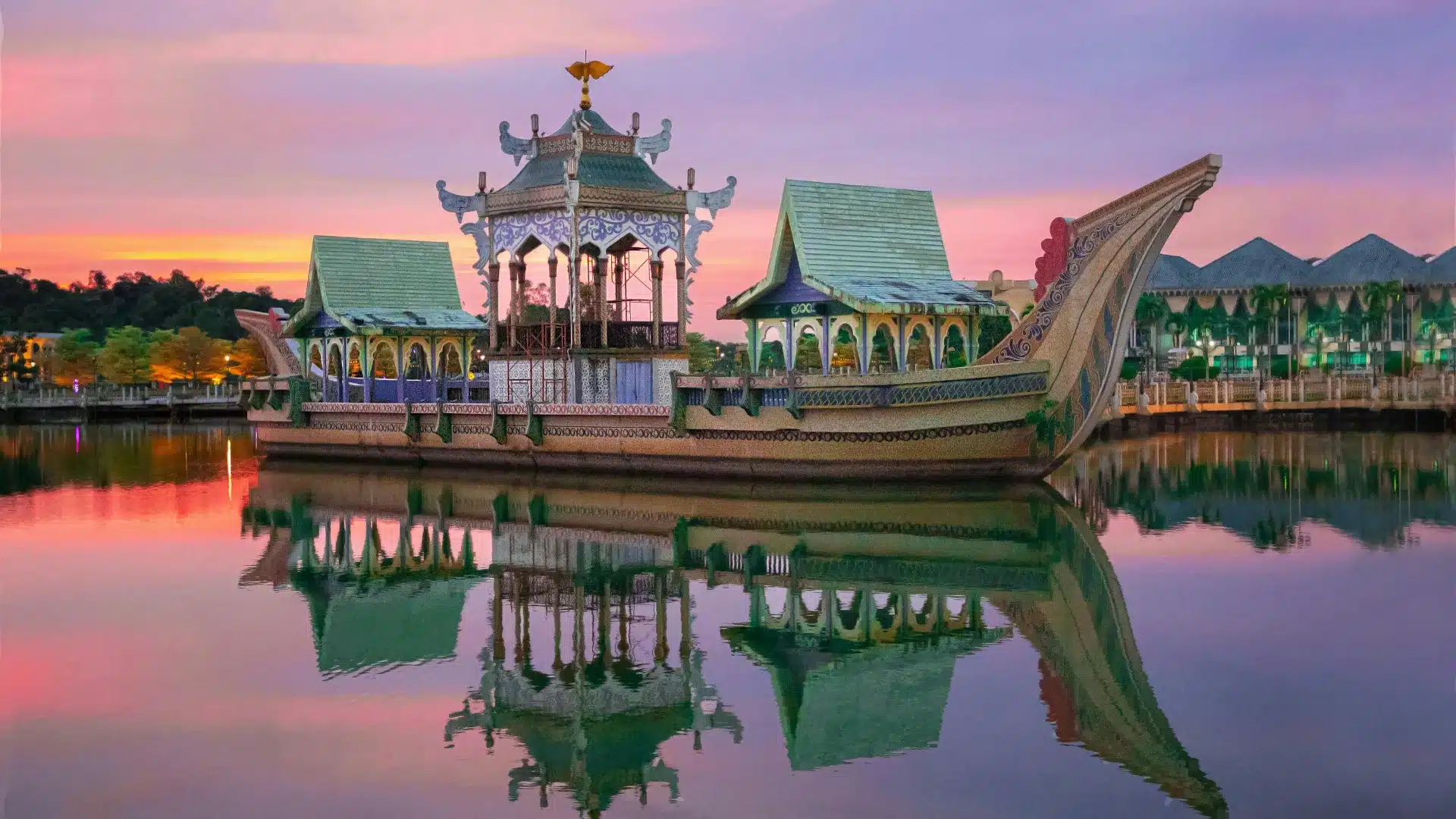
Sultan Omar Ali Saifuddien Mosque, Bandar Seri Begawan — one of the most architecturally distinctive Islamic landmarks in Southeast Asia, set on an artificial lagoon in the heart of the capital. The mosque’s golden dome, white marble exterior and the ceremonial barge on the lagoon create one of the most recognisable film environments in Brunei. Filming access requires Prime Minister’s Office approval and mosque authority coordination. Strict dress codes apply. Drone operations above or adjacent to the mosque require specific DCA confirmation.
Istana Nurul Iman — the official residence of the Sultan of Brunei, considered the world’s largest residential palace. Exterior filming from public areas may be possible with permit approval. Interior access is not available for commercial productions. Clear restrictions apply on distance and angle.
Kampong Ayer — the world’s largest water village, spanning approximately 30 hectares of the Brunei River with 42 villages connected by 36 kilometres of wooden walkways. A living community of over 30,000 people. Filming access requires Prime Minister’s Office approval, sensitivity to residents’ privacy and daily life, and boat logistics coordination. Extraordinary for documentary, cultural and travel productions.
Ulu Temburong National Park — primary rainforest covering approximately 50,000 hectares in the Temburong district, one of the most pristine ecosystems in Southeast Asia. Access requires longboat up the Temburong River. Park authority approval required. Drone operations within the national park require specific DCA and park authority confirmation. Access road and longboat logistics require advance planning.
Muara Beach and coastal environments — Brunei’s coastline on the South China Sea, including Muara Beach near the capital. Accessible for beach and coastal filming with Prime Minister’s Office permit and local authority coordination.
River and mangrove environments — the rivers and mangrove forests of the Brunei-Muara and Tutong districts offer boat and water-based filming environments of exceptional ecological character.
Drone operations in Brunei require prior approval from both the Brunei Department of Civil Aviation (DCA) and the Prime Minister’s Office, Information Department. Both approvals must be in place before any operation begins. One does not cover the other.
Specific restrictions apply around mosques, palaces, military installations and government buildings. These are not negotiable. Productions planning drone sequences above or adjacent to the Omar Ali Saifuddien Mosque, Istana Nurul Iman or other sensitive sites must have explicit DCA and Prime Minister’s Office confirmation for those specific locations before committing aerial days to the schedule.
Required documentation (local drone permit):
Required documentation (drone importation):
Issuing authority: Brunei Department of Civil Aviation (DCA).
Processing time: Seven to fourteen working days.
Estimated cost: BND 100–500 (approximately USD 75–375) depending on permit type and duration.
Hoodlum integrates drone planning into the overall permit application from the outset so aerial days are protected and location-specific restrictions are confirmed before the schedule is locked.
Brunei is an ATA Carnet country. Professional filming equipment can be imported under the standard ATA Carnet system, which is the most straightforward importation route for international productions.
Required documentation:
Issuing authority: Royal Customs and Excise Department.
Processing time: One to three working days.
Estimated cost: BND 50–500 (approximately USD 37–375) depending on the type and value of equipment and customs broker fees.
Carnet documentation must match exactly what arrives. All items — cameras, lenses, drones, batteries, lighting, grip, sound equipment and specialist gear — should be listed with serial numbers and values before departure.
Productions bringing drones should note that drone importation requires additional DCA and AITI permits beyond the standard Carnet process. Treat drone customs clearance as a separate stream from general equipment clearance.
Brunei is one of the safest filming environments in Southeast Asia. Crime rates are extremely low, the political environment is stable, and the country has a welcoming attitude towards international film productions.
Standard production security precautions are appropriate. Brunei is a conservative Muslim-majority country, and cultural sensitivity is essential throughout the production.
Key safety and security considerations include:
Brunei offers a film rebate of up to 30% of qualifying production expenditures for film and television productions shot in Brunei, administered through the Brunei Tourism Board.
This is one of the highest rebate rates available in Southeast Asia for qualifying productions and makes Brunei financially competitive alongside its distinctive visual environments.
Before budgeting the rebate, confirm:
Administering authority: Brunei Tourism Board.
Register for the rebate before qualifying production spend begins. Hoodlum helps productions structure local spend to maximise rebate eligibility and builds documentation tracking into the production process from day one.
Visa, Prime Minister’s Office film permit, crew accreditation, DCA drone approval, Prime Minister’s Office drone approval, ATA Carnet customs clearance, and sensitive site permissions are all separate processes. None covers the others.
A complete production plan connects:
Hoodlum manages all of these as one coordinated pre-production workflow.
Brunei is the right choice when a production needs a combination of Islamic architectural grandeur, traditional Bornean water village culture, pristine primary rainforest, river and coastal environments, and a safe, English-speaking, logistically compact filming base in Southeast Asia.
It is especially suitable for:
It may be less suitable for productions that need large studio infrastructure, very large crew logistics, or locations requiring complete crowd exclusion at heavily visited cultural sites.
Avoid:
Support may include:
Do international crews need a visa to film in Brunei? Visa requirements depend on nationality. Many nationalities can obtain a visa on arrival; others require advance application. A permit from the Prime Minister’s Office, Information Department is required in addition to the standard visa for film productions. Processing takes three to five working days. Estimated cost: BND 20–30 (USD 15–22).
How long should productions allow for the film permit? Apply six to eight weeks before the intended first filming day. Processing takes two to four weeks. Crew accreditation runs in parallel and takes five to seven working days. All documentation should be submitted to Hoodlum as early as possible.
Is there a cost for the Brunei film permit? No — there is no cost for a general film permit for filming in public areas without obstruction of traffic. Specific sensitive site permissions may carry separate fees. Drone permits cost BND 100–500 (USD 75–375). Crew accreditation costs BND 50–100 (USD 37–74) per person.
Can productions film at the Omar Ali Saifuddien Mosque? Yes, but filming requires Prime Minister’s Office approval and mosque authority coordination. Strict dress codes and behavioural protocols apply throughout. Drone operations above or adjacent to the mosque require specific DCA and Prime Minister’s Office confirmation for that location. Contact Hoodlum for specific access planning.
Can productions use drones in Brunei? Yes, but two separate approvals are required — from the Brunei Department of Civil Aviation (DCA) and the Prime Minister’s Office, Information Department. Both must be in place before any operation begins. Drone importation also requires additional DCA and AITI permits. Processing takes seven to fourteen working days. Cost: BND 100–500 (USD 75–375).
Is Brunei a Carnet country? Yes — Brunei is an ATA Carnet country. Customs clearance takes one to three working days. Cost: BND 50–500 (USD 37–375) depending on equipment value and broker fees. Drone importation requires additional DCA and AITI permits beyond the standard Carnet. Carnet documentation must match the actual equipment arriving.
Does Brunei offer a film rebate? Yes — up to 30% of qualifying production expenditures for film and television productions, administered through the Brunei Tourism Board. One of the highest rebate rates in Southeast Asia. Register before qualifying spend begins. Confirm current eligibility criteria directly with the Tourism Board before budgeting.
What makes Kampong Ayer a distinctive filming location? Kampong Ayer is the world’s largest water village — a community of over 30,000 people living in stilt houses connected by wooden walkways over the Brunei River. It has existed in its current form for centuries and is unlike any other location in Southeast Asia. Filming requires Prime Minister’s Office approval, sensitivity to residents’ daily life, and boat logistics coordination.
Prime Minister’s Office, Information Department — Brunei
Brunei Department of Civil Aviation (DCA)
Royal Customs and Excise Department — Brunei
Authority for Info-communications Technology Industry of Brunei — AITI
Filming in Brunei gives productions access to a combination of Islamic architectural grandeur, traditional Bornean water village culture and primary rainforest that is simply not available in the same geography anywhere else in Southeast Asia.
The Omar Ali Saifuddien Mosque, Kampong Ayer and Ulu Temburong National Park are not interchangeable with other locations in the region. They are genuinely distinct filming environments that require genuine local expertise to access and use properly.
The approval framework — Prime Minister’s Office film permit, dual-authority drone approval, sensitive site permissions, rebate registration — is structured but manageable with the right preparation and lead time.
This section consolidates the practical information for international productions planning a Brunei shoot.
The Brunei film permit is issued by the Prime Minister’s Office, Information Department. It is the central production approval for all international film, documentary, commercial and television work in Brunei.
Apply six to eight weeks before the first filming day. Processing takes two to four weeks from a complete application. There is no cost for a general public area permit.
Required documentation covers the shooting script, storyboard, location plans, crew and equipment lists, insurance and a production company introduction letter. All sensitive filming environments — mosques, palaces, Kampong Ayer, national parks — should be flagged in the original application rather than addressed as separate follow-ups after the general permit is issued.
Crew accreditation through the Prime Minister’s Office runs separately and takes five to seven working days. It should run in parallel with the permit process.
The filming visa Brunei process depends on nationality. Many nationalities can enter on arrival; others require advance application. The visa cost is low — BND 20–30 (approximately USD 15–22).
The important point for professional productions is that standard visitor entry does not automatically authorise paid production work. Work authorisation should be confirmed for each crew member’s nationality individually. Productions should provide Hoodlum with complete crew details — names, nationalities, passport details and roles — early in pre-production so that visa and accreditation requirements are confirmed before travel is booked.
The production company letter explaining the purpose and duration of the visit is a required visa document. Hoodlum provides this as part of the standard pre-production package.
The Omar Ali Saifuddien filming location is the most requested and most visually distinctive production environment in Brunei.
The mosque sits on an artificial lagoon in the heart of Bandar Seri Begawan — its golden dome, white marble exterior and the ceremonial barge on the still water have appeared in international productions ranging from commercial campaigns to documentary films. For productions needing a landmark Islamic architectural environment in Southeast Asia, there is no equivalent.
Filming access requires Prime Minister’s Office approval and mosque authority coordination. Strict dress codes apply for all crew entering the mosque grounds — long sleeves, long trousers or skirts, head covering for women. No exceptions. Productions that do not brief all crew on these requirements before arrival risk losing access on the shoot day.
Drone operations above or adjacent to the mosque require specific DCA confirmation beyond the general drone permit. Include the mosque in the drone application with specific coordinates and flight paths.
Kampong Ayer is a living community, not a cultural attraction. Over 30,000 people live in stilt houses connected by wooden walkways over the Brunei River. The village has existed in its current form for centuries and gives productions an authentic traditional Southeast Asian water village environment that cannot be replicated in a studio or at a heritage recreation.
Filming access requires Prime Minister’s Office approval and genuine sensitivity to residents’ daily life throughout the shoot. Camera positions, movement, noise, lighting and crew behaviour all need to reflect the fact that this is a working community rather than a set.
Boat logistics are required for all Kampong Ayer filming. Access to the village is by water taxi or private boat from the Bandar Seri Begawan waterfront. Equipment movement, crew transport, catering and logistics all need to be planned around river access.
Hoodlum manages Kampong Ayer access with established community relationships and experience of working within the village’s residential character.
The drone permit Brunei process requires two separate approvals — from the Brunei Department of Civil Aviation (DCA) and the Prime Minister’s Office, Information Department. Both must be confirmed before any drone operation begins.
This is one of the most important practical facts about drone production in Brunei. Receiving DCA approval does not mean the Prime Minister’s Office has approved. Receiving the general Prime Minister’s Office film permit does not mean the DCA has cleared the drone operation. Both processes run independently.
Processing takes seven to fourteen working days. Cost: BND 100–500 (USD 75–375).
Drone importation requires additional DCA and AITI permits beyond the standard ATA Carnet. Productions should not arrive with drones without having confirmed both operational approvals and the importation documentation well before departure.
Restrictions around the Omar Ali Saifuddien Mosque, Istana Nurul Iman, military installations and government buildings are strictly enforced. Location-specific confirmation — with coordinates and altitude — is required for any sensitive site drone work, not just general permit coverage.
Run drone approvals in parallel with the film permit application — not after it.
Brunei customs clearance for standard filming equipment is efficient thanks to Brunei’s ATA Carnet membership. Processing takes one to three working days at a cost of BND 50–500 (USD 37–375) depending on equipment volume and broker fees.
The critical point for Brunei customs clearance is the drone distinction. Drone importation requires additional DCA and AITI permits beyond the standard Carnet process. A production that arrives with drones covered only by Carnet documentation, without the DCA and AITI importation permits, will face clearance issues at Brunei International Airport.
Treat drone importation as a completely separate customs preparation stream from general equipment clearance. Both should be confirmed and documented before freight is packed.
Carnet documentation for all other equipment must match exactly what arrives. List all items — cameras, lenses, batteries, lighting, grip, sound equipment, monitors and specialist gear — with serial numbers and values before the Carnet is issued.
The Brunei film rebate of up to 30% of qualifying production expenditures is administered through the Brunei Tourism Board and is one of the highest rebate rates available to international productions anywhere in Southeast Asia.
For productions that qualify, the rebate makes a material difference to the total cost structure and directly improves the financial case for shooting in Brunei compared to competing regional destinations with lower or no incentive structures.
Register for the rebate before qualifying production spend begins. Confirm current eligibility criteria, qualifying expenditure categories, minimum spend thresholds and payment timelines with the Brunei Tourism Board before building the rebate into the production budget.
Hoodlum helps productions register at the correct stage and structures local spend documentation so the paperwork trail for a rebate claim is complete from day one.
Ulu Temburong National Park covers approximately 50,000 hectares of primary rainforest in the Temburong district — one of the most ecologically intact forest environments in Southeast Asia.
The park is accessible by express ferry from Bandar Seri Begawan to Bangar, then by longboat up the Temburong River to the park entrance. The Temburong Bridge opened in 2020 and now provides a road link between the Temburong district and the rest of Brunei, significantly improving access logistics.
Filming within the national park requires park authority approval in addition to the general Prime Minister’s Office permit. Drone operations within the park require specific DCA and park authority confirmation.
For nature documentary, conservation, wildlife and adventure productions, Ulu Temburong offers proboscis monkeys, hornbills, pygmy elephants in border areas, and a canopy walkway system in some zones. The river journey itself — longboat through primary forest — is one of the most distinctive and visually compelling access experiences in Southeast Asia.
Brunei location scouting requires knowledge of a country divided into four districts with different characters, different access logistics and — for Temburong — a physical separation from the rest of the country that requires boat or bridge planning.
Bandar Seri Begawan and the Brunei-Muara district contain the capital’s mosque, palace, Kampong Ayer and urban environments. Tutong and Belait districts offer river, coastal and rural environments. Temburong requires specific ferry, bridge or longboat logistics and offers the rainforest and national park environments that give Brunei its nature production credentials.
Productions planning to cover multiple districts need to build realistic travel times into the schedule and plan accommodation and logistics around the specific district geography rather than assuming proximity.
Hoodlum’s in-country team conducts location scouting across all four districts, assessing each environment against the creative brief, the permit requirements, the access logistics and the production timeline before recommendations are made.
A Brunei film fixer coordinates the Prime Minister’s Office film permit and crew accreditation simultaneously, manages visa and work authorisation confirmation for all international crew, handles mosque authority coordination for Omar Ali Saifuddien filming, manages Kampong Ayer community relationships and boat logistics, coordinates Temburong and national park access, runs DCA and Prime Minister’s Office drone approvals in parallel, manages AITI drone importation clearance alongside the standard Carnet, registers the production for the Brunei Tourism Board film rebate, briefs all crew on dress codes and cultural protocols before arrival, and plans location day logistics across all four Brunei districts.
Film production Brunei works most efficiently when Hoodlum is engaged six to eight weeks before the first filming day — giving the Prime Minister’s Office permit its full processing window while running all parallel approval streams simultaneously.
Hoodlum provides full production support for international crews across all Brunei filming locations — from early research and Brunei location scouting through permit coordination, mosque and water village access, drone planning, customs clearance, rebate registration and on-the-ground production management. For enquiries, visit hoodlum.tv/contact-us.
For productions building a Southeast Asia film production guide — comparing Brunei with Bali, Thailand, Malaysia, Vietnam and the Philippines — Brunei occupies a specific and distinctive position.
It is the only Southeast Asian filming destination that combines a 30% film rebate, the world’s largest residential palace, the world’s largest water village, primary Bornean rainforest accessible within a day of the capital, and a conservative Islamic cultural context that gives productions a visual register genuinely different from every other destination in the region.
Productions that have filmed in Malaysia or Singapore will find Brunei a compact and logistically manageable addition — a different architectural vocabulary, a different cultural register, a different level of ecological preservation, and a rebate structure that makes it financially attractive for qualifying productions.
The practical groundwork is always the same: apply for the Prime Minister’s Office permit six to eight weeks before filming, run crew accreditation in parallel, get both DCA and Prime Minister’s Office drone approvals confirmed simultaneously, prepare Carnet documentation and AITI drone importation permits before freight is packed, flag all sensitive site filming in the original permit application, brief all crew on dress codes and Ramadan observances before arrival, register for the 30% Brunei film rebate before spend begins, and engage a local fixer with genuine knowledge of all four districts and the specific access conditions of the mosque, water village and rainforest environments that make Brunei distinctive.
Planning a shoot in Brunei? Contact Hoodlum for film permits, government authorisations, media accreditation, content approval planning, local fixers, location scouting, customs clearance, drone coordination, boat and rainforest logistics, security support and full on-ground production management. You can also view the Hoodlum Film Fixers Brunei Google Business Profile for local production details.