

Film Production Services in the United Kingdom
The United Kingdom is one of the most established filming destinations in the world, combining world-class studios, a deep crew base, generous tax incentives and a sweep of locations that runs from medieval cathedrals and Georgian terraces to Highland wilderness, rugged coastline and the dense energy of central London. Few countries pack so much variety into such a compact area, and fewer still pair it with the production infrastructure to shoot it efficiently.
For international crews, the United Kingdom offers a rare blend of creative range and operational certainty. A production can base in London, draw on Pinewood, Leavesden, Shepperton or Elstree, hire crew and kit locally, then move out into the Cotswolds, the Lake District, the Scottish Highlands, the Welsh valleys or the Northern Irish coast depending on the creative direction. The roads are good, the airports are well connected, and the screen sector is supported by a mature ecosystem of fixers, location libraries, equipment houses and post facilities.
Hoodlum provides Film Production Services in the United Kingdom for documentaries, commercials, factual entertainment, branded content, music videos, photography campaigns, feature films and television drama. Our team supports visa and sponsorship guidance, filming permits, location agreements, drone planning, customs clearance, local crew sourcing, transport, security planning and full on-ground production management. You can see the full scope of what we do and the people behind it on our who we are page.
The United Kingdom rewards productions that arrive with their paperwork in order. It is a film-friendly country, but it is not a destination for informal, undocumented shooting by foreign crews. The right immigration route, the right permits and the right equipment-clearance plan all need to be settled before the cameras roll.
Why the United Kingdom Works for Locations, Crew and Infrastructure
The United Kingdom’s biggest production strength is the sheer density of usable environments within short travel distances. In a single schedule a production can capture a contemporary financial district, a centuries-old castle, a windswept moor, a sandy beach, a working harbour, an industrial mill town and a stately home, often within a day or two of each other. That compactness keeps travel days down and shooting days up.
London is the operational heart, but the value sits in the route. A commercial might pair a City skyline with a Cotswold village and a stretch of the Jurassic Coast. A natural-history documentary might move from the Cairngorms to the Pembrokeshire cliffs. A drama might combine a London studio build with location work in Yorkshire and a Scottish loch. The United Kingdom is strong because it can stand in for many places at once: period Europe, contemporary metropolis, untamed wilderness or quiet rural idyll.
The country is especially well suited to:
- Feature films and high-end television drama
- Period and heritage productions
- Commercials and branded content
- Documentary and factual series
- Music videos and live performance capture
- Fashion and photography campaigns
- Automotive and lifestyle shoots
- Natural-history and landscape programming
- Travel and tourism content
Hoodlum’s production support team helps crews decide which regions are practical, what permissions each location needs and how to sequence movement between the studios, the cities and the wilder corners of the United Kingdom.
London as the Production Base
London is the natural anchor for most international productions working in the United Kingdom. It is where crews usually arrive, where the major equipment houses, post facilities and production partners are concentrated, and where most immigration, permit and customs coordination begins.
The city itself is an enormous resource. It offers world-famous landmarks, Georgian and Victorian streetscapes, brutalist estates, glass-and-steel financial towers, royal parks, markets, museums, transport hubs, riversides and residential terraces that can double for almost any era. With the right approvals, productions can shoot on the South Bank, around the City, in the West End, along the river or in the surrounding boroughs.
London also matters logistically. Crew accommodation, vehicle hire, fixers, customs agents, drone operators, security planning and medical support are all easiest to coordinate from the capital. Hoodlum uses London as the practical hub for Film Production Services in the United Kingdom, particularly when a shoot needs to travel out to studios, regional cities or remote landscapes.
The Major Studios
The studio estate is one of the United Kingdom’s defining advantages. Pinewood, Shepperton, Leavesden, Elstree and a growing roster of newer facilities give productions soundstages, backlots, water tanks, virtual-production volumes and the technical support that major projects depend on. This is the infrastructure that has anchored some of the largest film and television productions ever made, and it remains a core reason international productions choose to base in the country.
For incoming crews, the studios are useful not only as stage space but as a centre of gravity for talent and suppliers. Building a London or Home Counties base near the studios puts a production close to crew, kit and the supporting trades it will rely on throughout the shoot.
Scotland: Highlands, Lochs and Edinburgh
Scotland gives the United Kingdom a completely different visual register from the south. The Highlands deliver mountains, glens, lochs, single-track roads and a sense of scale and isolation that is hard to find elsewhere in Western Europe. Glencoe, the Cairngorms, Skye and the western coast have become shorthand for cinematic wilderness, while Edinburgh and Glasgow offer dramatic historic cityscapes that double convincingly for many European and period settings.
These environments suit feature films, drama, natural-history programming, automotive films, fashion shoots and travel content that needs grandeur and atmosphere. Filming in remote Scottish locations requires tighter planning around weather, daylight, access, accommodation and movement, since the most striking landscapes are often the furthest from a base. Security needs are usually light in these controlled environments, with discreet, experienced personnel preferred over a heavy presence.
Hoodlum builds the local driver, location, accommodation and logistics coordination into the plan before a shoot moves north, so the difference between a beautiful landscape and a workable filming day is handled in advance.
Wales: Mountains, Coast and Cardiff
Wales offers mountains, coastline, castles, valleys, forests and a strong production base around Cardiff. Snowdonia delivers dramatic peaks and lakes, the Pembrokeshire coast offers cliffs and beaches, and some of the United Kingdom’s finest castles and industrial-heritage sites provide ready-made period texture. Cardiff itself has become a significant production centre with its own studio capacity and crew base.
Wales works well for drama, fantasy and period productions, natural-history sequences, commercials and travel content. The compact geography means a production can move between mountain, coast and city in a tight schedule. Hoodlum helps crews weigh whether Wales can deliver the creative need closer to base before committing to more distant routes.
Northern Ireland and the Causeway Coast
Northern Ireland combines coastline, countryside, historic sites and a well-developed production sector around Belfast. The Causeway Coast, the Mourne Mountains, the glens and the region’s distinctive geology have supported major film and television work, and Belfast offers studio space and an experienced local crew base.
The region is strong for drama, fantasy, landscape and documentary work, and its scale makes for efficient movement between locations. As with the rest of the United Kingdom, Hoodlum coordinates local fixers, transport, accommodation and location agreements so the production runs smoothly once it leaves the city.
England Beyond London: Countryside, Coast and Cities
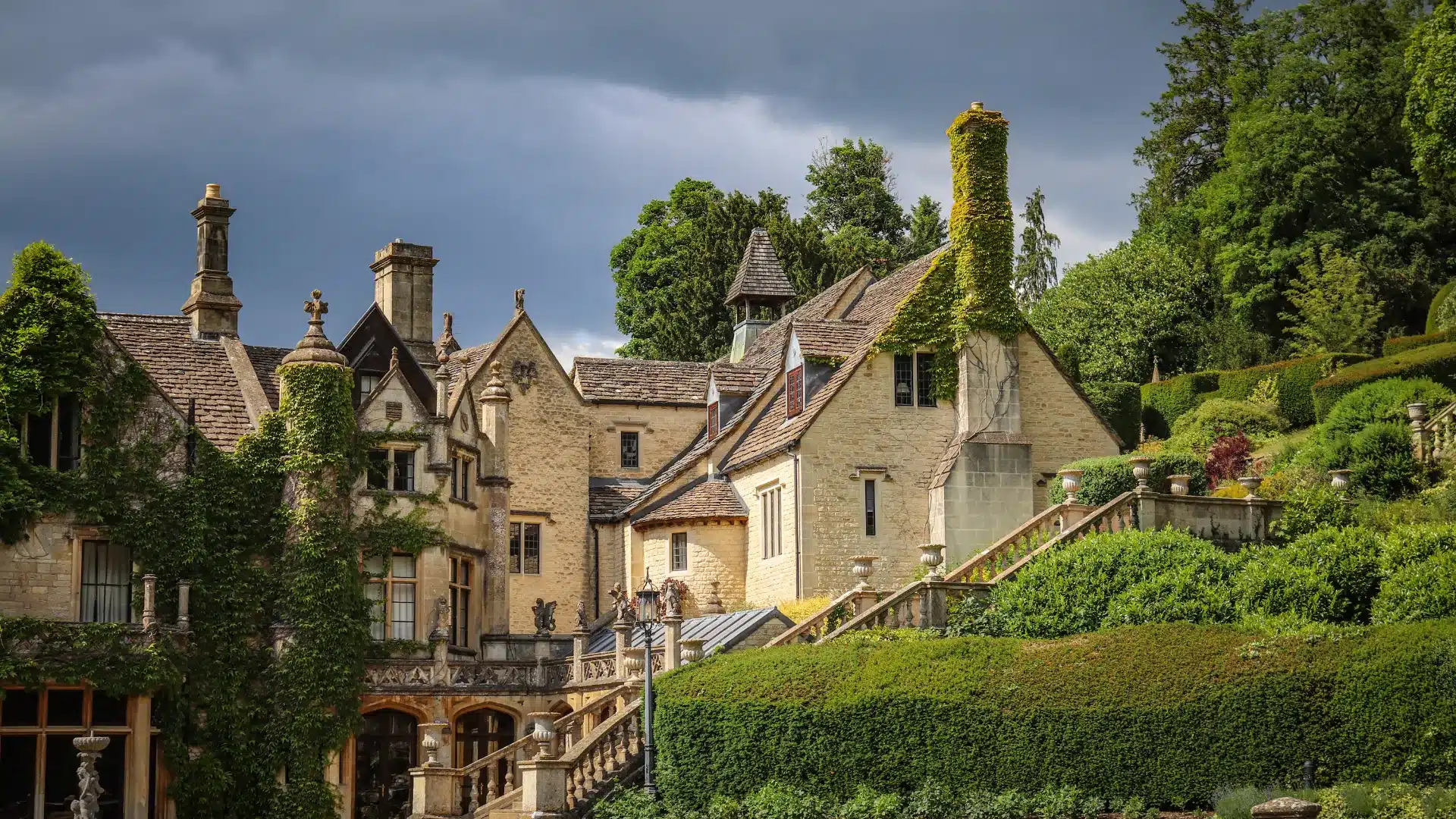
Outside the capital, England offers an enormous spread of options across the rest of the United Kingdom’s largest nation. The Cotswolds and the Home Counties provide honey-coloured villages and rolling farmland. The Lake District, the Peak District, the Yorkshire Dales and the North York Moors deliver fells, dales and dramatic open country. The South West offers the Jurassic Coast, Cornish beaches and Dartmoor. Cities such as Manchester, Liverpool, Bristol, Birmingham and Bath bring their own architecture, crew bases and screen-friendly streets.
This range means productions can match almost any creative brief without leaving England, from gritty urban drama to chocolate-box rural romance to wild coastal natural history. Hoodlum helps productions plan these regions as distinct shooting environments, each with its own access, permit and logistics considerations, rather than as simple add-ons to a London schedule.
Entry, Visas and Crew Sponsorship
Immigration is the area where incoming productions most often underestimate the planning required. The right route depends on each crew member’s nationality, role, length of stay and whether they will be paid by a British entity.
For genuinely short, specific engagements, some crew may be able to enter as a Standard Visitor to undertake permitted paid activities, but this route is narrow and must be used carefully. For most professional film work, the relevant route is the Creative Worker visa (Temporary Work), which replaced the old Tier 5 Temporary Worker category. This route requires a Certificate of Sponsorship from a licensed sponsor before the crew member applies, and the work must relate to the sponsoring organisation’s activity.
Applicants typically need a valid passport, the Certificate of Sponsorship reference number, proof of maintenance funds unless the sponsor certifies these, and any supporting documents required for their nationality. Most Creative Worker applications are decided in around three weeks, with priority services often available, and costs vary by route and length of stay. Non-visa nationals on short engagements of three months or less may be able to use a concession to seek entry at the border, but they must take care not to use automated e-gates, which would only grant visitor status.
Separately, many travellers entering the United Kingdom now need an Electronic Travel Authorisation before they fly. Hoodlum helps productions match each crew member to the correct route, keep sponsorship, supporting documents and the crew list aligned, and avoid immigration becoming a late-stage problem.
Filming Permits and Location Permissions
There is no single national film permit covering the whole of the United Kingdom. Instead, filming permissions are handled location by location, which makes local knowledge essential.
Public street filming and council-owned locations are usually arranged through the relevant local authority or a city film office, such as Film London in the capital, each with its own application process, lead times, fees and conditions. Many of the most photogenic heritage locations are managed by bodies such as the National Trust, English Heritage, Historic Environment Scotland and their equivalents in Wales and Northern Ireland, each of which has its own filming team, agreements and fee structures.
Applications generally require a completed permit form, proof of public liability insurance, a filming schedule, location plans, risk assessments and often a synopsis or script. Timelines vary widely, from a few working days for a simple street permit to several weeks for complex or large-scale productions on sensitive heritage sites. Fees are equally variable and depend on the location, crew size and duration.
Private locations, from stately homes and farms to hotels, businesses and private roads, are negotiated directly with owners or managers. A Hoodlum location scout can propose suitable options, after which we negotiate access, dates, crew size, vehicle movement, fees and reinstatement terms, and secure a standard location agreement. Private permission does not replace any council, heritage or public-space approvals that a location also requires. Location fees are project-specific and quoted once the locations are confirmed.
Drone Filming and Civil Aviation Rules
Drone operation across the United Kingdom is regulated by the Civil Aviation Authority, and the framework has changed significantly in recent years. The old Permission for Commercial Operations, often referred to as a PfCO, no longer exists. Commercial drone work is now governed by a risk-based system of Open, Specific and Certified categories, with pilot competence demonstrated through qualifications such as the A2 Certificate of Competency or the General Visual Line of Sight Certificate, and many operations requiring an Operational Authorisation from the regulator.
Operators also need to register for an Operator ID and Flyer ID, display the Operator ID on the aircraft, and hold appropriate third-party insurance for any paid work. Standard limits include a maximum height of around 120 metres and minimum distances from uninvolved people that depend on the drone’s class and the category of operation. Further rule changes around class marking, registration thresholds and night-flying equipment have come into force recently, so current guidance should always be checked before a shoot.
For incoming productions, the most practical route is almost always to engage a locally licensed drone operator who already holds the right qualifications, authorisation and insurance and understands current local procedures and airspace restrictions. Importing your own drone is possible but adds customs and compliance steps, and unfamiliar pilots can easily fall foul of the category rules. Hoodlum helps productions decide between a local operator and importing equipment, and builds the necessary lead time into the plan.
Equipment Customs Clearance and the ATA Carnet
The United Kingdom is an ATA Carnet country, which makes temporary equipment importation relatively straightforward for productions that prepare properly. An ATA Carnet acts as a single international customs document allowing professional filming gear to be temporarily imported duty-free and tax-free, on the guarantee that it will be re-exported within the validity period, typically up to one year.
Customs clearance is handled by HM Revenue & Customs, and a clean carnet supported by a detailed equipment list, accurate values and serial numbers usually moves through quickly. Air and road freight clearance is often completed within a few hours when documentation is in order, with marine freight taking longer. Costs vary with the size and value of the shipment and the agent’s fees.
A carnet is not the only option, and crews arriving from some territories or carrying minimal kit may have alternative routes, but for a substantial equipment package the carnet is generally the cleanest path. Hoodlum helps productions prepare the equipment list, values, carnet documentation and clearing-agent coordination so cameras, lighting, grip and sound gear move through the port or airport with minimal delay.
Tax Incentives and Production Rebates
One of the United Kingdom’s strongest draws is its screen-sector incentive regime, which has recently been overhauled. The long-standing Film Tax Relief and High-End Television tax relief have been replaced for new productions by the Audio-Visual Expenditure Credit, usually shortened to AVEC, administered through the corporation tax system. Productions already underway under the old reliefs can continue under transitional rules, but those legacy reliefs are being phased out entirely.
Under AVEC, qualifying film and high-end television productions can claim an expenditure credit on UK core spend, with animation and children’s television claiming at an enhanced rate, an additional uplift available for UK visual effects work, and a further enhanced credit for qualifying lower-budget independent films. To access the relief a production must be certified as British through the British Film Institute cultural test or qualify as an official co-production, be made by a UK production company within the corporation tax net, and meet minimum UK spend thresholds.
The exact rates, caps and eligibility rules are detailed and change periodically, so productions should take specialist advice and confirm current figures before budgeting. The British Film Commission is a useful first point of contact for incoming productions weighing up the incentive landscape. Reality and unscripted formats sit in a more nuanced position than scripted drama, so eligibility should be checked case by case rather than assumed.
Safety, Security and Practical Logistics
The United Kingdom is generally considered a very safe and film-friendly country, with a highly skilled workforce, strong infrastructure and a culture of professional, low-key production. The risk profile is low in most settings, but it still varies with location, subject matter, public exposure and crew footprint.
Controlled and private environments usually need little or no security. Busy public filming, high-profile landmarks, large crowd scenes or sensitive subjects may call for discreet private security or coordination with local police and councils. For regional and remote work, particularly in Scotland, Wales and the more isolated parts of England, the emphasis is on experienced personnel who blend into the environment and minimise disruption rather than a heavy or conspicuous presence.
Weather and daylight are the practical variables that most affect a schedule. Conditions change quickly, especially in upland and coastal areas, and winter daylight is short, so contingency planning matters. Medical infrastructure is excellent and no special vaccinations are required for entry. Hoodlum helps productions balance sensible security with efficient movement, and builds weather, daylight and contingency thinking into the schedule from the start.
When the United Kingdom Is the Right Production Choice
The United Kingdom is the right choice when a production needs a combination of world-class studios, deep crew resources, a competitive incentive regime and an exceptional spread of locations within easy reach. It is especially strong for feature films, high-end drama, period and heritage productions, commercials, documentary, natural history, fashion, automotive and travel content, and any project that wants to combine city, countryside and coast in a single efficient schedule.
It may be less suitable for productions that need instant, sponsorship-free work authorisation, or that expect to arrive and shoot informally without permits or planning. The country is highly workable when the immigration route, filming permissions, drone arrangements, carnet and location agreements are settled early.
Common Production Mistakes to Avoid
The most frequent mistakes include:
- Assuming a visitor entry covers paid crew work
- Leaving Creative Worker sponsorship too late
- Relying on the outdated PfCO terminology for drones
- Underestimating drone qualification and authorisation timelines
- Treating heritage locations as ordinary private sites
- Missing council or city-office permit lead times
- Arriving with equipment before carnet preparation is complete
- Underestimating how much weather and short winter daylight can compress a schedule
Most of these problems are avoidable by aligning the crew list, sponsorship, filming permits, drone plan, carnet and location agreements well before the crew travels.
How Hoodlum Supports Productions in the United Kingdom
Hoodlum provides Film Production Services in the United Kingdom for international crews that need experienced local coordination from early planning through to wrap. Our support covers immigration and sponsorship guidance, filming permits and location permissions, private location agreements, studio and regional coordination, drone planning, carnet and customs preparation, clearing-agent coordination, local crew sourcing, transport, accommodation, security planning and on-ground production management.
From London and the major studios to the Scottish Highlands, the Welsh mountains, the Northern Irish coast and the cities and countryside of England, we help productions access the strongest filming environments in the United Kingdom with the right permits, fixers, customs planning and logistics in place. Planning a shoot? Contact us to talk through permits, sponsorship support, local fixers, location scouting, carnet planning, drone coordination and full on-ground production management.
Frequently Asked Questions
Do international crews need a visa to film in the United Kingdom?
It depends on nationality, role and how long the work lasts. Most professional film work in the United Kingdom requires the Creative Worker visa (Temporary Work), which needs a Certificate of Sponsorship from a licensed sponsor. Some short engagements may use a visitor route or a concession, and many travellers also need an Electronic Travel Authorisation before flying.
Is there a single national filming permit?
No. Filming permissions are handled location by location through local authorities, city film offices, heritage bodies and private owners, each with its own process, lead time and fees.
Who issues drone permissions?
The Civil Aviation Authority regulates drone operation. The old PfCO no longer exists; commercial work now runs through a risk-based category system with qualifications such as the A2 CofC or GVC and, for many operations, an Operational Authorisation. Using a locally licensed operator is usually the most practical route.
Is the United Kingdom an ATA Carnet country?
Yes. Temporary importation of professional filming equipment is handled cleanly through the ATA Carnet system, with clearance via HM Revenue & Customs.
What tax incentives are available?
New productions claim through the Audio-Visual Expenditure Credit (AVEC), which has replaced the older Film Tax Relief and High-End Television reliefs. Qualifying film and high-end TV productions can claim a credit on UK core spend, with enhanced rates for animation, children’s TV, VFX and lower-budget independent films, subject to British certification and minimum spend rules.
What are the best filming locations?
Popular options include London and the major studios, the Scottish Highlands, Edinburgh and Glasgow, Snowdonia and Cardiff, the Causeway Coast and Belfast, the Cotswolds, the Lake District, Yorkshire, the South West coast and cities such as Manchester, Liverpool and Bath.
Useful Authority Links
- Creative Worker visa (Temporary Work)
- Civil Aviation Authority drones guidance
- HM Revenue & Customs
- British Film Institute
- British Film Commission
- Film London
Ready to bring your production to the United Kingdom? Hoodlum handles the permits, sponsorship guidance, location scouting, carnet and customs planning, drone coordination, local crew and full on-ground production management, so you can focus on the work in front of the lens. Get in touch with our team to start planning, and tell us your locations, dates and creative brief.
For more information, view our Hoodlum Film Fixers United Kingdom Google Business Profile.