


















Filming in Croatia
Croatia is one of Europe’s most versatile filming destinations, combining medieval walled cities, Roman ruins, Adriatic islands, dramatic coastline, waterfalls, forests, mountains and Central European urban environments within one compact country. From the honey-stone walls of Dubrovnik and the Roman heart of Split to the islands of Hvar and Vis, the waterfalls of Plitvice, the hill towns of Istria and the capital Zagreb, Croatia offers an unusually broad visual range for international productions.
For overseas crews, the appeal is not only visual. Croatia also offers experienced English-speaking crews, EU-aligned workflows, strong local production infrastructure and a competitive cash rebate on qualifying spend. A production can move from a walled medieval city to Roman architecture, islands, waterfalls and mountain landscapes within one connected schedule, provided the permits, customs, incentive planning and location logistics are handled correctly from the beginning.
Hoodlum provides Film Production Services in Croatia for feature films, streaming series, period drama, commercials, documentaries, branded content and large-scale location builds. Our team supports permits, incentive planning, municipal and regional coordination, location agreements, drone coordination, customs and equipment clearance, local crew and vendor sourcing, marine and island logistics, transport, accommodation, safety planning, rebate reporting and full on-ground production management. You can learn more about our international production network and the people behind it on our Who We Are page.
Why Croatia Works for Coast, Heritage and Rebates
The country’s biggest production strength is the combination of world-famous coastal and historic locations, experienced crews, EU-aligned workflows and a competitive 25% cash rebate. In a single schedule, a production can move from medieval walls and Roman ruins to islands, waterfalls, forests and mountains without leaving the country.
Zagreb, Split and Dubrovnik are the main production hubs, but the wider value lies in the range around them. Productions can combine fortified streets, Roman architecture, islands, waterfalls and contemporary city locations while remaining inside one national framework.
Croatia is well suited to feature films, streaming series, period and historical drama, documentary and factual television, travel and lifestyle programming, fantasy and action projects, coastal and marine productions, commercials and branded content. The cash rebate adds value for qualifying formats, while the location range remains available to productions that do not qualify for the incentive.
Hoodlum’s production team helps crews decide which regions are practical, which permissions apply and how to sequence the schedule efficiently. Our wider Where We Work network also supports productions comparing Croatia with other countries.
Dubrovnik and the Dalmatian Coast
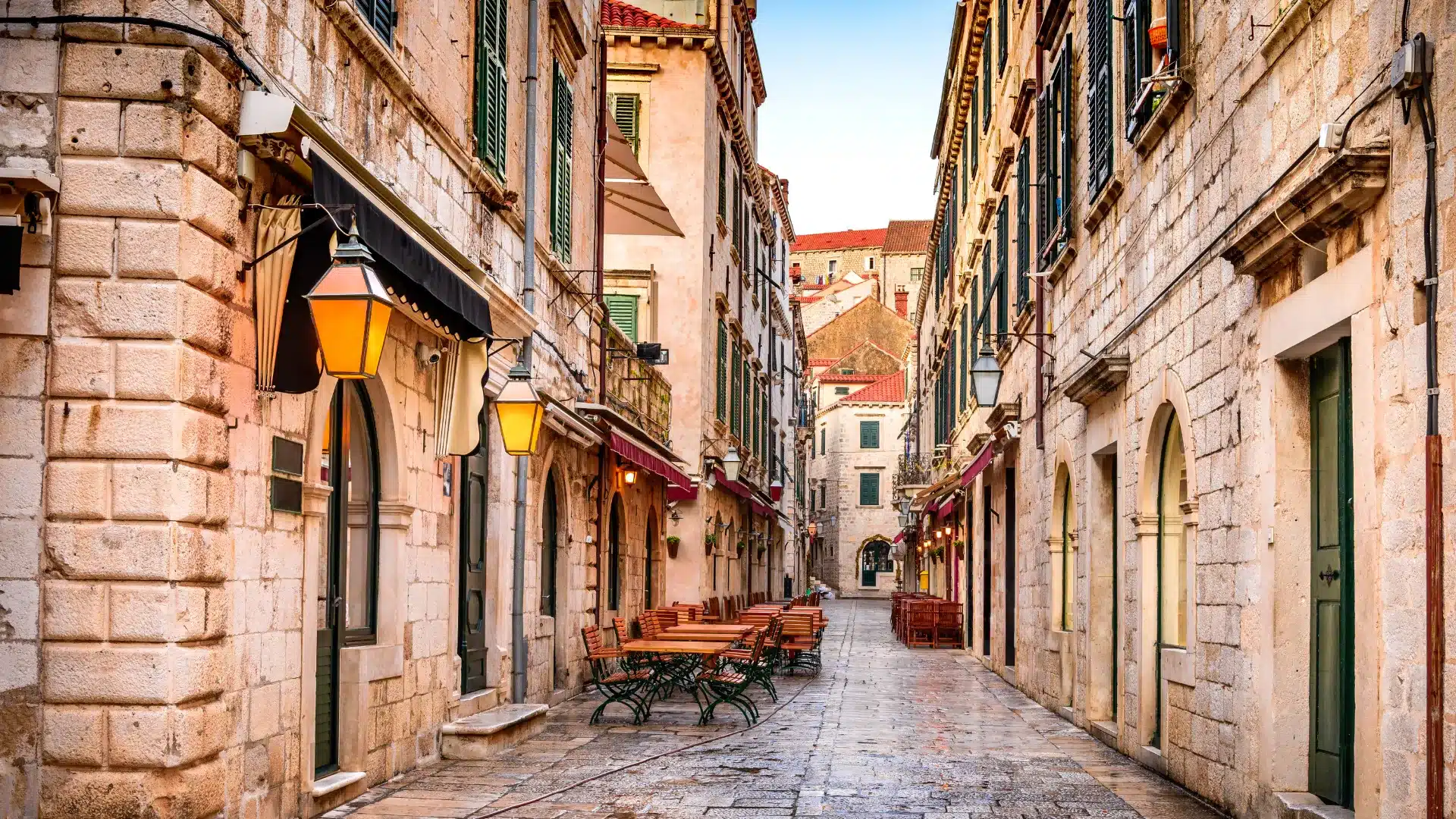
Dubrovnik is one of Europe’s most recognisable filming locations. Its ramparts, stone streets, Baroque buildings, forts and harbour create a complete historic city environment beside the Adriatic. The city is particularly valuable for period drama, fantasy, premium television, feature films, commercials and travel work.
The wider Dalmatian coast adds Split, Šibenik, the Makarska Riviera and a long chain of coastal towns, harbours and islands. These locations offer stone architecture, sea views, marinas, fishing villages, beaches, cliffs and coastal roads, allowing productions to build a varied Adriatic look without moving between countries.
Filming in Dubrovnik’s Old Town requires careful planning because it is a living city and a protected heritage environment. Access, visitor movement, equipment routes, parking, filming hours and public-space use all need to be coordinated. Heritage authorities, city bodies, property managers and other local stakeholders may be involved depending on the scale and nature of the shoot.
For productions using the coast as a base, Hoodlum manages the permissions, access planning and local logistics needed to protect both the schedule and the visual ambition of the project. This is a central part of our Film Production Services in Croatia for projects working across several coastal locations.
Split, Šibenik and Roman Heritage
Split is built around Diocletian’s Palace, a living Roman monument whose streets, cellars and squares form part of the modern city. The result is a location that can support Roman, medieval, historical and fantasy looks while still providing access to a major production hub.
Šibenik adds Renaissance architecture, Adriatic forts and historic streets, while the surrounding region offers further classical and medieval settings. These locations suit historical drama, features, commercials and cultural programming.
Because these are active public spaces and protected heritage environments, filming requires the relevant city and site permissions, careful access management and early coordination. Crew movement, lighting positions, equipment routes, visitor activity and restoration conditions must be planned before filming begins.
Hoodlum coordinates the local authorities, site representatives and practical production needs so these historic locations can be used safely and efficiently.
The Islands, Plitvice and Natural Locations
Beyond the historic cities, Croatia offers exceptional natural range. Hvar, Vis, Brač and Korčula provide harbours, stone villages, beaches, cliffs, open-water views and island roads. Plitvice and Krka National Parks offer waterfalls, lakes, forest paths and protected landscapes, while inland Croatia adds mountains, rivers and rural environments.
These locations are suitable for features, travel programming, natural-history work, commercials, adventure projects and productions needing coast, islands, waterfalls or mountain scenery. Vis is particularly well known as a filming location, while the wider island network gives productions a choice of visual styles and practical bases.
Island filming requires more than simple transport planning. Ferry and boat schedules, freight capacity, accommodation, equipment movement, weather, marine safety and return travel all need to be built into the production plan. A location that appears close on a map may require several transfers and limited operating windows.
National parks and other protected areas require environmental approvals and may place tighter controls on crew size, access, equipment and filming hours. Hoodlum builds marine logistics, permissions and transport into the schedule so island and landscape shoots remain practical.
Zagreb, Istria and Urban Locations
Zagreb offers a visual language that differs from the Adriatic coast. Austro-Hungarian architecture, elegant squares, museums, parks, residential areas and modern business districts give productions a Central European city environment with strong practical infrastructure.
The capital is also an important base for crews, equipment, suppliers and production coordination. It is often the most practical starting point for projects using several inland or northern locations, while the coastal hubs remain central for Adriatic work.
Istria brings another distinct look, combining Italian-influenced hill towns, vineyards, Roman heritage and Mediterranean landscapes. Pula’s amphitheatre and the surrounding historic environments add further value for period, travel and cultural projects.
Together, Zagreb and Istria broaden the country beyond the familiar coastal image. Hoodlum coordinates the crews, permissions and transport needed to connect these locations into one workable plan. Productions comparing nearby territories can also view our guide to Production in Eastern Europe.
Crew, Equipment and Production Infrastructure
Croatia has an experienced production workforce with a strong record across international film and television. Available local capacity includes camera, lighting and grip teams, production managers, location departments, art departments, scenic construction, costume support, marine specialists, drivers and crews familiar with rebate reporting.
English is widely used within the professional production sector, supporting communication between international departments and local teams. Local equipment rental can reduce the need for cross-border imports, while the country’s motorway network, airports and compact geography help productions move between hubs.
The right balance of local and incoming crew depends on the project. Some productions can source most departments locally, while others may bring specialist personnel or equipment. Early crew and equipment planning is especially important during busy production periods and the peak tourism season.
Hoodlum uses this local infrastructure to build a production model around the actual requirements of the project. Our Film Production Services in Croatia include crew sourcing, supplier coordination, equipment planning, transport, accommodation and production management from preparation through to wrap.
Entry, Visas and Crew Documentation
Croatia is a member of the European Union and the Schengen Area. EU and EEA nationals can enter under the applicable freedom-of-movement rules, while non-EU crew should confirm the correct entry and work route for their nationality and the nature of the production.
Nationals of many countries can enter visa-free for short stays under the Schengen framework, while others may require a Schengen visa. Entry permission and the right to work are separate matters, so each crew member’s role, nationality and production arrangement should be checked before travel.
Because entry, work authorisation, filming registration and the schedule are connected, late crew changes can create avoidable pressure. The safest approach is to confirm each person’s route early and align the documentation with the filming dates.
Hoodlum helps international productions organise crew documentation and coordinate it with the production plan. Official visa information is available through the Croatian Ministry of Foreign and European Affairs.
Film Permits and Location Permissions
Audiovisual productions filming in Croatia must register with the Croatian Audiovisual Centre. This registration records the production, but it is not a permit to film at a specific location.
Public-space permissions are handled at municipal or regional level, depending on the location and activity. Additional approvals may be required for heritage sites, UNESCO locations, national parks, environmentally sensitive areas, marine areas, roads, traffic control, drones, stunts, pyrotechnics and large crowd scenes.
The correct route depends on the location. Dubrovnik, Split and the national parks involve different authorities and operating conditions, while private property requires a separate agreement with the owner or authorised representative. Private permission does not replace any public, heritage, park, marine or aviation approval connected to the same location.
Because the permit structure is layered, productions should identify the controlling authority for every location during preparation. Hoodlum’s Film Production Services in Croatia include location research, authority coordination, application support, private agreements and the sequencing of approvals around the schedule.
Official registration guidance is available through Filming in Croatia.
Private Locations and Location Agreements
Private locations are negotiated directly with property owners, institutions or authorised representatives. The agreement should cover access dates, filming hours, fees, crew size, vehicles, equipment, set dressing, restoration, insurance, cancellation conditions and any limits on the use of the property.
A location scout can identify suitable options, complete a practical recce and confirm whether the creative brief can be achieved within the site’s access and operating conditions. Power, parking, loading, noise and neighbouring properties should be checked before the agreement is finalised.
Hoodlum manages scouting, negotiations and written location agreements. Where a location also falls inside a protected, municipal or regulated area, the relevant external permissions are coordinated alongside the owner agreement.
Drone Filming and Aviation Rules
Drone filming in Croatia is governed by EU aviation rules and overseen by the Croatian Civil Aviation Agency. Operators and drones must be registered where required, pilots must hold the appropriate competency and each flight must comply with the relevant category and local restrictions.
Additional approval may be required for sensitive areas, heritage zones, national parks, crowds, higher-risk flights or restricted airspace. Dubrovnik, protected landscapes and busy public environments require particularly careful planning.
Using a qualified local operator is the standard route for international productions. A local operator understands the EU framework, Croatian airspace procedures and the location-specific permissions that may apply.
Hoodlum arranges the local drone operator and coordinates the aviation and location requirements as part of the wider permit plan. Official information is available through the Croatian Civil Aviation Agency.
Equipment Customs Clearance and the EU
Croatia’s EU membership simplifies equipment movement for productions travelling from other member states. Equipment already in free circulation within the EU generally moves without the standard customs formalities that apply to goods arriving from outside the Union.
Professional equipment entering from outside the EU requires the correct temporary-import documentation. The ATA Carnet is the standard route for cameras, lighting, grip, sound and other qualifying professional equipment, supported by a detailed equipment list with serial numbers and declared values.
A customs broker is recommended for freight and complex equipment movements. The route, point of entry, documentation and re-export plan should be confirmed before the equipment leaves its country of origin.
Hoodlum helps productions plan the customs route, prepare the documentation and coordinate clearance. Official information is available through the Croatian Customs Administration.
The Croatia Cash Rebate and Incentive Planning
Croatia offers a 25% cash rebate on qualifying Croatian production expenditure. The rate can rise to 30% for eligible production activity in regions of below-average development and special national interest.
The programme is administered by the Croatian Audiovisual Centre through the Filming in Croatia incentive system. It applies to feature films, documentaries, animation, television films and television series. Commercials, reality television, game shows and soap operas are excluded.
International productions must work with a Croatian co-producer or production service provider, pass the required cultural qualification test, meet the applicable minimum-spend threshold and submit the application before production begins. The rebate is paid after production and audited reporting have been completed.
Because the incentive depends on early registration and accurate tracking of eligible local spend, it should be built into the budget and production plan from the start. Hoodlum integrates incentive planning with crew, suppliers, locations and reporting so the rebate is managed as part of the production rather than as a separate finance task.
Official information is available through the Croatian incentive programme. Producers can also compare Croatia with other territories through Hoodlum’s Film Incentives and Cash Rebates guide.
Safety, Seasons and Practical Logistics
Croatia operates within structured EU-aligned safety standards, but every production still needs a project-specific risk plan based on the script, locations, season and schedule.
Common considerations include marine and water safety, coastal and cliff work, heritage-site compliance, traffic control, summer heat, stunts, effects and crowd management. Island and remote-location work also requires clear medical, transport and weather planning.
Spring and autumn often provide warm weather, good light and lower visitor pressure. Summer offers long days and reliable sun but brings intense heat, higher accommodation demand and heavy tourism in coastal centres and islands. Winter is quieter on the coast but cooler inland, with shorter days and different continuity conditions.
Hoodlum uses seasonal and tourism-aware planning to assess not only the look of a location but also its effect on crew movement, access, accommodation, budget and daily efficiency.
When Croatia Is the Right Production Choice
Croatia is particularly strong when a production needs medieval cities, Roman heritage, islands, waterfalls, coast and mountains within one compact European country. It suits features, series, period drama, fantasy, documentary, travel, commercial, coastal and marine work.
It becomes especially valuable for multi-region projects, heritage-zone filming, national-park work, island logistics, drone activity and productions relying on the cash rebate. These projects benefit most when permits, customs, crew documentation, location agreements and incentive planning are settled early.
The country’s range allows productions to create several distinct visual environments without changing national production systems. With experienced local support, Croatia can deliver both creative scale and practical efficiency.
Common Production Mistakes to Avoid
The most common problems come from treating connected production tasks as separate issues. Rebate planning may be left too late, private-location permission can be mistaken for complete authority approval, or non-EU equipment may be sent without the correct customs documentation.
Productions can also underestimate heritage restrictions in Dubrovnik and Split, the operating conditions inside national parks, the demands of island transport and the effect of peak-season tourism on access and accommodation.
Commercials and reality formats should not be budgeted around the national cash rebate because they are excluded. Qualifying projects must also meet the cultural test, minimum-spend and Croatian partner requirements.
Most of these issues can be avoided by integrating permits, incentive registration, customs, location agreements and practical logistics before the crew travels.
How Hoodlum Supports Productions in Croatia
Hoodlum provides Film Production Services in Croatia for international crews that need experienced local coordination from early planning through to wrap.
Our support covers entry and documentation guidance, filming registration, municipal and regional permits, heritage and national-park approvals, private location agreements, location scouting, drone coordination, customs and carnet planning, local crew and vendor sourcing, marine and island logistics, transport, accommodation, safety planning, rebate registration and reporting, and on-ground production management.
From Dubrovnik and Diocletian’s Palace in Split to Hvar, Vis, Plitvice, Istria and Zagreb, we help productions access the strongest filming environments in Croatia with the correct permissions, crews and logistics in place.
To begin planning, contact Hoodlum Film Fixers with your locations, dates, production type and creative brief.
Frequently Asked Questions
Do international crews need a visa to film in Croatia?
EU and EEA nationals can enter under the applicable freedom-of-movement rules. Many other nationalities can enter visa-free for short stays under Schengen, while others require a Schengen visa. Work rules remain separate, so each crew member’s nationality and production role should be checked before travel.
Who issues filming permits in Croatia?
There is no single authority that issues every filming permission. Productions register with the Croatian Audiovisual Centre, while public-space, heritage, park, marine, road, aviation and private-location approvals are handled by the relevant authority or owner.
Who regulates drone filming?
Drone operations are governed by EU aviation rules and overseen in Croatia by the Croatian Civil Aviation Agency. Operator registration, pilot competency, flight category and location-specific restrictions must be confirmed before filming.
Is Croatia an ATA Carnet country?
Yes. Equipment arriving from outside the EU can use an ATA Carnet for qualifying temporary imports. Equipment moving from another EU member state generally circulates without the same external customs procedures.
Does Croatia offer a film rebate?
Yes. Croatia offers a 25% cash rebate on qualifying Croatian expenditure, rising to 30% for eligible activity in designated regions. The programme applies to qualifying film and television formats but excludes commercials, reality television, game shows and soap operas.
What are the best filming locations in Croatia?
Standout locations include Dubrovnik, Diocletian’s Palace in Split, Šibenik, Hvar, Vis, Brač, Korčula, Plitvice, Krka, Istria, Pula and Zagreb. Together they provide medieval, Roman, coastal, island, natural and Central European urban environments.
This guide was prepared by the Hoodlum Film Fixers team using official Croatian sources, including the Croatian Audiovisual Centre, the Ministry of Foreign and European Affairs, the Croatian Civil Aviation Agency and the Croatian Customs Administration. Last reviewed August 2026. Permit fees, processing times and entry rules can change; confirm current requirements with us before locking a schedule.
Ready to bring your production to Croatia? Hoodlum handles the permits, visa guidance, location scouting, temporary-import and customs coordination, drone planning, local crew, marine and island logistics, safety planning and full on-ground production management, so you can focus on the work in front of the lens. Get in touch with our team to start planning, and tell us your locations, dates and creative brief.
For more information, view our Hoodlum Film Fixers Croatia Google Business Profile.