















Albania is one of the few remaining European destinations where a production can still find genuinely unfamiliar images. Ottoman stone towns that have barely changed in two centuries, a Mediterranean coastline without the development that consumed its neighbours, alpine valleys reachable only by ferry or single-track road, post-communist bunkers and brutalist Tirana, and Europe’s last major wild river running free through the south. All of it inside a country roughly the size of Belgium, with a 30% cash rebate attached.
Hoodlum provides Film Production Services in Albania for commercials, documentaries, travel and lifestyle campaigns, branded content, factual television, feature films and international co-productions across Tirana, Berat, Gjirokastër, Butrint, the Albanian Riviera, Shkodër, Theth, Valbona and the Vjosa valley. Our team handles QKK liaison, municipal and heritage permits, protected-area access, visa and crew documentation, ATA Carnet customs planning, AAC drone approvals, local fixers, location scouting, crew sourcing, transport and full on-ground production management. You can see the wider scope of what we do and the team behind it on our who we are page.
Albania is genuinely film-friendly. It is also a country where a film-friendly destination is not the same as a permission-free destination. Permissions are real, they are issued locally rather than nationally, and heritage and protected sites — which is where most of the best material sits — carry an approval layer beyond the municipal permit. The work is straightforward when it starts early and awkward when it doesn’t.
Why Albania Works for Coast, Heritage and Cost
Albania’s first advantage is compression. The drive from Tirana to the Riviera is under three hours. Berat and Gjirokastër are day trips. The Alps are half a day north. A production can build a schedule that would need three countries elsewhere without a single internal flight, which changes the cost base before any rebate is applied.
The second is that it still looks unfamiliar. Croatia, Montenegro and Greece have been photographed exhaustively; Albania has not. For travel, lifestyle, automotive and documentary work in particular, that novelty has real commercial value — and for period and historical projects, Berat and Gjirokastër offer intact Ottoman architecture with very little modern intrusion to remove.
The third is the cost base. Local crew rates, accommodation, transport and location fees sit well below Western European levels, and the 30% rebate applies on top of an already lower baseline rather than compensating for a high one.
Albania is especially well suited to:
- Travel, tourism and lifestyle campaigns
- Documentary and factual television
- Commercials and branded content
- Period and historical projects
- Automotive and road-based work
- Adventure, outdoor and nature programming
- Feature films and international co-productions
- Productions needing coast, mountains and heritage in one schedule
Filming in Tirana
Tirana is the production base and the natural first stop. It’s where the crews, equipment, fixers, customs coordination and QKK contact all sit, and it’s a genuinely distinctive location in its own right.
The city offers a visual contrast few capitals can match: Ottoman-era fabric and the Et’hem Bey Mosque in the centre, Italian rationalist architecture from the interwar period, Soviet-era blocks painted in the colour scheme that made the city internationally known, the Pyramid of Tirana, the Bunk’Art bunker complexes, the Blloku district that was closed to ordinary Albanians until 1991 and is now the nightlife centre, and new towers going up fast enough that the skyline changes year to year.
Practical planning centres on traffic, parking, loading and public-space permits from the municipality. Filming around government buildings, Skanderbeg Square and sensitive sites needs additional coordination. Dajti Mountain, reachable by cable car, gives elevated city views without a drone.
Filming on the Albanian Riviera and Coast
The Riviera between Vlorë and Sarandë is the country’s best-known visual asset — clear water, pebble beaches, cliff-backed coves, hillside villages and the Llogara Pass dropping from mountain forest to sea in a single stretch of road that has become a location in itself. Dhërmi, Himarë, Ksamil and Porto Palermo are the recognised points.
The coast suits travel, tourism, lifestyle, fashion, automotive and lifestyle commercial work. The constraints are seasonal rather than administrative: July and August bring heavy domestic and regional tourism, accommodation pressure and busy beaches, while May, June, September and early October give the same light with far more control.
North of Vlorë the character changes — Durrës is a working port and beach city with Roman amphitheatre remains, and the lagoons at Divjakë and Karavasta bring wetland and birdlife environments under protected-area rules.
Filming in Berat, Gjirokastër and Butrint
These are Albania’s strongest heritage locations and they need their own treatment.
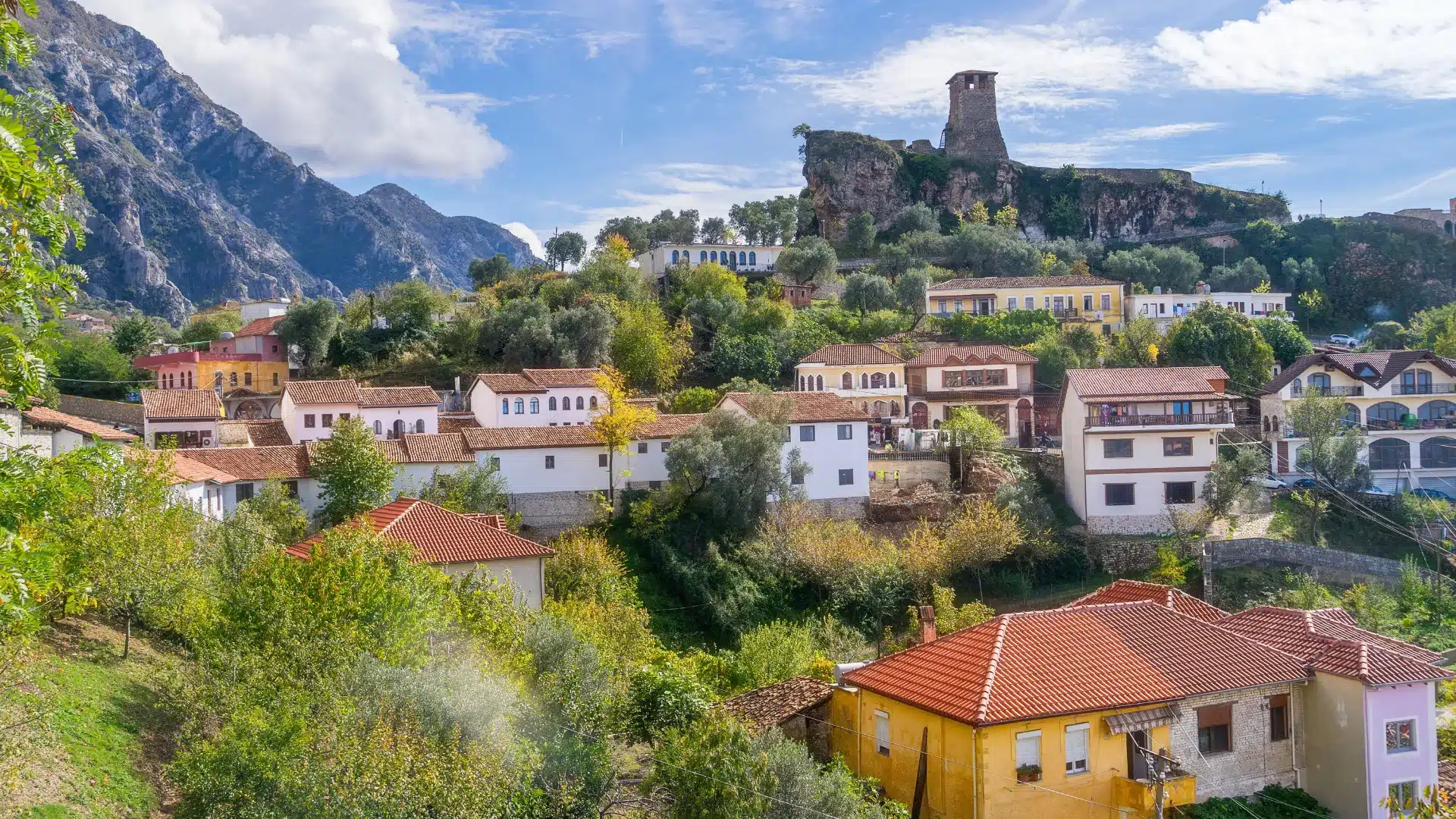
Berat, the town of a thousand windows, stacks white Ottoman houses up a hillside beneath a still-inhabited castle. Gjirokastër is a stone town of slate roofs and fortified houses in the southern mountains. Butrint is an archaeological site running from Greek through Roman, Byzantine and Venetian occupation, set in a lagoon and forest landscape. All three carry UNESCO World Heritage designation.
They photograph exceptionally and they are not ordinary locations. Details are in the heritage section below, but the short version is that heritage authorisation runs alongside the municipal permit, conditions attach to rigging, vehicles, crew numbers and any physical intervention, and lead times are longer. A production that adds Berat to the schedule late, having budgeted for a street permit, will find the timeline is the problem rather than the fee.
Filming in the Albanian Alps and the Vjosa
The north is where Albania stops resembling anywhere else in the Mediterranean. Theth and Valbona sit in glacial valleys in the Accursed Mountains, connected by a walking pass and reached by mountain road or by the Lake Koman ferry — a three-hour passage through a flooded canyon that is itself one of the most cinematic journeys in Europe.
Shkodër is the northern base, with its lake, castle and Ottoman-era centre. Further south, the Vjosa became Europe’s first Wild River National Park, protecting one of the last major undammed rivers on the continent — a significant subject for environmental documentary and a distinctive landscape for anything else.
These locations need genuine logistical planning. Roads are single-track and seasonal, the Koman ferry has payload and vehicle limits that dictate what equipment can come, accommodation in the valleys is guesthouse-scale, and medical evacuation times are long. Protected-area authorisation applies across the national parks and the Vjosa.
Filming at Heritage and Protected Sites in Albania
Some of Albania’s strongest visual assets are protected sites, and they do not work like ordinary locations. Butrint, and the historic centres of Berat and Gjirokastër, carry heritage designation, which means filming there involves an approval layer beyond the municipal permit.
Heritage filming typically requires authorisation from the National Institute of Cultural Heritage in addition to the film permit, and conditions attach: restrictions on rigging, on vehicle access within the site, on crew numbers, on lighting, and on any physical intervention with the historic fabric. Nothing gets fixed to a wall. Nothing gets moved. Cabling routes are agreed in advance.
Drone flights over heritage sites are treated separately again, and may be refused where the aviation position would otherwise permit them. The same applies inside the national parks and the Vjosa Wild River National Park, where the National Agency of Protected Areas governs access and aerial activity independently of the AAC.
Lead times are the real constraint. A municipal street permit might take a week; a heritage authorisation for the Berat castle quarter needs several. Hoodlum coordinates heritage and protected-area authorisations alongside the municipal permit and drone approval, and advises early on whether a heritage site is realistic for the shoot window or whether a comparable unprotected location will deliver the same shot.
Crew Visas and Entry Requirements for Albania
Albania is not in the Schengen Area, and this is worth stating plainly because a great deal of published guidance gets it wrong. Schengen visa rules do not govern Albanian entry, and Schengen-focused advice — including from commercial visa-service websites that rank well in search — does not apply here.
Entry itself is straightforward for most crews. Nationals of the EU, UK, US, Canada, Australia and many other countries enter visa-free for short stays, typically up to 90 days within a 180-day period. Albania also periodically extends seasonal or unilateral visa-free entry to additional nationalities, so the position moves and should be confirmed close to travel rather than assumed from a previous shoot.
Visa-free entry covers arrival and preparatory work. It is not automatic authorisation for paid production work — longer engagements, employment-based roles and extended stays require the appropriate visa or residence route, depending on nationality, duration and activity. Where a visa is required, applications go directly to Albanian embassies and consulates; there is no e-visa portal for film crew.
Crew should travel with a letter from the production company confirming role, dates and purpose, along with the local partner’s details, the shooting schedule and the crew list. Consular and visa guidance is published by the Ministry for Europe and Foreign Affairs.
Hoodlum confirms the current position per nationality, prepares the supporting production documentation and makes sure the entry route matches what the crew are actually doing.
Film Permits and Location Permissions in Albania
There is no single national filming permit in Albania. QKK — the Albanian National Center of Cinematography — is the national film body, administers the rebate and is the right first point of contact, but it does not issue the permissions themselves. Those come from the relevant local and site authorities.
Municipalities handle public space, streets, squares, road use and parking, with Tirana, Durrës, Berat, Gjirokastër, Shkodër and Vlorë each running their own procedures. The National Institute of Cultural Heritage covers protected monuments and historic centres. The National Agency of Protected Areas covers national parks, Butrint, Llogara, Theth, Valbona and the Vjosa. The AAC covers aerial work. Traffic police handle road closures and vehicle work. Private owners and venue management handle their own properties.
Applications generally require a project synopsis, production and Albanian partner details, shooting schedule, exact location list, crew list, equipment and vehicle lists, insurance, and traffic or public-space plans where relevant. Municipal permits for straightforward requests often come through in one to two weeks. Heritage sites, protected areas, road closures and public-space occupation in historic centres take longer, and a location involving several authorities takes as long as its slowest one.
Private permission covers the property and nothing more. It does not replace municipal consent, heritage authorisation, protected-area approval or road permission the location separately requires. Hoodlum maps the full permission stack per location before the schedule locks, which is when changing it is still cheap.
Drone Filming and Aviation Rules in Albania
Aerial operations are regulated by the Albanian Civil Aviation Authority. Professional drone filming requires prior authorisation, and that authorisation is location-specific rather than general — approval for one shoot does not carry to the next.
Allow two to three weeks for a standard authorisation, longer for Tirana’s urban centre, heritage zones, protected areas and anything near controlled airspace. Restricted areas include airports and their surrounds, government and military installations, strategic infrastructure, border regions, protected areas and heritage sites.
Two things productions consistently get wrong here. First, permission to film is not permission to fly — the AAC authorisation is a separate process from the municipal permit, and neither implies the other. Second, aviation approval is not the whole story: the National Institute of Cultural Heritage governs flights over heritage sites and the National Agency of Protected Areas governs flights over national parks, and both can refuse where the aviation position would otherwise allow.
Drones travel on the equipment manifest with everything else, declared by make, model, serial number and specification under the carnet documentation.
Equipment Customs Clearance and the ATA Carnet in Albania
Albania accepts ATA Carnets, which makes temporary equipment importation relatively clean for productions that prepare properly. A carnet allows professional filming gear to be temporarily imported duty-free and tax-free on the guarantee that it will be re-exported within the validity period, typically up to one year.
The point that catches productions out: the carnet is issued in the country the equipment travels from, by that country’s national guaranteeing association — not on arrival in Albania. A UK production applies through the London Chamber of Commerce, a US production through USCIB, a South African production through SACCI. The Albanian Chamber of Commerce and Industry is Albania’s own guaranteeing association, which matters for equipment leaving Albania rather than for a foreign crew arriving with a carnet already in hand.
A detailed equipment list with make, model, serial numbers, quantities, declared values and country of origin is essential and must match the carnet exactly. Radio, satellite and drone equipment should be flagged early rather than discovered at inspection.
On arrival, the carnet and equipment are presented to the Albanian Customs Administration for stamping, and again on departure, with everything re-exported in the same configuration. Stamping is normally efficient where the paperwork is accurate. Build clearance time in before the first critical filming day rather than planning to shoot on landing day.
Hoodlum prepares the equipment documentation, coordinates the customs position with the arrival schedule and advises on what is worth importing against what can be sourced locally.
Albania Film Incentives and Cash Rebate
Albania operates a cash rebate of up to 30% of eligible local spend, administered by QKK, with a minimum local spend typically referenced at around €100,000. Eligible expenditure covers local goods and services, local crew wages and services, equipment and location rentals in Albania, and post-production carried out locally.
The mechanics matter. Application review is required before principal photography begins — this is not a rebate that can be claimed retrospectively, and a production that starts shooting before the application is reviewed has forfeited it. The rebate is paid after approval and verification of expenditure, and availability is subject to the annual programme budget.
Albania’s 30% sits mid-table among European incentives, and several neighbouring territories run comparable or stronger schemes — you can compare them on our film incentives hub. What distinguishes Albania is that the rebate applies on top of a genuinely lower cost base rather than compensating for a high one, which changes the effective value considerably.
One thing worth watching if you’re planning beyond this year. A draft cinema and audiovisual law would raise the rebate to 35%, replace QKK with a new agency called AKKA, and widen eligibility to include series, video games, VR and AR projects, post-production and international co-productions — categories currently outside the scheme. It is not yet in force, so budget against the 30% position, but the direction of travel is clear and it may change the calculation for 2027 shoots.
Hoodlum can help engage a qualifying Albanian partner, structure eligible spend, file before principal photography and confirm the current position at the point of application.
Safety, Security and Practical Logistics in Albania
Albania is a safe and welcoming country to work in, with low serious crime and a straightforward operating environment. The practical risks are logistical rather than security-related.
Standard precautions apply in Tirana and the urban centres, particularly with visible equipment. Beyond that, the planning centres on roads, weather and distance from medical facilities. Mountain roads in the north are single-track and seasonal. The Llogara Pass is spectacular and demanding. The Lake Koman ferry has payload and vehicle limits that dictate the equipment package rather than the other way round. Evacuation times from Theth and Valbona are significant, and satellite or backup communications are sensible for the northern valleys.
Coastal and river work needs water safety planning. Summer heat on the Riviera and in the south affects crew welfare and equipment. Traffic police coordination is required for road closures and vehicle work.
Hoodlum builds route planning, weather contingency, medical access and communications into the schedule before the crew is moving between coast, heritage towns and mountains.
When Albania Is the Right Production Choice
Albania is the right choice when a production needs Mediterranean coastline without the development, intact Ottoman heritage architecture, alpine landscape, distinctive post-communist urban texture and a competitive cost base with a 30% rebate on top — all within short driving distances.
It is especially strong for travel and lifestyle campaigns, documentary and factual work, commercials, period projects, automotive and road-based filming, and outdoor and nature programming.
It may be less suitable for productions needing large studio infrastructure, very deep specialist crew in a single discipline, instant heritage-site access, or a rebate materially higher than 30% today. Those shoots can still work, but they need lead time and realistic expectations about which locations are achievable in the window.
Common Production Mistakes to Avoid in Albania
- Applying Schengen visa rules to Albanian entry — Albania is not in the Schengen Area
- Assuming visa-free entry authorises paid production work
- Treating QKK as the issuer of every permit, when permissions are local and site-specific
- Treating Berat, Gjirokastër and Butrint as ordinary street locations
- Adding a heritage site to the schedule late, having budgeted only for a municipal permit
- Assuming a filming permit includes drone permission
- Assuming AAC approval covers heritage and protected-area flights
- Applying for the rebate after principal photography has started
- Building a northern mountain schedule without checking Koman ferry payload limits
- Underestimating seasonal road access in the Alps
- Booking Riviera locations in peak August without accounting for tourism density
- Arriving with a carnet that doesn’t match the equipment list exactly
How Hoodlum Supports Productions in Albania
Hoodlum provides Film Production Services in Albania for international crews needing experienced local coordination from early planning through wrap. Our support covers QKK liaison, municipal permits, heritage and protected-area authorisations, visa and crew documentation, private location agreements, AAC drone coordination, ATA Carnet customs planning, local fixers and crew sourcing, transport and route planning, accommodation, security and risk planning, rebate registration and full on-ground production management.
From Tirana’s layered urban contrast to the Riviera’s coastline, the Ottoman stone of Berat and Gjirokastër, the archaeology of Butrint and the glacial valleys of Theth and Valbona, we help productions reach the strongest locations in Albania with the permits, fixers, customs planning and logistics already in place. Planning a shoot? Contact us to talk through permits, visas, local fixers, location scouting, heritage access, customs coordination, drone planning and rebate support.
Frequently Asked Questions
Do international crews need a visa to film in Albania?
Albania is not in the Schengen Area and runs its own entry regime. Nationals of the EU, UK, US, Canada, Australia and many other countries enter visa-free for short stays, typically 90 days within 180. That covers arrival and prep but is not automatic authorisation for paid production work. Confirm the position per nationality close to travel — Albania periodically extends seasonal visa-free entry to additional countries.
Is Albania in the Schengen Area?
No. Schengen visa rules and Schengen-focused guidance do not govern Albanian entry. A great deal of published advice gets this wrong, including commercial visa-service sites that rank well in search — use the Ministry for Europe and Foreign Affairs as the reference.
Who issues filming permits in Albania?
There is no single national permit. QKK is the national film body and the right first contact, but permissions are issued locally: municipalities for public space, the National Institute of Cultural Heritage for protected monuments and historic centres, the National Agency of Protected Areas for national parks, the AAC for aerial work, and traffic police for road closures.
Can productions film at Butrint, Berat and Gjirokastër?
Yes, and they are among Albania’s strongest locations, but all three carry UNESCO World Heritage designation. Filming requires heritage authorisation alongside the municipal permit, with conditions on rigging, vehicle access, crew numbers, lighting and any intervention with the historic fabric. Lead times are longer than for standard street permits — plan several weeks, not one.
Is Albania an ATA Carnet country?
Yes. Albania accepts ATA Carnets for temporary duty-free import of professional filming equipment. The carnet is issued by the guaranteeing association in the country the gear travels from, not on arrival — the Albanian Chamber of Commerce and Industry is Albania’s own guaranteeing body, relevant for equipment leaving Albania.
Can foreign productions fly drones in Albania?
Yes, with prior authorisation from the Albanian Civil Aviation Authority. Approval is location-specific and does not carry between shoots. Allow two to three weeks, longer for urban Tirana, heritage zones and protected areas. A filming permit does not include permission to fly, and AAC approval does not cover heritage or protected-area flights, which are governed separately and can be refused.
What film rebate does Albania offer?
A cash rebate of up to 30% of eligible local spend, administered by QKK, with a minimum local spend around €100,000. Application review is required before principal photography begins — it cannot be claimed retrospectively. A draft law would raise it to 35% and widen eligibility to series, video games and VR, but is not yet in force. Compare territories on our film incentives hub.
When is the best time to film in Albania?
Late spring, early summer and early autumn give the strongest combination of light, temperature and access. July and August bring heat and heavy tourism on the Riviera. Winter closes or complicates mountain roads in the north, though it delivers snow and atmosphere for anything that wants it.
Useful Authority Links
- QKK – Albanian National Center of Cinematography
- Ministry for Europe and Foreign Affairs – Consular Services
- Albanian Civil Aviation Authority (AAC)
- Albanian Chamber of Commerce and Industry
- ICC – ATA Carnet
- Municipality of Tirana
Ready to bring your production to Albania? Hoodlum handles the permits, visa guidance, heritage and protected-area access, location scouting, carnet and customs coordination, drone planning, local crew, rebate registration and full on-ground production management. Get in touch with our team to start planning.
For more information, view our Hoodlum Film Fixers Albania Google Business Profile.