
















Film Production Services in Belgium
Belgium is one of Europe’s most underrated filming destinations, packing medieval old towns, grand civic squares, contemporary cities, canals, coastline and a deep co-production and post-production industry into a small, exceptionally well-connected country. From the storybook canals of Bruges and the guild houses of Ghent to the Art Nouveau facades and European-institution architecture of Brussels and the port energy of Antwerp, few places offer such a range of looks within such short travel distances, and fewer still pair it with a sophisticated financing ecosystem.
For international crews, Belgium offers a rare blend of creative variety, strong infrastructure and one of Europe’s most powerful financing tools. A production can base in Brussels, draw on local crew, studios, suppliers and a renowned VFX and post-production sector, then move quickly to a historic Flemish town, a Walloon landscape or the North Sea coast depending on the creative direction. As a member of the European Union and the Schengen Area, the country combines straightforward access for many nationalities with a mature, film-friendly administrative culture.
Hoodlum provides Film Production Services in Belgium for documentaries, commercials, factual entertainment, branded content, music videos, photography campaigns, feature films and television drama. Our team supports visa and accreditation guidance, filming permits, location agreements, drone planning, customs and carnet clearance, local crew sourcing, transport, security planning and full on-ground production management. You can see the full scope of what we do and the people behind it on our who we are page.
Belgium rewards productions that arrive with their paperwork in order. It is a welcoming, well-organised country for film, but it is not a destination for informal, undocumented shooting by foreign crews. The right immigration route, the right permits and the right equipment-clearance plan all need to be settled before the cameras roll, and the most efficient way to handle that is through an experienced local production partner.
Why Belgium Works for Locations, Crew and Financing
The country’s biggest production strength is the combination of distinct, usable environments within tiny travel distances and a financing system built specifically to attract audiovisual work. In a single schedule a production can capture a perfectly preserved medieval canal town, a grand baroque market square, a sleek modern business district, an industrial dockside and a windswept stretch of coast, often within an hour or two of each other. That compactness keeps travel days down and shooting days up.
Brussels is the operational heart, but the value sits in the route and in the money. A drama might pair a Brussels Art Nouveau interior with the canals of Bruges and the harbour at Antwerp. A commercial might combine a contemporary cityscape, a historic square and a coastal dune in a single tight schedule. A feature might shoot principal photography elsewhere in Europe and bring its post-production and visual effects to Belgium to access the financing. The country is strong because it can stand in for many European settings at once, while offering a structured way to fund part of the work.
The country is especially well suited to:
- Feature films and high-end television drama
- Period and heritage productions
- Commercials and branded content
- Documentary and factual series
- Animation and visual-effects-heavy projects
- Music videos and live performance capture
- Fashion and photography campaigns
- Co-productions seeking European financing
- Travel and tourism content
Hoodlum’s production support team helps crews decide which regions and cities are practical, what permissions each location needs and how to sequence movement between Flanders, Wallonia, Brussels and the coast.
Brussels as the Production Base
Brussels is the natural anchor for most international productions working in Belgium. It is where crews usually arrive, where the major equipment houses, post facilities and production partners are concentrated, and where most immigration, permit and financing coordination begins. As the de facto capital of the European Union, it is also exceptionally well connected by air and high-speed rail.
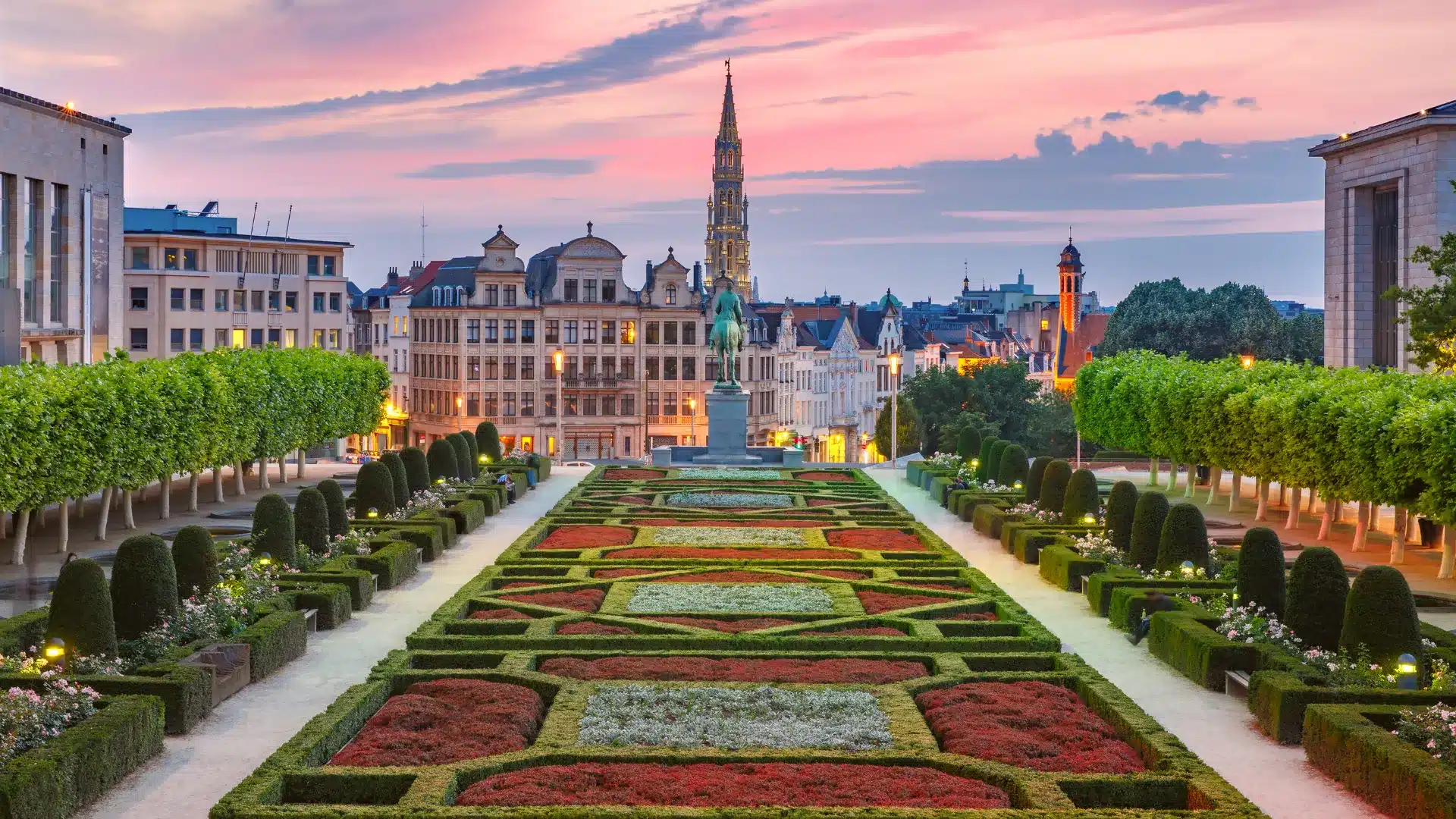
The city itself is an enormous resource. It offers the grandeur of the Grand-Place, world-class Art Nouveau architecture, the European-institution quarter, elegant townhouses, parks, markets, contemporary districts and the kind of anonymous modern streets that double for many European capitals. With the right approvals, productions can shoot across the city’s varied neighbourhoods and landmark squares.
Brussels also matters logistically. Crew accommodation, vehicle hire, fixers, customs agents, drone operators, security planning and medical support are all easiest to coordinate from the capital. Hoodlum uses Brussels as the practical hub for Film Production Services in Belgium, particularly when a shoot needs to travel out to the historic towns, the regions or the coast.
Bruges, Ghent and Historic Flanders
The historic cities of Flanders are among the country’s strongest visual assets. Bruges offers an almost perfectly preserved medieval core of canals, cobbled lanes, bell towers and step-gabled houses that has become shorthand for storybook Europe. Ghent adds grand guild houses, a riverside old town and a castle, while Antwerp brings a magnificent station, a diamond and fashion district, a working port and bold contemporary architecture.
These cities suit period drama, romance, heritage productions, commercials and travel content that needs authentic European texture. Filming around protected historic centres and popular tourist destinations calls for careful timing, permit coordination and crowd management. Hoodlum handles the local permissions, access and logistics so the picturesque location becomes a workable filming day rather than a crowd-management headache.
Wallonia, the Ardennes and the Countryside
Southern Belgium offers a completely different register. Wallonia delivers rolling countryside, forests, rivers, castles, citadels and the wooded hills of the Ardennes, along with post-industrial towns and landscapes that suit grittier or more rural stories. Cities such as Liège and Namur add their own character, and the region’s funds actively support productions that shoot there.
This range means productions can match almost any creative brief without long transfers, from gritty drama to period romance to natural-history and outdoor content. Hoodlum helps productions plan these regions as distinct shooting environments, each with its own access, permit and logistics considerations, rather than as simple add-ons to a Brussels schedule.
The Coast and the North Sea
The country’s North Sea coastline adds wide beaches, dunes, promenades, piers and the faded grandeur of seaside resorts such as Ostend. The coast works well for lifestyle and fashion shoots, atmospheric drama, commercials and documentary sequences that need open sky, sea and a distinctive Northern European light.
Coastal filming should account for tides, wind, weather and seasonal crowds, as well as any local beach and promenade permissions. Hoodlum helps productions plan the coast as its own production environment, with the right access, timing and contingency built in.
Entry, Visas and Crew Accreditation
As an EU and Schengen member, the country offers straightforward access for many nationalities, but the right route still depends on each crew member’s nationality, role and length of stay.
Citizens of the EU, EEA and Switzerland may enter and work freely. Citizens of many other countries may enter visa-free for up to 90 days within any 180-day period under Schengen rules, while nationals of visa-required countries must obtain a short-stay Schengen visa, often described for professional travel as a Type C visa, in advance. Schengen visa applications are typically processed in around 15 calendar days, though they can take up to 30, so crews should apply at least three to four weeks before travel.
Applicants should travel with supporting production documentation, including an invitation letter, proof of employment and qualifications, a flight itinerary and accommodation details, travel medical insurance meeting the Schengen minimum cover, and proof of financial means. For paid work and longer engagements, additional work authorisation may apply and is best arranged through the local production partner. Hoodlum helps productions match each crew member to the correct route, keep the documentation and crew list aligned, and avoid immigration becoming a late-stage problem.
Filming Permits and Location Permissions
There is no single national film permit covering the whole of Belgium. Instead, filming permissions are coordinated location by location, and because the country is federal, the relevant bodies vary by region and city, which makes local knowledge essential.
Permits are typically handled through regional film commissions and local authorities, with city film offices in places such as Brussels, Bruges, Ghent and Antwerp managing public-space filming in their own territories. Applications generally require a valid passport and visa where applicable, proof of insurance, proof of financing, a script or storyboard and a detailed shooting schedule, with straightforward permits often clearing in around five to ten working days. Fees vary with location, production type and duration.
Private locations, from historic buildings and homes to hotels, businesses and private roads, are negotiated directly with owners or managers. A Hoodlum location scout can propose suitable options, after which we negotiate access, dates, crew size, vehicle movement, fees and reinstatement terms, and secure a standard location agreement. Private permission does not replace any municipal or public-space approvals that a location also requires, and fees are quoted once the locations are confirmed.
Drone Filming and Aviation Rules
Drone operation is regulated by the Belgian Civil Aviation Authority within the harmonised EU drone framework. Commercial film work generally requires operator registration, pilot competence appropriate to the operation, adequate liability insurance and, depending on the risk category and location, specific authorisation. Flights near airports, over populated areas, in controlled airspace or near sensitive sites attract additional restrictions and approvals, and Brussels in particular has tightly managed airspace.
Applications typically require proof of liability insurance, drone registration documents, a detailed flight plan and a certificate of remote-pilot competence, with processing often taking around one to two weeks. Importing a drone means meeting customs and product-compliance requirements as well, including CE marking and declarations of conformity.
For incoming productions, the most practical route is often to engage a locally licensed drone operator who already holds the right registration, qualifications, insurance and familiarity with Belgian and EU airspace rules. Importing your own drone is possible but adds customs and compliance steps. Hoodlum helps productions decide between a local operator and importing equipment, and builds the necessary lead time into the plan.
Equipment Customs Clearance and the ATA Carnet
The country is an ATA Carnet country, which makes temporary equipment importation relatively straightforward for productions that prepare properly. An ATA Carnet acts as a single international customs document allowing professional filming gear to be temporarily imported duty-free and tax-free, on the guarantee that it will be re-exported within the validity period, typically up to one year.
Customs clearance is handled by Belgian Customs, and a clean carnet supported by a detailed equipment list, accurate values and serial numbers usually moves through quickly, often within a few hours. Costs are modest relative to the value of a typical equipment package. For crews travelling within the EU, goods in free circulation move without carnet formalities, so the carnet primarily matters for kit arriving from outside the Union.
Hoodlum helps productions prepare the equipment list, values, carnet documentation and clearing-agent coordination so cameras, lighting, grip and sound gear move through the airport or border with minimal delay.
The Tax Shelter and Regional Funds
Belgium’s headline incentive is the federal Tax Shelter, one of Europe’s most established audiovisual financing tools, but it works very differently from a simple cash rebate. Rather than paying a fixed percentage back to the production, it allows Belgian companies to invest part of their taxable profits in eligible audiovisual works in exchange for a tax benefit, channelling that investment into the production. In practice, a certified Belgian producer can raise financing worth a substantial share of the Belgian-eligible spend, with figures of up to roughly 42% of qualifying Belgian expenditure commonly cited.
The system is administered through the Federal Public Service Finance, and it is open to Belgian productions and to qualifying European and international co-productions with Belgium. Because access runs through a Belgian co-producer and accredited intermediaries, and because spend must be structured to meet Belgian and European Economic Area requirements, the Tax Shelter is powerful but procedurally complex, and it generally rewards productions that engage a local co-production partner early.
Alongside the federal mechanism, three regional funds add a second financing layer: Screen Flanders in the north, Wallimage in Wallonia, and Screen Brussels in the capital. These are selective, economy-focused funds that support projects spending in their respective regions. The exact rates, caps, thresholds and conditions are detailed and change periodically, so productions should take specialist advice and confirm current figures before locking a budget. Hoodlum can help connect productions with the right local co-production and advisory partners to navigate the system.
Safety, Security and Practical Logistics
The country is generally considered a very safe and film-friendly destination, with strong infrastructure, a skilled multilingual workforce and welcoming local communities. The risk profile is low in most settings, but it still varies with location, subject matter, public exposure and crew footprint.
Controlled and private environments usually need little or no security. Busy public filming, high-profile landmarks, large crowd scenes or sensitive subjects may call for professional film-production security, equipment-protection measures and coordination with local authorities. Thorough location scouting to identify and plan around risks, and sensible measures to secure vehicles and equipment, are the practical foundations of a smooth shoot.
Weather and daylight are the practical variables that most affect a schedule. Belgian weather is changeable and often wet, winter daylight is short, and the coast can be exposed, so contingency planning matters. Medical infrastructure is excellent and no special vaccinations are required for entry. Hoodlum helps productions balance sensible security with efficient movement, and builds weather, daylight and contingency thinking into the schedule from the start.
When Belgium Is the Right Production Choice
The country is the right choice when a production needs a combination of medieval and historic European looks, contemporary cities, a powerful co-production financing system and a compact, exceptionally well-connected geography at the heart of Europe. It is especially strong for feature films, high-end drama, period and heritage productions, animation and VFX-heavy work, commercials, documentary, fashion and travel content, and any project seeking European co-production financing.
It may be less suitable for productions that want a simple, automatic cash rebate with minimal structuring, or that expect to arrive and shoot informally without permits or planning. The country is highly workable when the immigration route, filming permissions, drone arrangements, carnet, financing structure and location agreements are settled early.
Common Production Mistakes to Avoid
The most frequent mistakes include:
- Treating the Tax Shelter as a simple cash rebate rather than a co-production financing mechanism
- Engaging a Belgian co-production partner too late to structure the financing
- Assuming visa-free Schengen entry covers paid crew work for non-EU nationals
- Underestimating permit coordination across Belgium’s federal regions and cities
- Treating popular historic centres as easy to shoot without timing and crowd planning
- Underestimating drone authorisation timelines and Brussels airspace restrictions
- Arriving with non-EU equipment before carnet preparation is complete
- Underestimating how much changeable weather and short winter daylight can compress a schedule
Most of these problems are avoidable by aligning the crew list, accreditation, filming permits, drone plan, carnet, financing structure and location agreements well before the crew travels.
How Hoodlum Supports Productions in Belgium
Hoodlum provides Film Production Services in Belgium for international crews that need experienced local coordination from early planning through to wrap. Our support covers immigration and accreditation guidance, filming permits and location permissions, private location agreements, studio and regional coordination, drone planning, carnet and customs preparation, clearing-agent coordination, local crew sourcing, transport, accommodation, security planning and on-ground production management, plus introductions to the right co-production and financing partners.
From Brussels and the studios to Bruges, Ghent and Antwerp, the Ardennes and Wallonia, and the North Sea coast, we help productions access the strongest filming environments in Belgium with the right permits, fixers, customs planning and logistics in place. Planning a shoot? Contact us to talk through permits, accreditation support, local fixers, location scouting, carnet planning, drone coordination and full on-ground production management.
Frequently Asked Questions
Do international crews need a visa to film in Belgium?
It depends on nationality, role and length of stay. EU, EEA and Swiss citizens may work freely, and many other nationals can enter visa-free for up to 90 days within 180 under Schengen rules. Visa-required nationals need a short-stay Schengen visa, applied for at least three to four weeks ahead, and paid work may require additional authorisation arranged through the local production company.
Who issues filming permits?
There is no single national permit. Because the country is federal, permits are coordinated through regional film commissions, city film offices and local authorities depending on the location, with straightforward permits often clearing in around five to ten working days.
Who regulates drones?
The Belgian Civil Aviation Authority regulates drone operation within the EU framework. Commercial work needs operator registration, appropriate pilot competence, liability insurance and, depending on the operation and location, specific authorisation. Using a locally licensed operator is usually the most practical route.
Is Belgium an ATA Carnet country?
Yes. Temporary importation of professional filming equipment from outside the EU is handled cleanly through the ATA Carnet system, with clearance via Belgian Customs.
How does the Belgian incentive work?
Belgium’s federal Tax Shelter is an investment-based financing mechanism rather than a cash rebate: Belgian companies invest in eligible audiovisual works in exchange for a tax benefit, channelling financing worth a substantial share of Belgian-eligible spend into the production. It is accessed through a Belgian co-producer, and regional funds in Flanders, Wallonia and Brussels add further support. Engage a local partner early.
What are the best filming locations?
Popular options include Brussels and its studios, the medieval canals of Bruges, the historic centre of Ghent, the port and architecture of Antwerp, the castles and forests of Wallonia and the Ardennes, cities such as Liège and Namur, and the North Sea coast around Ostend.
Useful Authority Links
- Belgium Visa on Web – Visa Applications
- FPS Finance – Tax Shelter for Audiovisual Production
- Belgian Civil Aviation Authority – Drones
- Screen Flanders
- Centre du Cinéma et de l’Audiovisuel (CCA)
- Belgian Customs – FPS Finance
Planning a shoot in Belgium? Contact Hoodlum for Screen Brussels, Screen Flanders and Wallimage coordination, municipal filming permits, local fixers, EU institution location coordination, private location agreements, ATA Carnet customs planning, drone coordination, multilingual crew sourcing, urban logistics and full on-ground production management. You can also view the Hoodlum Film Fixers Belgium Google Business Profile for local production details.