
















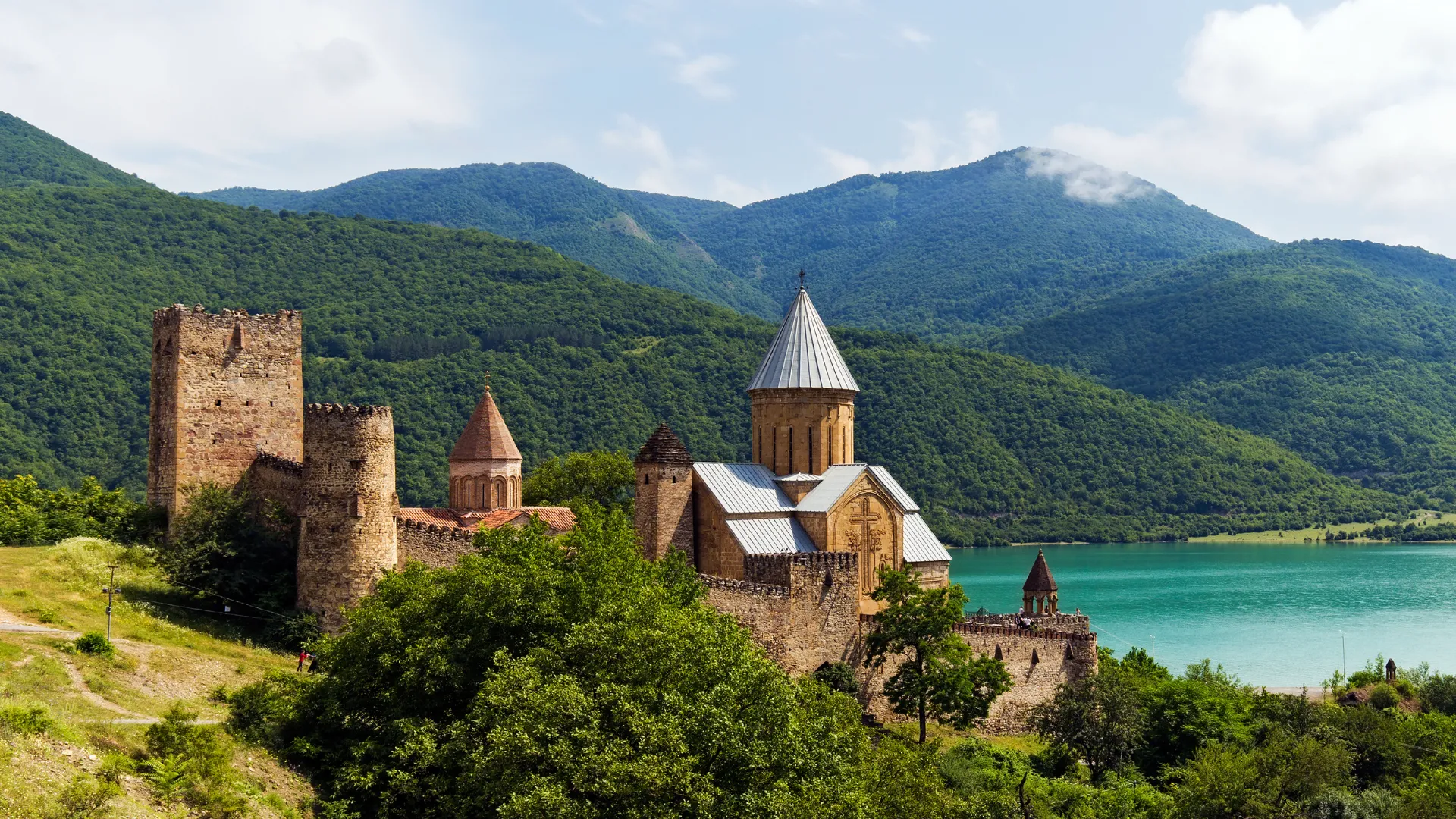
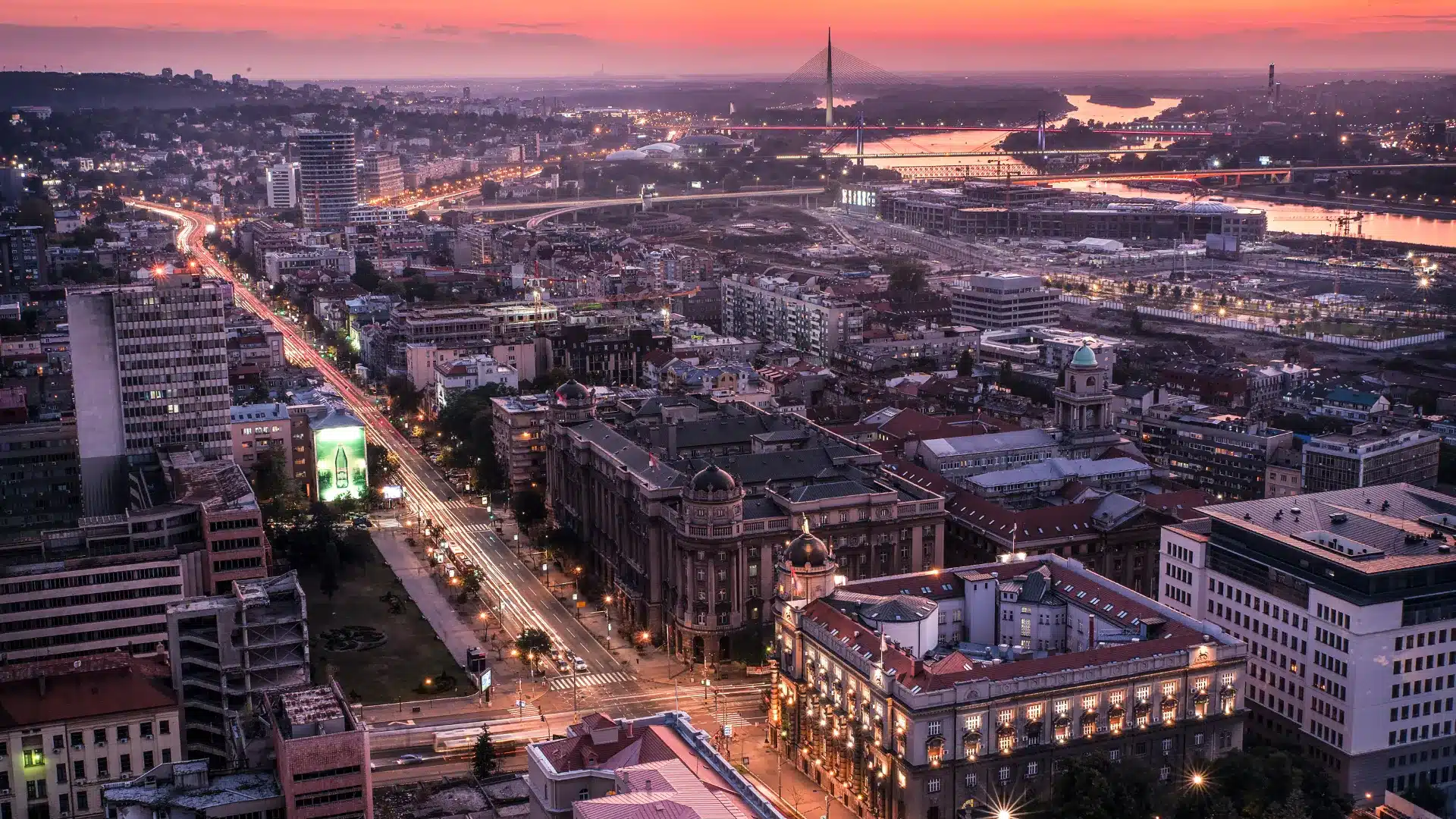
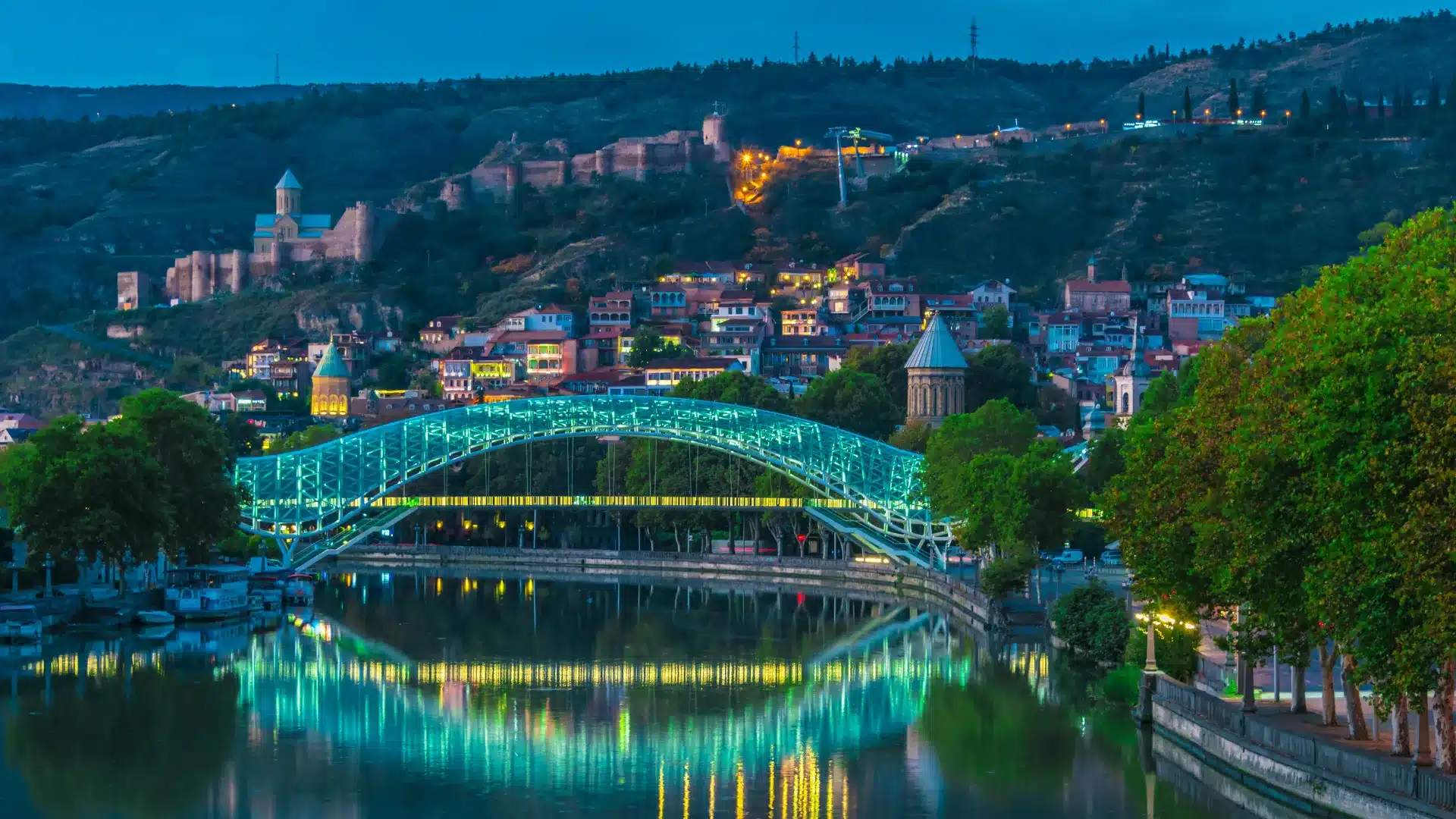
The Republic of Georgia — the South Caucasus country, not the US state — has become one of Eastern Europe’s most practical filming destinations. It offers alpine mountains, semi-desert, Black Sea coast, forest, vineyards, Soviet-era industrial architecture and a medieval capital, often within a few hours’ drive of each other. The national investment agency counts six climate zones. Costs are low, crews are capable, permits are fast by regional standards, and a 20–25% cash rebate is available on qualified local spend.
Hoodlum provides film fixing and on-ground production support across Georgia for documentary, factual television, commercial, branded, travel, automotive, adventure, lifestyle, reality and drama-support productions. We handle local production partner coordination, film and location permits, crew sourcing, drone permissions, equipment customs under the national temporary importation procedure, transport, accommodation, police liaison, rebate guidance and full on-ground production management. You can see our full scope on the what we do page and the team behind it on who we are.
Georgia is genuinely film-friendly, but 2026 changed the compliance picture in two ways that matter. Health and accident insurance became mandatory for all foreign visitors in January, and a work authorisation regime came into force in March that means a visa alone is no longer a legal basis for paid work. Both need settling before crew travel, and both are handled through the local production partner. Things remain efficient — they just require more front-loaded structure than a year ago.
Why Georgia Works for International Productions
The case rests on range, cost and speed.
Range. City streets and modern architecture in Tbilisi, Soviet-era infrastructure, mountain roads through Kazbegi and Svaneti, rural villages, Kakheti vineyards, hilltop monasteries, Black Sea coast at Batumi, semi-desert at David Gareja, forest and protected landscape. Within a compact production geography, a schedule can cover looks that would need three countries elsewhere.
Cost. Crew, talent, location fees, transport and accommodation are materially cheaper than Western Europe. Private location fees commonly sit in the USD 100–800 per day range, and many public locations carry little or no fee.
Speed. Simple public-space permits in the capital can turn around in 24 to 48 hours. That is unusually fast, and it makes the country viable for documentary and factual work operating on short lead times.
The rebate. A 20–25% cash rebate on qualified local spend, with a clearly published five-point Cultural Test for the uplift.
Tbilisi is the production base. It holds the crew, suppliers, equipment houses, production offices, transport, customs support and government-facing relationships, and everything else is reachable from it.
The territory suits documentary, factual, commercial, branded content, travel, automotive, adventure, lifestyle, reality, music video and drama-support work particularly well.
Crew Entry, Visas and the 2026 Work Authorisation Change
Citizens of more than 95 countries — including the US, UK, Canada, Australia, Japan and all EU states — enter visa-free for up to 365 days. EU and Swiss nationals may travel on national ID cards. Holders of a valid US, UK, Schengen or GCC visa or residence permit can generally enter visa-free for 90 days regardless of passport nationality. Everyone else applies through the official e-Visa portal at evisa.gov.ge.
Two things changed in 2026 and both apply to every production.
Insurance became mandatory in January. All foreign travellers must hold valid health and accident insurance for the duration of their stay, with minimum cover of 30,000 GEL, roughly USD 11,000. Border control may ask for evidence on arrival. Build it into the crew travel package rather than leaving it to individuals.
Work authorisation came into force on 1 March. Amendments to the Law on Labour Migration introduced the country’s first work permit regime. Foreign nationals without permanent residence who carry out compensated work, self-employment or entrepreneurial activity now require authorisation from the State Employment Promotion Agency. A visa or visa-free entry is no longer a standalone basis for paid work, and the penalty for getting it wrong — 2,000 GEL for a first offence — falls on both the individual and the engaging company.
Subsequent legislation introduced exemptions and a category of short-term professional activity, and accredited foreign journalists are separately exempt. Whether a particular crew falls inside or outside the requirement depends on engagement length, who is paying and the nature of the work. This is not something to assume. Hoodlum confirms the position for each production with local counsel and structures the engagement through the local partner accordingly.
Crews should carry a passport valid at least six months, insurance meeting the 30,000 GEL minimum, a production company letter setting out the project, objectives, locations, schedule, crew list and equipment, and an invitation letter from the local production partner.
Film Permits and Location Permissions
Permits are issued by Tbilisi City Hall in the capital and by regional municipalities elsewhere. The Georgian National Film Center runs a Film Commission unit for international producers that recommends local partners, hosts recce visits, facilitates logistics and helps navigate the process — it is the practical route in, even though it is not itself the issuing authority.
Enterprise Georgia is a separate body. It administers the Film in Georgia cash rebate. It does not issue permits, and productions that approach it for permitting will be redirected. Both relationships matter, at different stages.
Applications typically require the permit form, script or treatment, synopsis, production schedule with locations and dates, crew and equipment lists, proof of liability insurance, a site plan, and a police coordination request where street closures or crowds are involved.
| Requirement | Authority | Lead time | Cost |
|---|---|---|---|
| Public space, street, short blocking work (Tbilisi) | Tbilisi City Hall | 24–48 hours | Low |
| Street closure with traffic management | Tbilisi City Hall + police | ~3 days | Rises with footprint |
| Regional and rural locations | Municipal authority | Varies | Varies |
| Heritage buildings | Ministry of Culture | 5–10 working days | On application |
| Cathedrals, monasteries, religious sites | Site authority | Advance application required | By arrangement |
| Protected areas and national parks | Protected area authority | 5–10 working days | On application |
| Commercial drone operation | Civil Aviation Agency (GCAA) | 5–7 working days minimum | Low administrative fees |
| Equipment entry | Revenue Service of Georgia | Same-day accompanied; 1–3 days freight | Nominal declaration fee |
| Crew entry, visa-free nationals | None | Immediate | None |
| Crew entry, e-Visa nationals | Ministry of Foreign Affairs | Around 5–10 working days | Varies by nationality |
Private locations are secured by direct negotiation with owners. Hoodlum scouts options, conducts site visits and technical assessment, negotiates terms and executes a written location agreement covering dates, access hours, permitted areas, fees, insurance, property protection, parking, power, restoration and cancellation. Private permission never replaces a municipal permit or a heritage, religious or protected-area approval the location separately requires.
Tbilisi as the Production Base
Tbilisi holds the country’s crew depth, suppliers, equipment, production companies, fixers, transport, hotels and government-facing coordination. Most productions base there even when the bulk of filming happens elsewhere.
The city supports documentary interviews, commercial and branded work, street scenes, old-town and modern architecture, roads, public spaces, restaurants, offices, rooftops, hotels, industrial locations and private interiors. It is also where permits get prepared, equipment tested, drone plans confirmed and regional travel coordinated.
Public filming in Tbilisi may require municipal permits, police support or traffic coordination depending on footprint. A small documentary crew moves lightly. Larger commercial shoots, vehicle work, crowd scenes, road closures and equipment-heavy setups need formal coordination and more lead time.
Mountain, Rural and Regional Filming
The mountains and regional landscapes are the main draw for adventure, automotive, travel, documentary and expedition work — Kazbegi, Svaneti, the Kakheti wine country, the Black Sea coast, the semi-desert around David Gareja.
Mountain filming needs real planning. Road access, weather, altitude, vehicle specification, communications, drone restrictions and local permissions all affect what a day actually delivers. Weather in the Caucasus turns fast, and roads that are open in the morning may not be in the afternoon. Map distance is a poor guide to travel time.
Regional shoots may involve municipalities, protected area authorities, private owners, local communities or police. Filming near the borders with Abkhazia and South Ossetia requires specific assessment and is generally restricted.
Drone Filming and Aviation Rules
Drone operations are regulated by the Civil Aviation Agency of Georgia, on a framework aligned with EASA and divided into Open, Specific and Certified categories.
All drones above the 250-gram threshold must be registered at uas.gov.ge, and the user registration number must be labelled on the exterior of the aircraft before flight. The core limits are a 120-metre ceiling, unaided visual line of sight at all times, minimum 6 kilometres horizontal separation from any aerodrome, and no flight over structures, crowds, busy intersections or power lines. Restricted, prohibited and dangerous areas require prior authorisation — check airspace.gov.ge before planning any aerial.
Commercial filming generally falls outside the Open category, which means a Specific category operation: a risk assessment with mitigating measures, safety plan, flight details and insurance submitted to the GCAA, and either a declaration against a standard scenario or a full operational authorisation. Allow a minimum of five to seven working days, and considerably more for restricted airspace, heritage sites or non-standard operations.
Drone insurance is not legally mandatory but is strongly recommended, and in practice location owners and permit conditions often require it.
Hoodlum arranges GCAA registration and authorisation, prepares flight plans and coordinates with local operators. Using a Georgian operator who knows the airspace and the site rules is usually the faster route.
Equipment Customs Clearance
Georgia is not an ATA Carnet member country. This is the single most commonly misunderstood fact about filming in Georgia, and getting it wrong costs time and money.
Equipment enters under Georgia’s own temporary importation procedure, administered by the Revenue Service of the Ministry of Finance. Foreign goods may be imported and re-exported in an unaltered state with total or partial exemption from import charges, for a period not exceeding two years. A guarantee may be required depending on the goods, and where a partial duty obligation is assessed, periodic charges may apply monthly for the duration.
Documentation includes a detailed equipment list with make, model, serial number and declared value per item, commercial invoices, packing lists, certificates of origin, proof of temporary importation purpose, proof of production company registration, a return itinerary confirming re-export, and passport copies for the crew responsible for the equipment.
Equipment carried as accompanied baggage is generally cleared same-day at Tbilisi International Airport. Freighted equipment takes one to three working days. Declaration fees are nominal.
Productions travelling from ATA Carnet member countries should still carry their Carnet — Georgian customs may accept it as supporting documentation — but it is not the entry mechanism and should not be budgeted or scheduled as though it were.
Hoodlum prepares the temporary importation documentation and value declarations, coordinates a Georgian customs broker, and liaises with the Revenue Service and the port of entry.
The Film in Georgia Cash Rebate
Enterprise Georgia’s Film in Georgia programme, launched in 2016 as a joint initiative of the Ministry of Economy and Sustainable Development and the Ministry of Culture, offers a 20–25% cash rebate on qualified expenses incurred in Georgia. It has drawn 64 international productions, 56 of them completed, spanning European co-productions, US studio projects and Asian television series.
| Item | Detail |
|---|---|
| Incentive type | Cash rebate |
| Base rate | 20% on qualified Georgian expenses |
| Uplift | Additional 2–5% via a five-point Cultural Test |
| Applicant | Must be registered as a legal entity in Georgia |
| Financing test | At least 50% of total production budget mobilised at application |
| Eligible formats | Feature films, TV films, series and mini-series including pilots, animation, documentaries, commercials, reality shows, music videos |
| Eligible spend | Georgian crew wages, location fees, equipment rental, accommodation, catering, post-production in Georgia, VFX |
| Audit | Independently audited expenditure report, due within one year of the beneficiary certificate |
| Payment | Base 20% within one year of the audit report |
| Uplift window | One year after the base payment |
| Administered by | Enterprise Georgia |
The five Cultural Test criteria, each worth 1%:
- The production is completed and released theatrically or on a major television network, and a “making-of” video showcasing the Georgian shoot is produced
- Georgian citizens are employed in credited key roles: lead actor or director; screenwriter or composer; two supporting actors; or at least three heads of department
- Georgia appears on screen — as an identified location, a story drawn from Georgian literature or history, a UNESCO or listed landmark, or the Georgian flag visible for at least two seconds
- At least 50,000 GEL is spent on post-production services in Georgia
- The finished production is distributed in two or more EU countries, the US, Canada or India; or competes in the main competition of an FIAPF-accredited festival or Sundance; or receives an AMPAS or BAFTA nomination
A line producer can score a project against those five in ten minutes, and three of them cost nothing extra to satisfy on a production that was already shooting in Georgia.
The honest caveat is timing. The programme allows up to a year to file the audited report and up to a further year to reimburse. This is recovery, not cash flow, and it should be modelled that way.
Comparing territories? See our film incentives guide for rates and qualifying rules across every market we cover, and our guide to Eastern Europe film tax incentives for regional context.
Safety, Security and Restricted Areas
Georgia is safe and stable for international productions. Crime rates are low, incidents involving foreigners are rare, and travel advice from the US, UK, Australia and Canada recommends normal precautions rather than advising against travel.
The clear exception is the Russian-occupied regions of Abkhazia and South Ossetia. Do not plan filming in or near them. Russian troops and border guards occupy both, administrative boundary lines are difficult to identify on the ground, and there are risks from crime, unrest and landmines. Entering can result in arrest, imprisonment or a fine. Areas near the Russian and Azerbaijani borders can experience periodic tension, and border-adjacent work requires specific assessment and authority confirmation.
Otherwise, standard practice applies: on-set security for larger productions or busy public locations, secure overnight equipment storage, a maintained equipment manifest, police permits for street closures or crowd management, and local guides for mountain and remote work.
When Georgia Is the Right Production Choice
Georgia is the right call when a project needs strong location variety across short distances, competitive costs, fast permits, mountain and rural access, urban texture, or a workable cash rebate — and when the schedule can accommodate a proper front-loaded compliance process.
It is less suitable for productions needing unrestricted border-area filming, informal drone work near sensitive locations, ATA Carnet-based equipment entry, or crew engagements that cannot be structured around the 2026 work authorisation rules.
Common Georgia Production Mistakes
- Assuming visa-free entry covers paid work. Since March 2026 it does not, and the fine falls on the production and the local partner alike.
- Overlooking the mandatory health and accident insurance introduced in January 2026, and the 30,000 GEL minimum.
- Assuming Georgia is an ATA Carnet country. It is not — equipment enters under the Revenue Service temporary importation procedure.
- Approaching Enterprise Georgia for permits. It administers the rebate; permits come from municipalities, with GNFC coordination.
- Budgeting the rebate as production cash flow rather than post-delivery recovery.
- Leaving heritage, religious and protected-area permits to the last minute, when they run on much longer timelines than city permits.
- Underestimating drone lead times, particularly near airports, borders or heritage sites.
- Planning mountain days off map distance rather than real travel time and weather.
- Planning anything near Abkhazia or South Ossetia without specific local assessment.
How Hoodlum Supports Productions in Georgia
Hoodlum provides fixer-led film production support in Georgia for international crews, from first recce through wrap. Our support covers crew entry and work authorisation guidance, Georgian production partner coordination, GNFC liaison, municipal and regional permits, Ministry of Culture and protected-area applications, police coordination, private location negotiation, local crew sourcing, GCAA drone registration and authorisation, temporary importation and customs clearance through the Revenue Service, transport, accommodation, insurance alignment, rebate guidance and daily production management.
From Tbilisi’s old town to the Kazbegi mountain roads, the Kakheti vineyards and the Black Sea coast, we get productions permitted, documented, mobile and shooting. Contact us with your locations, dates and creative brief, or send through our client brief. You can also see our work and read more on Georgia as a film destination.
Frequently Asked Questions
Which Georgia is this — the country or the US state?
The Republic of Georgia, in the South Caucasus, with Tbilisi as its capital and the Georgian Lari as its currency. It is a separate sovereign country from the US state of Georgia, and it has its own entirely separate film incentive, permitting and aviation regimes.
Do film crews need a visa for Georgia?
Citizens of more than 95 countries, including the US, UK, EU states, Canada, Australia and Japan, enter visa-free for up to 365 days. EU and Swiss nationals may travel on national ID cards. Other nationalities apply through the official e-Visa portal at evisa.gov.ge. Since 1 January 2026, all foreign travellers must also carry health and accident insurance with minimum cover of 30,000 GEL.
Does visa-free entry allow paid filming work in Georgia?
No, not by itself. Since 1 March 2026, foreign nationals without permanent residence who perform compensated work in Georgia require a work authorisation from the State Employment Promotion Agency, and a visa or visa-free entry is no longer a standalone legal basis. Later legislation introduced exemptions and a short-term professional activity category, and accredited foreign journalists are separately exempt, so the correct route depends on the engagement. Confirm it with the Georgian production partner before crew travel — the penalty applies to both the individual and the engaging company.
Who issues film permits in Georgia?
Tbilisi City Hall issues permits in the capital and regional municipalities issue them elsewhere. The Georgian National Film Center runs a Film Commission unit that coordinates for international producers and liaises with authorities. Enterprise Georgia is a separate body that administers the cash rebate and does not issue permits.
How long do film permits take in Georgia?
Simple public space, street and short blocking permits in Tbilisi can often be secured within 24 to 48 hours, and a street closure with traffic management typically needs around three days. Heritage buildings, religious sites and protected areas run on longer timelines and should be allowed five to ten working days or more.
Who regulates drone filming in Georgia?
The Civil Aviation Agency of Georgia, on an EASA-aligned framework of Open, Specific and Certified categories. Drones above 250 grams must be registered at uas.gov.ge with the registration number labelled on the exterior. Limits include a 120-metre ceiling, unaided visual line of sight and 6 kilometres minimum separation from aerodromes.
How long does drone approval take in Georgia?
Allow a minimum of five to seven working days for commercial operational authorisation from the GCAA, and considerably longer for restricted airspace, heritage sites or operations outside standard scenarios.
Is Georgia an ATA Carnet country?
No. Georgia is not an ATA Carnet member. Equipment enters under Georgia’s own temporary importation procedure through the Revenue Service of the Ministry of Finance, which allows import and re-export in an unaltered state with total or partial exemption from import charges for up to two years. Productions from Carnet member countries should still carry their Carnet as supporting documentation, but not rely on it as the entry route.
How long does customs clearance take in Georgia?
Equipment carried as accompanied baggage is generally cleared same-day at Tbilisi International Airport. Freighted equipment takes one to three working days. Declaration fees are nominal.
Does Georgia offer film incentives?
Yes. Enterprise Georgia’s Film in Georgia programme offers a 20–25% cash rebate on qualified Georgian expenses. The base rate is 20%, with an additional 2–5% available through a five-point Cultural Test. The applicant must be a Georgian-registered legal entity with at least 50% of the budget mobilised at application.
How long does the Georgia rebate take to pay out?
The programme allows up to one year from the beneficiary certificate to file the independently audited expenditure report, and up to a further year from that report for Enterprise Georgia to reimburse the base 20%. The Cultural Test uplift follows in the year after. Budget it as recovery, not production cash flow.
Is Georgia safe for filming?
Yes. Georgia is safe and stable, with low crime rates and travel advice from the US, UK, Australia and Canada recommending normal precautions rather than advising against travel. The exception is the Russian-occupied regions of Abkhazia and South Ossetia, which should not be entered, and border-adjacent areas which require specific assessment.
When is the best time to film in Georgia?
May to October gives the most reliable access to mountain roads and the Black Sea coast. Winter works well in Tbilisi and for snow-dependent material, but mountain access can close at short notice and schedules need genuine contingency.
External Authority Links
- Film in Georgia Programme — https://www.enterprisegeorgia.gov.ge/en/business-development/filmingeorgia
- Enterprise Georgia — https://www.enterprisegeorgia.gov.ge/en
- Georgian National Film Center — https://www.gnfc.ge/
- Georgia e-Visa Portal (Ministry of Foreign Affairs) — https://www.evisa.gov.ge/geovisa/en/VisaApp
- Georgian Ministry of Foreign Affairs — https://mfa.gov.ge/en
- Civil Aviation Agency of Georgia — Drone Registration — https://uas.gov.ge/EN
- Georgian Airspace Map — https://airspace.gov.ge
- Revenue Service of Georgia — https://rs.ge/
- Tbilisi City Hall — https://tbilisi.gov.ge
Ready to bring your production to Georgia? Hoodlum handles permits, crew entry and work authorisation guidance, location scouting, customs and temporary importation, GCAA drone authorisation, local producers and crew, security planning, rebate guidance and full on-ground production management. Get in touch with your locations, dates and creative brief.
For more information, view our Hoodlum Film Fixers Georgia Google Business Profile.