
















Filming in Hungary
Hungary is the most sought-after production hub in continental Europe, and it got there by combining three things most markets only manage two of: deep studio infrastructure, crews that have worked at the top of the international market for two decades, and a state-guaranteed rebate that has run continuously since 2004.
Hoodlum provides Film Production Services in Hungary for feature films, television series, commercials, documentaries, branded content, music videos, photography and high-end productions. We handle National Film Office registration and rebate documentation, NFI Location Office permits, private location agreements, work authorisation, drone approvals, ATA Carnet preparation, crew sourcing, transport and on-ground production management.
Budapest can double for Paris, Berlin, Vienna, Moscow or a dozen fictional European capitals. The wider country provides castles, manor houses, villages, forests, lakes, vineyards, industrial sites and open roads. What makes it work commercially is that all of it sits behind one incentive, one permitting office and one crew base.
Hungary’s 30% Film Rebate — and What It Actually Pays
Hungary offers a 30% cash rebate on eligible Hungarian production spend. Because non-Hungarian costs can be included up to 25% of eligible Hungarian spend, the effective return reaches 37.5% measured against Hungarian spend — an additional 7.5 points that most competing schemes have no equivalent for.
The structural facts producers need at budget stage:
- Rate: 30% of eligible Hungarian spend, extendable to an effective 37.5%
- Minimum spend: none
- Per-project cap: none
- Annual allocation: HUF 70 billion for 2026, drawn first-come, first-served from the Collection Account (HUF 69bn in 2024, HUF 81bn in 2025)
- Approved until: end of 2030, under the European Commission approval granted in 2024
- Form: post-financing cash rebate, state-guaranteed through the Collection Account operated by NFI
- Administration fee: 2.5% deducted by NFI
- Payment: typically within 15–30 business days of the rebate settlement resolution
Two bodies are involved and they do different jobs. The National Film Office registers the production, applies the cultural test and conducts the cost-control audit that establishes the final eligible spend. The National Film Institute operates the Collection Account and pays the money out. Correspondence goes to different places depending on which stage you are at.
The 2025 freeze and the July 2026 reopening. A registration cap introduced in 2025 froze new registrations and sent several major projects to other territories. In July 2026 the government removed the cap, and new productions can register without restriction. Any incentive guidance written between mid-2025 and mid-2026 — including material still circulating — reflects the frozen position and is now wrong.
The six-month rule is the one that catches schedules. Under a rule introduced in early 2026, principal photography must begin within six months of the notification of the registration decision. Miss it and the National Film Office may amend or revoke the decision. Registering early to hold a place, then slipping the start date, is now an active risk rather than a free option.
Eligibility caps worth knowing before the budget is locked:
- Non-Hungarian sub-contractor services: capped at 25% of eligible Hungarian spend
- Producers’ fees (line, co-, executive and other): maximum 4%
- Completion bond costs: maximum 5% of budget, capped at HUF 100 million
- Cast and crew remuneration: 100% eligible up to HUF 3 million per person per production; 50% eligible above that
Direct Hungarian production costs include not only goods and services bought from Hungarian suppliers, but part of the remuneration of foreign cast and crew who are liable to Hungarian tax — provided the tax settlement is properly evidenced.
Compare Hungary against other markets on our film incentives hub, or read the detail on the Hungary 30% film rebate.
Budapest as the Core Filming City
Budapest is the most versatile filming capital in Europe, shifting from grand imperial to gritty urban, elegant residential, modern commercial or period European depending on the district.
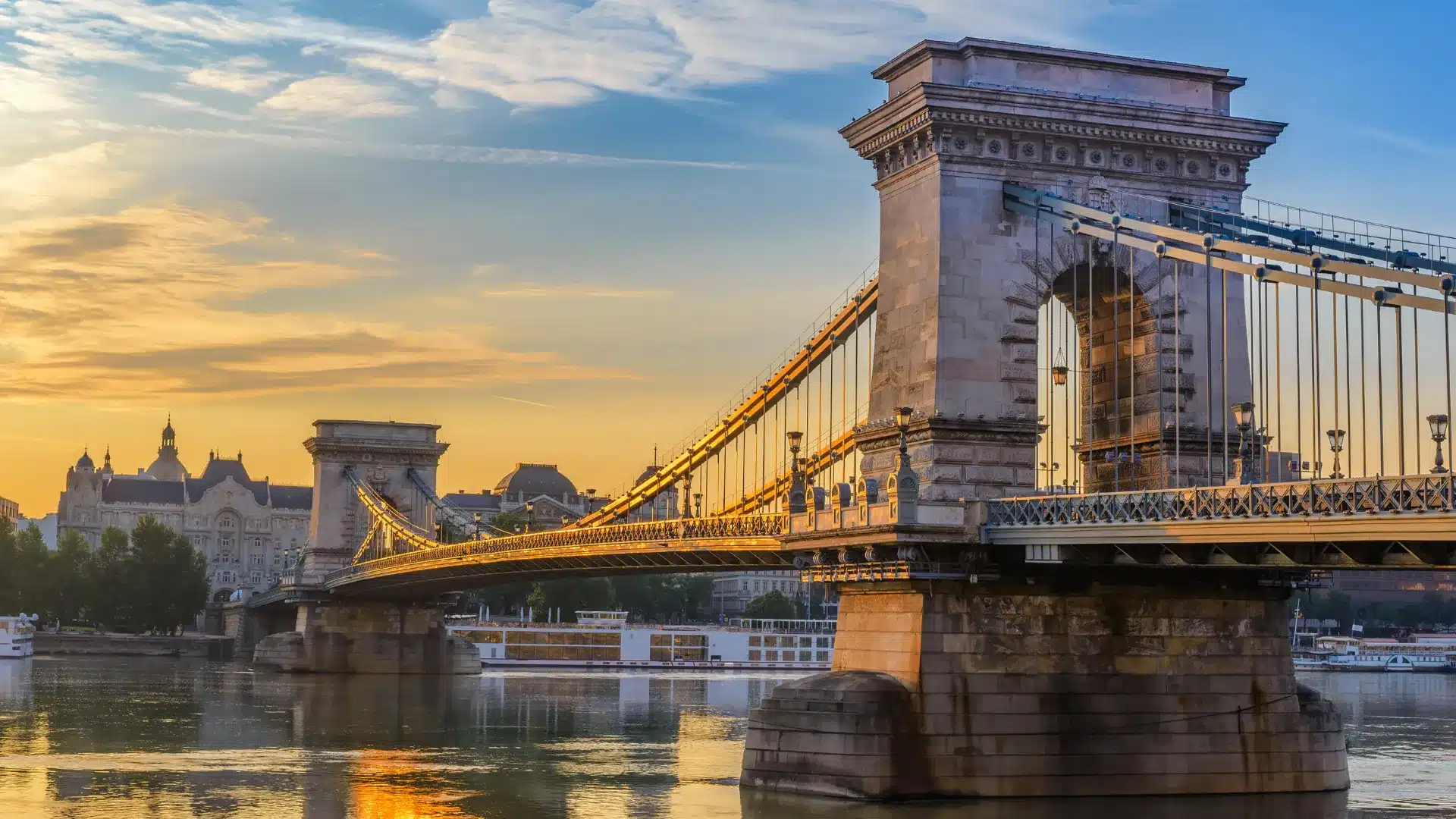
The Danube gives riverfront visuals, bridges, embankments, boats and wide city views. Buda Castle, the Parliament area, Andrássy Avenue, Heroes’ Square, Fisherman’s Bastion, the Chain Bridge, old courtyards, thermal baths, metro stations, ruin bar districts and historic streets each carry a different production identity.
It is also the practical base: hotels, crew, equipment suppliers, studios, transport and authority coordination are all easier to run from the capital. One complication worth planning around — public-area permits in Budapest require a separate application for each district the shoot touches, so a day that crosses three districts is three applications.
Studios and Controlled Production Infrastructure
Hungary’s studio infrastructure is why the biggest productions come. Crews can build sets, control interiors, shoot large-scale sequences and combine backlot work with real Budapest exteriors — which is what makes the country work for high-end television, features, action, period and technically complex projects.
The hybrid approach is the usual pattern: interiors and technical sequences in a studio, then out into Budapest, surrounding towns, countryside roads or private estates for exteriors. We help productions judge when studio infrastructure protects the schedule and when a real location delivers more on screen.
Beyond Budapest: Castles, Villages, Lakes and Countryside
Outside the capital, Hungary offers castles, manor houses, villages, farms, forests, lakes, vineyards, old industrial sites and rural roads. Lake Balaton supports waterside settings, resorts, summer lifestyle content and travel campaigns. The countryside suits period stories, documentary work, automotive shoots and commercials needing open roads.
These locations reduce pressure on overused Budapest streets and often deliver more control, less disruption and easier access. Municipal permissions and site-specific approvals still apply, and locally protected natural sites run a separate 15-day nature-protection procedure.
Schengen Entry and Work Authorisation
Hungary is in the EU and in Schengen. EU, EEA and Swiss nationals need no visa and no work permit.
Third-country nationals from visa-exempt countries may enter for up to 90 days in any 180-day period. The question that matters is not how long the shoot runs but how the crew member is engaged.
Crew who remain under 90/180, are not resident in Hungary, are not employed by the Hungarian production company and are paid at home have long been treated as not requiring a Hungarian work permit and as carrying no Hungarian tax obligation. That treatment rested on legislation replaced on 1 January 2024 by Act XC of 2023 and Government Decree 35/2024, so the position must be confirmed per production rather than assumed from older guidance.
Where crew are employed or paid by the Hungarian production company, or stay beyond 90/180, a residence permit for employment purposes is required, arranged through the Hungarian employer or production partner. Act XC of 2023 restructured these into categories — residence permits for employment purposes, guest worker permits and the National Card — with annual quotas set by ministerial decree, so availability is not open-ended.
The Schengen short-stay visa fee is EUR 90. National long-stay and residence permit fees are set separately.
Start immigration planning with the crew list and the contracting structure, not with the shoot dates. Which entity pays which crew member is the fact that determines everything else.
Film Permits Through the NFI Location Office
Permits to use public areas for filming are issued through the NFI Location Office under a one-door process, with the police, road authorities, transport authorities and site managers feeding into a single application.
The target processing time is 5 days, reduced to 3 days for expedited applications at an additional fee — including for prominent, heavily visited locations. The administrative service fee is HUF 50,000 standard and HUF 130,000 expedited, with public-area use fees and location fees on top.
Applications carry the permit form, script or treatment, synopsis, production schedule, crew list, equipment list, proof of insurance for crew, equipment and public liability, location list and maps, traffic and public space plans where relevant, and proof of fee payment. In Budapest, file separately per district.
Some locations sit outside the Location Office process and go to their own managers: bridges to the Municipality of Budapest, City Park to Városliget Ingatlanfejlesztő Zrt., the Castle and Palace District to Várgondnokság.
Worth knowing: no permit is required for news programmes, current affairs magazines, sports broadcasts, talk shows and game shows filmed in public areas.
Private Locations and Local Permissions
Private locations are negotiated directly with owners, institutions or authorised representatives, through scouting, site visits, technical checks, photography, negotiation and a written agreement.
The agreement should confirm dates, approved areas, crew size, equipment and vehicle access, overtime, cleaning, restoration, privacy rules and payment terms. Hotels, offices, historic interiors, homes and institutional properties often carry restrictions on branding, guests, residents and public visibility.
Private permission does not replace a public-area permit where the shoot affects roads, pavements, parking, traffic or controlled public space. Heritage and protected buildings carry further approvals, and the Parliament is filmed from surrounding vantage points rather than from inside or on its grounds.
Drone Filming in Hungary
Hungary applies the EU drone framework and adds strict national requirements. This is the section of a Hungarian schedule most likely to fail, and it fails on lead time.
The MyDroneSpace app is mandatory for every flight. It logs the flight plan, checks live airspace restrictions and confirms authorisation. If the app cannot connect, the flight cannot legally proceed — a real constraint in areas with patchy mobile coverage.
Flights in built-up areas require a temporary designated airspace permit from the Military Aviation Authority, and lead times are commonly cited at 30 days or more — longer for large operations in Budapest. Civil aviation regulation sits with the General Directorate for Air Transport within the Ministry of Construction and Transport; airspace is managed by HungaroControl.
Operators must be registered with the operator ID displayed on the aircraft, and third-party liability insurance is mandatory. Restricted and no-fly areas include the vicinity of Liszt Ferenc International Airport, military and government sites, critical infrastructure buffer zones, borders and — in Budapest — the Buda Castle area, the Parliament area and stretches of the Danube embankment.
Privacy is not a soft constraint here. Unauthorised drone surveillance is a criminal offence in Hungary, and GDPR applies to footage capturing identifiable people or vehicles.
Plan aerials at least 30 days out, and expect that the most photogenic Budapest locations are the most restricted. We assess whether a drone shot is realistic before it goes into a board, and place a licensed local operator where it is.
ATA Carnets and Equipment Importation
Hungary accepts ATA Carnets, and a carnet is the recommended route for professional equipment arriving from outside the EU customs union. Equipment moving from another EU member state moves freely and needs no carnet at all — a single carnet covers the EU customs territory.
Customs is handled by the National Tax and Customs Administration. Clearance at airport or land border typically takes one to four hours where documentation is in order.
With a carnet, no import duties or VAT apply. Without one, temporary import VAT runs at 27% — the highest standard rate in the European Union — plus customs charges. On a large equipment package that is a material cash-flow event, not a paperwork inconvenience.
Safety, Police Support and Public Filming
Hungary is safe, stable and highly experienced with international production. Police attendance is required for road closures, crowd scenes, weapons, pyrotechnics, stunts and large public-facing filming, and additional permits apply at historic sites, protected buildings and sensitive public areas. EU workplace safety regulation applies throughout.
Controlled shoots need standard production safety planning. Larger public setups need lead time for police coordination, road control, pedestrian management and emergency access.
When Hungary Is the Right Production Choice
Hungary is the right call for studio infrastructure, experienced crews, Budapest city doubles, period architecture, riverfront visuals, castles, high-end services and a rebate that reaches an effective 37.5% of local spend. It suits features, television series, commercials, fashion, luxury campaigns, action, music videos, automotive and high-end scripted work.
It is a poor fit for productions needing fast drone turnaround, informal paid crew entry or large public-space setups without police and municipal coordination.
Common Production Mistakes
- Registering for the rebate early, then slipping the start date past the six-month principal photography deadline
- Working from incentive guidance written during the 2025 registration freeze
- Budgeting the 30% without structuring for the non-Hungarian cost allowance that lifts it to an effective 37.5%
- Missing the eligible cost caps — producers’ fees, completion bonds, the HUF 3 million remuneration threshold
- Assuming Schengen access settles the work authorisation question
- Assuming all paid crew work needs a Hungarian permit, without checking how each crew member is contracted and paid
- Planning aerials on a two-week lead time in a built-up area
- Filing one Budapest permit for a day that crosses three districts
- Arriving without carnet paperwork and meeting 27% VAT at the border
- Treating private location approval as covering public filming impact
How Hoodlum Supports Productions in Hungary
We provide film production services in Hungary from early planning through wrap:
- National Film Office registration and rebate documentation
- Cultural test and eligible spend structuring
- NFI Location Office permits and per-district Budapest filing
- Private location agreements and institutional site access
- Work authorisation strategy under Act XC of 2023
- Drone authorisation, airspace permits and licensed local operators
- ATA Carnet preparation and NAV customs coordination
- Studio liaison, crew sourcing, transport and on-ground production management
From Budapest and the Danube to studio facilities, historic streets, castles, countryside estates and Lake Balaton.
Frequently Asked Questions
What is the film rebate in Hungary?
Hungary offers a 30% cash rebate on eligible Hungarian production spend, rising to an effective 37.5% of Hungarian spend when non-Hungarian costs are included, capped at 25% of eligible Hungarian spend. There is no minimum spend and no per-project cap.
Is the Hungarian film incentive still open in 2026?
Yes. A registration cap introduced in 2025 froze new registrations, and the government removed it in July 2026. Registrations are open without restriction, with HUF 70 billion allocated for 2026 on a first-come, first-served basis. The scheme is approved by the European Commission through the end of 2030.
How does the 30% rebate become 37.5%?
Eligible non-Hungarian sub-contractor costs can be added up to 25% of eligible Hungarian spend, and those costs attract the same 30% rate. Measured against Hungarian spend alone, the effective return is 37.5%.
How soon must filming start after rebate registration in Hungary?
Principal photography must begin within six months of the notification of the registration decision. Beyond that, the National Film Office may amend or revoke the decision.
Who administers the Hungarian film rebate?
Two bodies. The National Film Office registers the production, applies the cultural test and conducts the cost-control audit. The National Film Institute operates the state-guaranteed Collection Account and pays the rebate, deducting a 2.5% administration fee.
Who issues film permits in Hungary?
Permits to use public areas are issued through the NFI Location Office under a one-door process, with police, road and transport authorities feeding into a single application. Some sites go to their own managers — bridges to the Municipality of Budapest, City Park to Városliget Ingatlanfejlesztő Zrt., the Castle and Palace District to Várgondnokság.
How long do film permits take in Hungary, and what do they cost?
The target is 5 days for a standard application and 3 days expedited at extra fee. The administrative service fee is HUF 50,000 standard and HUF 130,000 expedited, with public-area use and location fees additional. In Budapest, a separate application is required for each district.
When is no filming permit required in Hungary?
News programmes, current affairs magazines, sports broadcasts, talk shows and game shows filmed in public areas do not require a permit for public-area use.
Do international crews need a work permit to film in Hungary?
EU, EEA and Swiss nationals do not. For third-country nationals it depends on the engagement: crew staying under 90 days in 180, not resident, not employed by the Hungarian company and paid at home have been treated as not requiring a Hungarian work permit, but that basis moved under Act XC of 2023 from 1 January 2024 and should be confirmed per production. Crew employed or paid by the Hungarian company, or staying longer, require a residence permit for employment purposes.
Can productions use drones in Hungary?
Yes, with preparation. The MyDroneSpace app is mandatory for every flight, operators must be registered and insured, and flights in built-up areas require a temporary designated airspace permit from the Military Aviation Authority — commonly 30 days or more of lead time. Buda Castle, the Parliament area and parts of the Danube embankment are restricted, and unauthorised drone surveillance is a criminal offence.
Is Hungary an ATA Carnet country?
Yes. A carnet is recommended for professional equipment arriving from outside the EU customs union; equipment from another EU member state moves freely and needs no carnet. Without a carnet, temporary import VAT of 27% and customs charges may apply.
What are the best filming locations in Hungary?
Budapest — the Danube riverfront, Buda Castle, Andrássy Avenue, Heroes’ Square, Fisherman’s Bastion, the Chain Bridge, thermal baths and historic districts — plus studio facilities, Lake Balaton, castles, manor houses, villages, vineyards and countryside roads.
External Authority Links
- National Film Institute – Hungary — incentive administration and Collection Account
- Hungarian Film Incentive — rate, eligibility and conditions
- NFI Location Office — permit information — public-area permits, documents and fees
- National Tax and Customs Administration (NAV) — carnets and temporary importation
- Ministry of Foreign Affairs and Trade — Consular Information — visas
- National Directorate-General for Aliens Policing — residence permits and employment authorisation
Planning a shoot in Hungary? Contact Hoodlum for rebate registration, NFI Location Office permits, local fixers, location scouting, ATA Carnet support, drone approvals and on-ground production management. You can also view the Hoodlum Film Fixers Hungary Google Business Profile.