For film productions in Laos, security typically involves hiring local police or military personnel to provide on-set security, manage crowd control, and offer escort services, particularly when filming in public areas or sensitive locations.
Vientiane
Luang Prabang
Laotian
Lao Kip (LAK)
The best time to film in Laos is from November to February
For a film crew visa application in this region, the necessary documents typically include a valid passport, a completed visa application form, an invitation letter from the Lao government or a local partner, a filming permit, and a detailed itinerary outlining the filming schedule.
For more details and to apply for an eVisa, visit:
https://www.visatraveler.com/visa/laos/apply-for-evisa/
International film crews must obtain accreditation from the Lao Ministry of Information, Culture and Tourism. This is a required component of the film permit process and confirms professional status for all crew members.
To apply for international crew accreditation in Laos, the required documents generally include a completed application form, copies of passports, proof of film permit, proof of insurance, and a detailed crew list outlining positions and nationalities.
The film permits in Laos are issued by the Department of Cinema, under the Ministry of Information, Culture, and Tourism.
To apply for a film permit in Laos, the necessary documents usually include a completed application form, script and storyboard, location list, crew list, equipment list, proof of insurance, and a letter of intent from the production company.
Private locations require direct negotiation with property owners through Hoodlum. UNESCO Luang Prabang heritage district filming requires heritage authority permissions in addition to the Department of Cinema permit. Plain of Jars in Xieng Khouang requires archaeological authority approval and mandatory local guide accompaniment — no off-path movement permitted without confirmed UXO clearance. National protected areas and the Bolaven Plateau's waterfall and plantation environments require local authority coordination. Buddhist temple filming requires temple administration permission and strict cultural protocols. Government buildings, military installations and sensitive border areas are restricted.
Location fees are determined after reviewing the production schedule and specific requirements. Heritage, archaeological and national park permissions should be initiated in parallel with the Department of Cinema permit.
Drone operators are required to obtain a permit from the Lao Ministry of Information, Culture and Tourism. Additionally, they must seek approval from the Lao Civil Aviation Authority and adhere to strict guidelines, including flying below 120 meters and avoiding sensitive areas.
Required Information/Documentation for Local Drone Permit
To apply for a drone permit in Laos, the following documents are generally required: a completed application form, drone specifications, pilot’s license and certification, proof of insurance, flight plan, and a map of the intended flight area.
When importing drones into Laos, a permit from the Lao Ministry of Information, Culture and Tourism is required, along with a customs clearance document. For drones valued over $1,000 USD, a temporary import bond is typically necessary.
Required Information/Documentation for Drone Importation
To import a drone into Laos, required documents typically include a commercial invoice, bill of lading, packing list, customs declaration form, certificate of origin, and a permit from the Lao Ministry of Information, Culture and Tourism.
Permits are issued by the Lao Civil Aviation Authority (CAA).
The processing time for a drone permit in Laos typically takes around 7-14 business days.
The cost for obtaining a drone permit in Laos ranges from $100 to $300 USD.
Yes, Laos is a Carnet country.
General Process for Carnet Countries
In Carnet countries like Laos, the process involves obtaining a Carnet de Passages en Douane (CPD) from the applicant’s home country. This serves as a guarantee for customs duties and taxes, allowing the temporary importation of goods without the need to pay duties or taxes.
For customs clearance, film crews typically need to provide documents such as a Carnet de Passages en Douane (CPD), commercial invoices, packing lists, customs declaration forms, and a detailed equipment list with serial numbers.
In Laos, the Lao Customs Department, which operates under the Ministry of Finance, is responsible for issuing customs clearance.
Laos provides a unique and pristine filming destination, featuring rich cultural heritage, breathtaking natural landscapes, and a cost-effective, smooth shooting environment. These factors make it an appealing choice for international film and television productions.
For film productions in Laos, security typically involves hiring local police or military personnel to provide on-set security, manage crowd control, and offer escort services, particularly when filming in public areas or sensitive locations.
Laos does not currently have a dedicated film rebate or incentive program for reality TV productions. However, the government may offer support or discounts on certain services on a case-by-case basis.
Laos

Fill in our client brief and we’ll get back to you with everything you need to start filming in this region.
Is Laos an emerging film destination in South East Asia? The short answer…
Laos is one of Southeast Asia’s most visually arresting production destinations — a…
Hoodlum offers expert film fixer services in Laos, supporting international productions across one of Southeast Asia’s most visually distinctive and least commercialised filming destinations.
Laos is a landlocked nation of extraordinary natural and cultural richness — the only landlocked country in Southeast Asia, and one of the few in the region where traditional village life, ancient Buddhist temple culture, pristine river environments and dramatic limestone karst landscapes coexist without the commercial tourism overlay that has transformed neighbouring destinations. The Mekong River runs the length of the country. Luang Prabang is a UNESCO World Heritage city. The Bolaven Plateau in the south offers coffee plantation landscapes and spectacular waterfalls. The Plain of Jars in Xieng Khouang presents one of Southeast Asia’s most archaeologically distinctive environments. And the limestone karst formations of Vang Vieng give productions a dramatic natural backdrop that has few equivalents in the region.
For documentary productions, travel programming, commercial campaigns, feature films and factual entertainment that need an authentic, unspoiled and visually compelling Southeast Asian environment, Laos delivers production value that is genuinely difficult to find elsewhere.
Laos is an ATA Carnet country. Film permits are issued by the Department of Cinema under the Ministry of Information, Culture and Tourism. The country does not yet have a formal film rebate programme.
Capital: Vientiane
Main Cities: Vientiane, Luang Prabang, Pakse, Savannakhet
Official Language: Lao (Laotian)
Currency: Lao Kip (LAK) — Thai Baht and USD widely accepted in tourist and commercial areas
Climate: Tropical. Dry season November to April — optimal for filming. Monsoon season May to October.
Best Time to Film: November to February — coolest and driest conditions
Borders: China (north), Vietnam (east), Cambodia (south), Thailand (west), Myanmar (northwest)
Laos is a Southeast Asian filming destination that works for productions needing an authentic and visually distinctive environment — limestone karst landscapes, Mekong River port towns, ancient Buddhist wats, French colonial architecture, remote highland villages, jungle interior and waterfall environments — without the logistical complexity and commercial saturation of more heavily visited regional destinations.
The country is served by Wattay International Airport in Vientiane and Luang Prabang International Airport, with domestic connections to Pakse and Savannakhet. The Mekong River corridor provides an alternative logistics route for river-based productions working along the western border with Thailand.
The main production environments include Vientiane and its unique combination of French colonial architecture and Buddhist temple culture, Luang Prabang’s UNESCO World Heritage historic district, the Nam Ou and Mekong river valleys, the limestone karst environment around Vang Vieng, the coffee and waterfall landscape of the Bolaven Plateau in southern Laos, the Plain of Jars in Xieng Khouang, and the remote tribal village environments of the northern highland provinces.
A successful Laos production requires two to four weeks of pre-production lead time for the Department of Cinema film permit. Visa arrangements, crew accreditation, drone permits from the Civil Aviation Authority, ATA Carnet customs clearance and private location access should all run in parallel.
Laos works for productions that need a Southeast Asian visual environment of genuine authenticity — not a destination shaped by decades of mass tourism but one where traditional culture, natural environments and heritage architecture remain largely intact and accessible.
Strong production use cases include:
The combination of the Mekong River corridor, Luang Prabang’s UNESCO heritage, the limestone karst of Vang Vieng, the Bolaven Plateau’s coffee and waterfall landscape, and the archaeological significance of the Plain of Jars gives productions a visual range across a single country that is unusual for its geographic size.
The cost-effectiveness of Laos as a production destination — crew rates, location fees, accommodation and logistics — compares very favourably with neighbouring Thailand and Vietnam for productions that can manage the longer permit timelines and absence of a major international production hub.
The dry season from November to April is the optimal filming window. November to February offers the coolest and driest conditions across the country — the most comfortable for outdoor crew work and the most reliable for exterior filming across all location types.
March and April remain dry but temperatures rise significantly. The monsoon season runs May to October, bringing heavy rainfall, high humidity and river flooding that can affect road access, location availability and logistics in many parts of the country.
Productions should plan for:
Most international visitors can obtain a visa on arrival or in advance through a Lao embassy or consulate. An e-visa is also available through the official portal.
For professional film crews, an invitation letter from the Lao government or a local partner is required as part of the visa application. Hoodlum provides this letter.
Required documentation:
Processing time: Approximately three working days.
Estimated cost: USD 31–36 depending on nationality.
E-visa application: https://www.laoevisa.gov.la/
Work authorisation for paid professional filming should be confirmed separately from standard tourist entry for each crew member’s nationality. Hoodlum coordinates invitation letters for all international crew.
International film crews must obtain accreditation from the Lao Ministry of Information, Culture and Tourism. This confirms professional status and is a required component of the film permit process.
Required documentation:
Processing time: Seven to ten working days. Apply at least two to three weeks before the planned filming date.
Estimated cost: USD 50–200 per person depending on accreditation type and duration.
Accreditation should run in parallel with the film permit process. Hoodlum coordinates both simultaneously.
Film permits in Laos are issued by the Department of Cinema, under the Ministry of Information, Culture and Tourism. This is the central production approval authority for all international films, documentaries, commercials and television productions.
Required documentation:
Processing time: Two to four weeks.
Estimated cost: USD 500–2,000 depending on production nature and scope.
Productions filming in Luang Prabang’s UNESCO World Heritage district, at Buddhist temple complexes, in national protected areas or in sensitive border regions require additional permissions from the relevant managing authority beyond the Department of Cinema permit.
Hoodlum helps productions identify the full permission picture for each specific location and manages all parallel approval streams.
Luang Prabang — a UNESCO World Heritage city at the confluence of the Mekong and Nam Khan rivers, with the most intact historic urban fabric in mainland Southeast Asia. French colonial architecture, gilded temple complexes, the alms-giving ceremony at dawn, the night market and the surrounding hillside monastery environments give productions a cultural and architectural depth of extraordinary quality. UNESCO and heritage authority permissions required for filming within the historic zone in addition to the Department of Cinema permit.
Vientiane — the capital, with its unique combination of French colonial boulevards, Buddhist stupas (including the golden Pha That Luang national monument), the Patuxay arch, the Presidential Palace and the Mekong waterfront. Municipal coordination required for public location filming.
Vang Vieng — a river valley town surrounded by dramatic limestone karst formations, caves and jungle. One of the most visually striking landscapes in Laos for aerial and landscape work. The karst environment around Vang Vieng has appeared in international travel productions and commercial campaigns. Film permit and local authority coordination required.
The Mekong River corridor — from the Golden Triangle in the north to the Cambodian border in the south, the Mekong provides a 1,800-kilometre filming corridor of river towns, fishing communities, Buddhist temples, jungle-covered banks and traditional long-tail boat culture. River logistics require boat hire coordination and varies significantly by season.
Bolaven Plateau, southern Laos — a highland plateau of extraordinary natural beauty, with coffee and tea plantations, multiple spectacular waterfalls (Tad Fane, Tad Yuang, Tad Lo), highland tribal villages and a cool climate distinct from the rest of southern Laos. An exceptional environment for travel, nature and commercial productions.
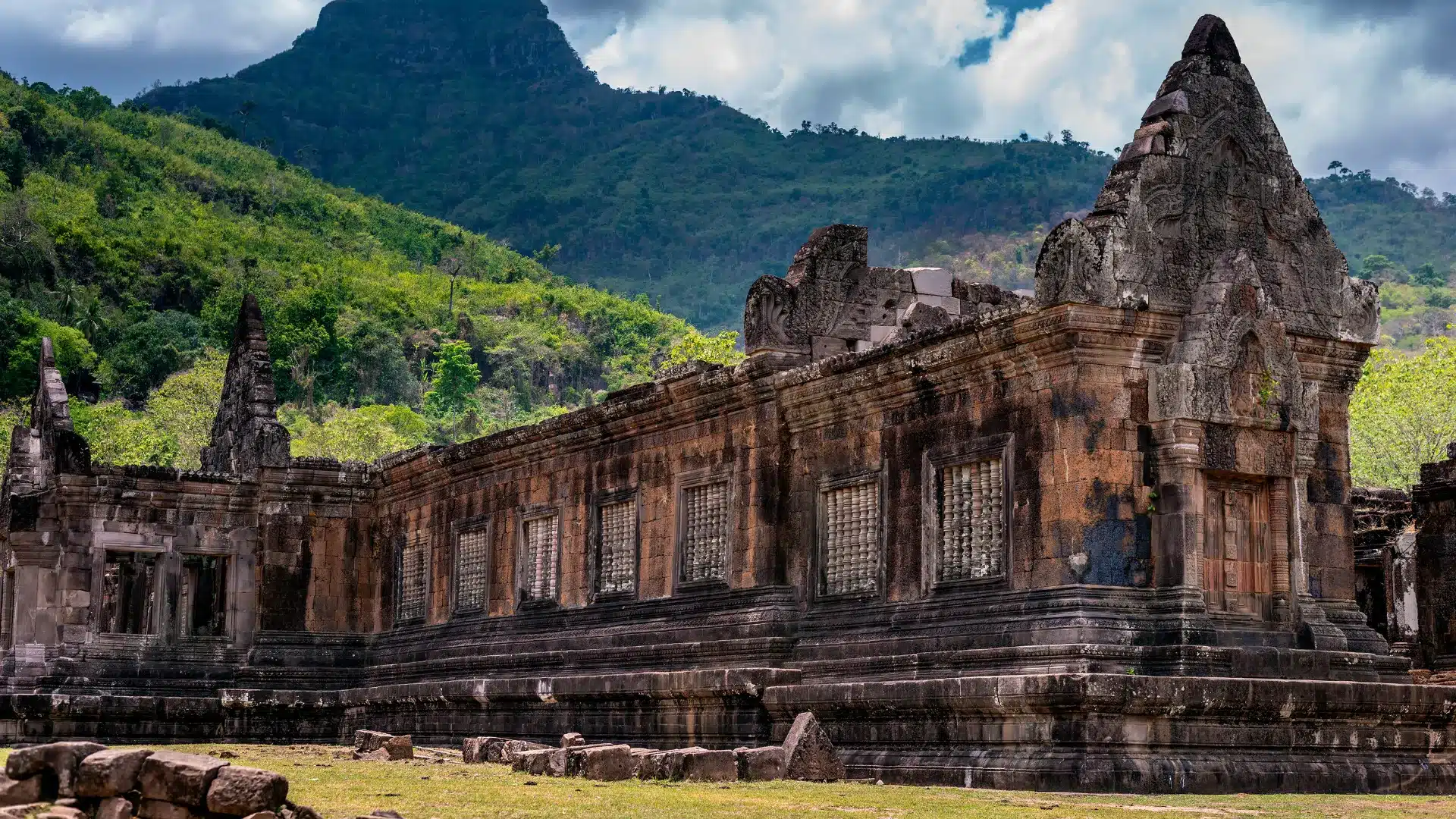
Plain of Jars, Xieng Khouang — one of Southeast Asia’s most important and most mysterious archaeological sites — thousands of stone jars of unknown origin scattered across highland meadows. UNESCO Tentative List site. Archaeological authority permissions required. UXO (unexploded ordnance) risk in some areas of the province — local guide accompaniment is mandatory and no off-path movement permitted without confirmation of clearance.
Nam Ou River Valley — a river valley of exceptional scenic quality in northern Laos, accessible by boat from Luang Prabang or Nong Khiaw. Remote limestone cliff environments, traditional villages and cave systems along the river banks.
Drone operations in Laos require approval from both the Lao Ministry of Information, Culture and Tourism and the Lao Civil Aviation Authority (CAA) before any operation begins. Both approvals must be in place. One does not cover the other.
Strict operational guidelines apply: drones must fly below 120 metres and must avoid sensitive areas including government buildings, military installations, airports and border zones.
Required documentation (local drone permit):
Required documentation (drone importation):
Issuing authority: Lao Civil Aviation Authority (CAA).
Processing time: Seven to fourteen working days.
Estimated cost: USD 100–300.
Drones valued over USD 1,000 require a temporary import bond in addition to standard importation documentation. Productions planning drone work above the Luang Prabang UNESCO zone, near Vientiane’s government district, above the Plain of Jars or in border areas should confirm specific airspace restrictions before travel.
Hoodlum runs drone applications in parallel with Department of Cinema permit and accreditation processes so aerial days are protected.
Laos is an ATA Carnet country. Professional filming equipment can be imported under the standard Carnet system, which is the most straightforward importation route.
Required documentation:
Issuing authority: Lao Customs Department, Ministry of Finance.
Processing time: Two to five working days.
Estimated cost: 2–5% of total equipment value plus approximately USD 5–10 fixed fee.
All items should be listed with serial numbers and values. Productions arriving through Vientiane and Luang Prabang airports should ensure documentation reflects the correct arrival location for each item.
Drones valued over USD 1,000 require a temporary import bond in addition to the standard Carnet documentation.
Laos is a generally safe and stable filming environment. Production risks are primarily logistical and environmental rather than conventional security concerns.
Key safety and security considerations include:
Laos does not currently have a dedicated film rebate or incentive programme for international productions. The government may offer support or service discounts on a case-by-case basis.
The primary financial advantage of Laos as a production destination is cost-effectiveness — crew rates, location fees, accommodation, catering and logistics are among the most competitive in mainland Southeast Asia.
Confirm any available facilitation directly with the Ministry of Information, Culture and Tourism before budgeting.
Visa with invitation letter, Department of Cinema film permit, Ministry accreditation, Lao CAA drone approval, Ministry drone permission, ATA Carnet customs clearance and UNESCO or heritage site permissions are all separate processes. None covers the others.
A complete production plan connects:
Hoodlum manages all of these as one coordinated workflow.
Laos is the right choice when a production needs an authentic, unspoiled and visually rich Southeast Asian environment — UNESCO heritage city, Mekong river culture, limestone karst, ancient temple and traditional village settings — without the commercial overlay of more heavily developed regional destinations.
It is especially suitable for:
It may be less suitable for productions requiring very large studio infrastructure, heavy freight logistics into a major hub, or complete crowd exclusion at heavily visited heritage sites during peak tourism season.
Avoid:
Support may include:
Do international film crews need a visa to film in Laos? Most nationalities can obtain a visa on arrival or through an e-visa. An invitation letter from the Lao government or a local partner is required for film crew visa applications — Hoodlum provides this. Processing takes approximately three working days. Cost: USD 31–36. Apply at https://www.laoevisa.gov.la/.
How long should productions allow for the film permit? The Department of Cinema permit takes two to four weeks. Crew accreditation takes seven to ten working days. Both should run in parallel. Allow a minimum of four to six weeks before the first filming day for all processes to complete.
Can productions film at Luang Prabang’s UNESCO heritage sites? Yes, but UNESCO Luang Prabang filming requires heritage authority permissions in addition to the Department of Cinema permit. These are separate processes. Initiate heritage site permissions in parallel with the main permit application.
Is the Plain of Jars safe to film at? The Plain of Jars is accessible for professional filming with proper preparation. UXO (unexploded ordnance) risk exists in parts of Xieng Khouang province. Local guide accompaniment is mandatory and no off-path movement is permitted without confirmed area clearance. Archaeological authority permissions are also required.
Can productions use drones in Laos? Yes. Approvals are required from both the Lao Ministry of Information, Culture and Tourism and the Lao Civil Aviation Authority. Both must be in place before operations begin. Processing takes seven to fourteen working days. Drones over USD 1,000 require a temporary import bond. Cost: USD 100–300.
Is Laos a Carnet country? Yes — Laos is an ATA Carnet country. Customs clearance takes two to five working days. Cost: 2–5% of equipment value plus approximately USD 5–10. Drones over USD 1,000 require an additional temporary import bond.
What is the best time to film in Laos? November to February — cool, dry conditions across the country. March and April remain dry but hotter. Avoid May to October monsoon season unless the production specifically requires monsoon conditions, river flooding or wet season aesthetics.
What documents are typically needed? Visa with Hoodlum invitation letter, Department of Cinema permit application including script, location list, crew and equipment list, Ministry accreditation, Lao CAA drone permit and Ministry drone permission where applicable, ATA Carnet, UNESCO or heritage authority permissions for Luang Prabang, and Plain of Jars archaeological authority documentation.
Filming in Laos rewards productions that understand the country’s specific approval structure and plan the permit timeline as the foundation of everything else.
The Department of Cinema permit takes two to four weeks. Crew accreditation takes seven to ten working days. Drone approvals require both Ministry and Civil Aviation Authority confirmation simultaneously. UNESCO Luang Prabang heritage permissions and Plain of Jars archaeological authority approvals run as independent parallel streams. None of these processes cover the others, and none can be rushed by the urgency of a production schedule.
Productions that build four to six weeks of pre-production lead time into the plan — with all approval streams running in parallel from the moment Hoodlum is engaged — will find Laos one of the most rewarding and least commercially compromised filming destinations in Southeast Asia. Productions that start late will find the permit timeline the binding constraint on everything else.
The Laos film permit is issued by the Department of Cinema under the Ministry of Information, Culture and Tourism. It is the central production approval for all international film, documentary, commercial and television work in Laos.
Required documentation covers a completed application form, script and storyboard, location list, crew list, equipment list, insurance and a letter of intent from the production company. Processing takes two to four weeks from a complete submission. Cost: USD 500–2,000 depending on production scope.
The Department of Cinema permit covers general filming activity in Laos. It does not automatically cover filming in Luang Prabang’s UNESCO World Heritage district, which requires heritage authority permissions separately. It does not cover the Plain of Jars, which requires archaeological authority approval and UXO guide confirmation. It does not cover drone operations, which require both Ministry and Lao CAA approval running as a separate stream.
All intended locations — particularly UNESCO and heritage sites, archaeological sites, national parks and sensitive areas — should be flagged in the permit application from the outset so the complete approval picture is established early.
The filming visa Laos process is accessible for most nationalities through visa on arrival or the official e-visa system. An invitation letter from the Lao government or a local partner is required for film crew visa applications.
Hoodlum provides this letter as part of the standard pre-production package. Processing takes approximately three working days. Cost: USD 31–36 depending on nationality.
Work authorisation for paid professional filming should be confirmed separately from tourist or visitor entry for each crew member’s nationality. Productions should provide Hoodlum with complete crew details — names, nationalities, passport details and roles — as early as possible so that invitation letters are prepared before individual visa applications are submitted.
Luang Prabang is the most requested filming location in Laos and one of the most visually distinctive cities in mainland Southeast Asia.
The city sits at the confluence of the Mekong and Nam Khan rivers, enclosed by forested hills. The historic district — largely intact from the French colonial and pre-colonial periods — contains over thirty Buddhist temples and wats, French colonial mansions, traditional wooden houses, the Royal Palace Museum and the daily alms-giving ceremony at dawn in which hundreds of Buddhist monks in saffron robes walk the streets collecting offerings from kneeling townspeople.
Filming in Luang Prabang’s UNESCO World Heritage district requires heritage authority permissions in addition to the Department of Cinema permit. These are entirely separate approval streams that must be initiated in parallel. The alms-giving ceremony is one of the most requested filming moments in Laos — it requires specific cultural protocols, early morning access coordination, respectful behaviour from all crew, and sensitivity to the religious participants throughout.
Luang Prabang International Airport provides direct access for productions based in the city. Transport time from Vientiane by road is approximately ten hours; by air, approximately one hour.
Vientiane filming locations give productions access to one of Southeast Asia’s most characterful and least internationally recognised capital cities.
The city’s unique identity comes from the combination of French colonial boulevards and shophouses, golden Buddhist stupas including the magnificent Pha That Luang national monument, the Patuxay victory arch modelled on the Arc de Triomphe, the presidential palace area, the Mekong waterfront promenade, and the informal street life of a city that has maintained a slower pace than most other Southeast Asian capitals.
Municipal coordination applies for public location filming in Vientiane. The area around government buildings, the presidential palace and military installations requires specific confirmed permissions before scheduling.
The Mekong River is the visual spine of Laos — a 1,800-kilometre corridor from the Golden Triangle at the northern border with Myanmar and China, down through the country to the Cambodian border at Don Khon and the 4,000 Islands. The river connects Luang Prabang, Vientiane, Pakse and a chain of riverside towns and villages that give productions an authentic and visually compelling waterway environment unlike anything available in neighbouring countries.
Boat logistics are required for river-based filming. Long-tail boats, traditional wooden slow boats and charter vessels are all available through local operators. River levels change significantly between dry and wet season — the Mekong is dramatically different visually and logistically in the dry season low water of March and April versus the monsoon high water of August and September.
Productions planning river sequences should assess seasonal conditions, boat access at intended locations and whether river logistics need to be sequenced around dry season low water windows for the most visually accessible filming environments.
The Plain of Jars in Xieng Khouang province is one of Southeast Asia’s most archaeologically significant and visually distinctive filming environments. Thousands of stone jars — some over 2,000 years old, some over two metres in diameter — are scattered across highland meadows with mountain backdrops that give productions an environment of genuine archaeological drama.
It is also in one of the most heavily UXO-contaminated areas of the world. Laos is the most heavily bombed country per capita in history — over two million tonnes of ordnance were dropped during the Vietnam War era, and an estimated 30% of it failed to detonate. Xieng Khouang province was particularly affected.
This does not make the Plain of Jars inaccessible. Specific sites have been cleared and are officially open for visitors. But it does mean that no movement off established paths and cleared areas is permitted under any circumstances without local guide confirmation of area clearance. This applies to camera operators, drone operators, sound crew, art department — every person associated with the production.
Archaeological authority permissions are required for filming at the Plain of Jars sites in addition to the Department of Cinema permit. Local guide accompaniment is mandatory throughout. Productions should discuss the Plain of Jars logistics with Hoodlum before scheduling to ensure the safety framework is built into the location day plan.
The Lao Civil Aviation Authority drone permit process requires approvals from two separate authorities — the Lao Ministry of Information, Culture and Tourism and the Lao Civil Aviation Authority (CAA). Both must be in place before any drone operation begins.
Processing takes seven to fourteen working days. Cost: USD 100–300. Drones over USD 1,000 require a temporary import bond for importation in addition to standard customs documentation.
Productions planning drone work above Luang Prabang’s UNESCO zone, near government and military installations in Vientiane, above the Plain of Jars or in border areas should confirm specific location restrictions with Hoodlum before committing aerial days to the schedule.
Both drone applications should run in parallel with the Department of Cinema permit and accreditation from the point of engagement — not sequentially after the main permit is confirmed.
Laos customs clearance benefits from Laos’s ATA Carnet membership. Standard equipment processing takes two to five working days at a cost of 2–5% of total equipment value plus approximately USD 5–10 fixed fee.
The important additional consideration is drones. Drones valued over USD 1,000 require a temporary import bond in addition to the standard Carnet documentation. This is a separate requirement that should be prepared before departure alongside the standard Carnet.
All equipment should be listed with serial numbers and values. Carnet documentation must match exactly what arrives at Wattay International Airport in Vientiane or Luang Prabang International Airport.
A Laos film fixer provides Hoodlum invitation letters for all international crew visa applications, submits the Department of Cinema film permit application with complete documentation, runs Ministry accreditation in parallel, coordinates UNESCO Luang Prabang heritage authority permissions as a separate stream, manages Plain of Jars archaeological authority approvals and UXO guide coordination, initiates both Ministry and Lao CAA drone approvals simultaneously, prepares ATA Carnet customs documentation and temporary import bond for drones over USD 1,000, manages Mekong and Nam Ou river boat logistics with seasonal water level planning, coordinates Bolaven Plateau access and logistics, and plans location day logistics around road access conditions in remote northern and highland provinces.
Film production Laos works most efficiently when Hoodlum is engaged four to six weeks before the first filming day. That window allows the Department of Cinema permit to complete within its two-to-four-week timeline while all other approval streams run simultaneously.
Hoodlum provides full production support for international crews across all Laos filming locations — from early research and Laos location scouting through Department of Cinema permit coordination, Luang Prabang heritage access, Plain of Jars safety and archaeological coordination, drone planning, customs clearance and on-the-ground production management across Vientiane, Luang Prabang, Vang Vieng, Pakse and all regional environments. For enquiries, visit hoodlum.tv/contact-us.
For productions building a Southeast Asia film production guide — comparing Laos with Thailand, Vietnam, Cambodia, Myanmar and Indonesia — Laos occupies a specific and increasingly important position.
It is the only mainland Southeast Asian destination that combines a fully intact UNESCO World Heritage city in Luang Prabang, a Mekong River corridor of 1,800 kilometres, the archaeological significance of the Plain of Jars, the natural drama of the Bolaven Plateau and Vang Vieng’s limestone karst, and a cost structure among the most competitive in the region — all without the commercial tourism infrastructure that has transformed the visual character of Thailand, Bali and parts of Vietnam.
Productions that have filmed in Thailand or Cambodia will find Laos a genuinely distinct visual register — quieter, less developed commercially, more culturally intact, and with a permit system that rewards proper preparation with genuine access to environments that are simply not available in equivalent form in neighbouring countries.
The practical groundwork is always the same: start the Department of Cinema permit four to six weeks before filming, run accreditation and drone applications in parallel from day one, treat Luang Prabang UNESCO and Plain of Jars as separate permission streams, confirm UXO guide and clearance for any affected province location, prepare ATA Carnet documentation with temporary import bond for drones over USD 1,000, plan Mekong and river logistics around seasonal water conditions, and engage Hoodlum at the research stage rather than the departure week.