















Film Production Services in Belize
Belize is one of Central America’s most distinctive filming destinations, combining Caribbean coastline, dense jungle, ancient Maya temples, coral atolls and a small, welcoming, English-speaking film industry into a single compact and easily navigated country. From the cayes and the world-famous Blue Hole to the rainforests of the Cayo District, the rivers and waterfalls of the interior and the colonial streets of Belize City, the country offers a tropical, untamed look that is hard to find anywhere else, backed by a streamlined permitting process built specifically to welcome international crews.
For international crews, the country offers a rare blend of pristine natural locations, straightforward entry and the practical advantage of English as the official language, all on a small country where reef, jungle and ruins sit within a few hours of each other. It is one of the few places in the region where productions can shoot Caribbean sea, broadleaf jungle and Maya archaeology in a single tight schedule, without a language barrier and with a film commission set up to smooth the way.
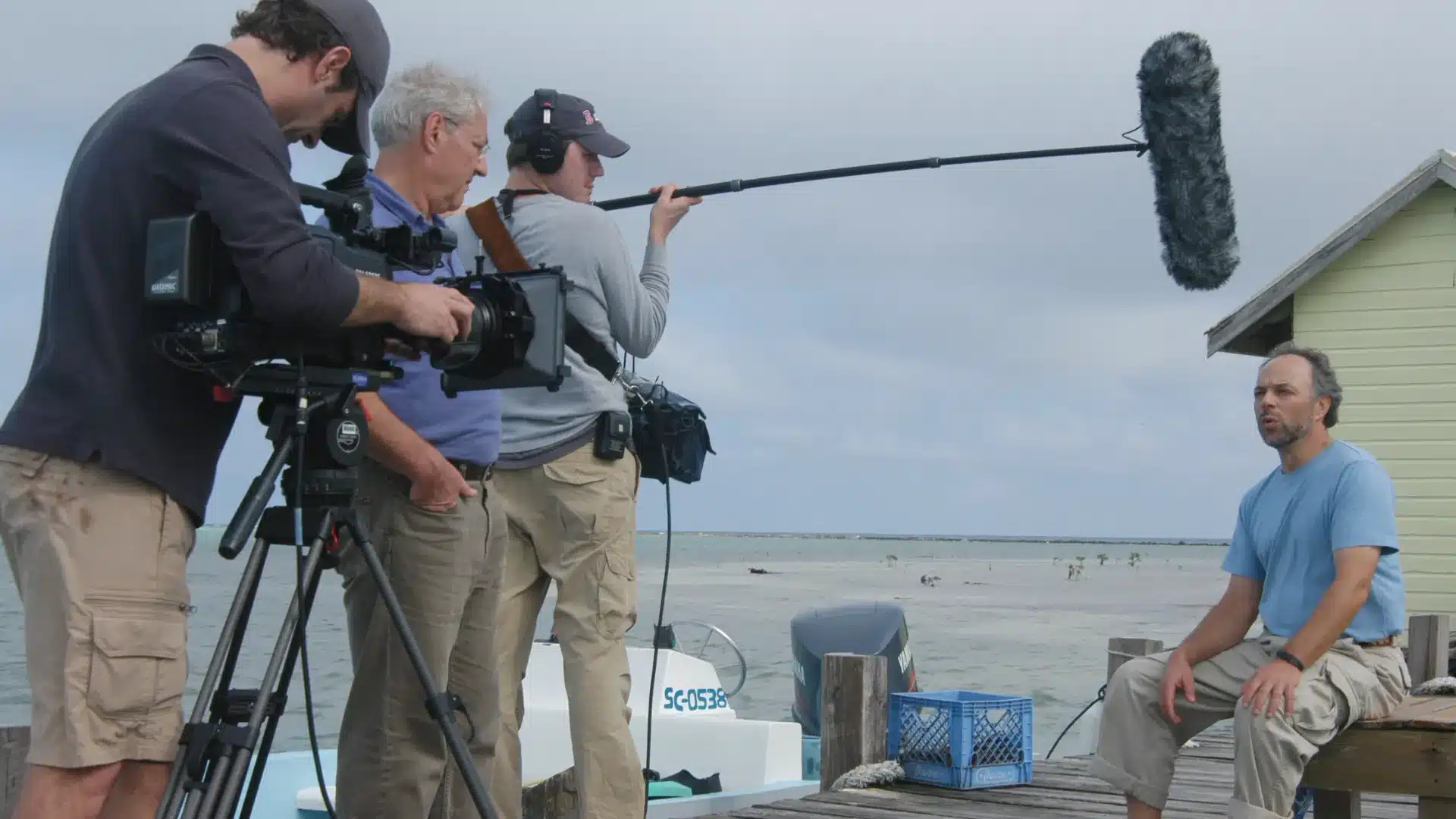
Hoodlum provides Film Production Services in Belize for documentaries, commercials, factual entertainment, branded content, music videos, photography campaigns, feature films and television productions. Our team supports entry and accreditation guidance, film permits, location agreements, drone planning, customs clearance, local crew sourcing, transport, security planning and full on-ground production management. You can see the full scope of what we do and the people behind it on our who we are page.
The country rewards productions that arrive with their paperwork in order. It is a welcoming, film-friendly country, but it is not a destination for informal, undocumented shooting by foreign crews. The right entry route, the right permits, the right customs plan and the right local coordination all need to be settled before the cameras roll, and the most efficient way to handle that is through an experienced local production partner.
Why the Country Works for Jungle, Reef and Maya Locations
The country’s biggest production strength is the combination of dramatic, unspoiled natural environments within tiny travel distances, plus the ease of working in English with helpful authorities. In a single schedule a production can capture a turquoise Caribbean lagoon, a coral reef, a dense jungle canopy, a thundering waterfall, an ancient temple rising above the trees and a colourful coastal town, often within a few hours of each other. The tropical climate also delivers strong, consistent light across much of the year.
The largest city is the usual arrival point, but the value sits in the route. A commercial might pair a barrier-reef caye with a jungle river and a Maya ruin. A documentary might move from the reef and atolls to the rainforest and the cave systems of the interior. A natural-history piece might follow wildlife from the coast to the broadleaf jungle. The country is strong because it offers a genuinely wild, tropical canvas of reef, jungle and ancient ruins that few other accessible destinations can match.
The country is especially well suited to:
- Natural-history and wildlife documentaries
- Travel, adventure and expedition content
- Commercials and branded content
- Conservation and environmental films
- Reality and survival formats
- Diving, marine and underwater shoots
- Archaeology and history programming
- Photography and fashion campaigns
- Feature and television projects needing a tropical look
Hoodlum’s production support team helps crews decide which regions are practical, what permissions each location needs and how to sequence movement between the cayes, the coast, the jungle and the Maya sites.
Belize City and the Coast
Belize City is the practical anchor for most international productions working in the country. It is where crews usually arrive, where suppliers, transport and accommodation are easiest to coordinate, and where permit and customs coordination with the Film Commission and immigration begins. The international airport nearby is the main gateway for crew and equipment.
The city and the wider coast offer colonial architecture, working waterfronts, markets, fishing communities and the jumping-off points for the cayes. From here, boats and short domestic flights reach the islands and atolls. Crew accommodation, vehicle hire, fixers, customs coordination, boat operators and security planning are all easiest to arrange from the coastal hub. Hoodlum uses the coastal hub as the practical base for Film Production Services in Belize, particularly when a shoot needs to reach the reef or move inland.
The Cayes, the Barrier Reef and Marine Locations
The country’s Caribbean coast is one of its greatest assets. Ambergris Caye and Caye Caulker offer classic island scenery, while the Belize Barrier Reef, the second-largest reef system in the world, delivers coral gardens, atolls and the iconic Great Blue Hole. The sea, the light and the marine life give productions an exceptional underwater and aerial canvas.
These locations suit diving and marine documentaries, travel and lifestyle content, commercials and any project needing turquoise water and coral reef. Marine and island filming calls for careful planning around boats, tides, weather, dive safety, marine-protected-area rules and equipment protection in salt and humidity. Hoodlum helps productions plan the reef and the cayes as their own production environment, with the right boat support, permits, timing and safety in place.
The Cayo District, Jungle and Maya Sites
Inland, the Cayo District and the western interior give the country its jungle and archaeology register: broadleaf rainforest, rivers, waterfalls, cave systems and major Maya sites such as Caracol, Xunantunich and Lamanai, where stone temples rise above the forest canopy. The Mountain Pine Ridge adds a different texture of pine forest, granite and waterfalls.
These environments suit natural-history and adventure content, archaeology and history programming, expedition and survival formats and drama needing a wild jungle backdrop. Filming at archaeological and protected sites requires additional permissions, and remote jungle locations call for tighter planning around access, transport, communications, heat, insects and medical cover. Hoodlum builds the local guide, driver, site-permission and logistics coordination into the plan before a shoot moves into the interior.
Entry, Visas and Crew Accreditation
The country keeps entry comparatively simple for production crews, but the right route still depends on each crew member’s nationality.
Crew from visa-exempt countries do not need a visa to enter, while crew who are nationals of countries that normally require a visitor’s visa for the country must obtain a tourist visa in advance, typically processed in a few working days. Visa applicants generally submit a letter of intent, proof of payment for services, a detailed itinerary and a crew list with roles and passport details. All crew should carry a passport valid for at least six months beyond the intended stay.
International crews coordinate accreditation through the Belize Film Commission, submitting a project synopsis, a crew list with nationalities and roles, an equipment list with serial numbers and values, location agreements and proof of liability insurance, with the commission registering the production with the immigration department. Hoodlum helps productions match each crew member to the correct entry route, assemble the accreditation and permit documentation, and avoid immigration becoming a late-stage problem.
Film Permits and Location Permissions
The Belize Film Commission is the central authority for filming, responsible for issuing film permits, promoting the industry and regulating film-related activity. The process is comparatively quick and friendly, with application review, location approval, permit issuance and payment processing each typically taking a few business days once documentation is complete.
A permit application generally requires the film permit application form, a project synopsis, a crew list, an equipment list with serial numbers and values, passports, a letter of introduction from the production company or sponsor, location agreements and proof of liability insurance. Separate permits apply for drone use and for filming at cultural or historical sites, and an environmental impact assessment may be required when working in sensitive ecosystems. Permit fees are modest, with administrative fees on top.
Private locations, from resorts and homes to businesses, farms and private land, are negotiated directly with owners or managers through a signed location agreement covering dates, access, fees and conditions, followed by the film permit and any local location permit. A Hoodlum location scout can propose suitable options, after which we negotiate access, dates, crew size, fees and reinstatement terms, and secure the agreement. Private permission does not replace the Film Commission permit or any cultural-site or protected-area approvals a location also requires, and fees are quoted once the locations are confirmed.
Drone Filming and Aviation Rules
Drone operation requires a permit from the Belize Department of Civil Aviation, alongside a film permit from the Film Commission. Requirements include an application, drone specifications, pilot information, insurance and a flight plan, and operators must be certified, maintain visual line of sight and observe altitude and airspace limits, generally up to around four hundred feet. No-fly zones include national parks, protected areas, military sites and airport vicinities, and temporary importation of the drone must be cleared through customs.
Drone permit fees themselves are low, but the documentation chain, the film permit link and the customs step mean advance coordination is essential, and an environmental impact assessment may apply for sensitive ecosystems. For incoming productions, engaging a locally experienced drone operator who knows the permit process, the protected areas and the airspace rules is often the most practical route. Hoodlum helps productions decide between a local operator and importing equipment, and builds the necessary lead time into the plan.
Equipment Customs Clearance
Belize is not an ATA Carnet country, so equipment importation works differently from many European destinations, and this is an important planning point. For gear arriving with the crew as accompanied baggage, the Film Commission can arrange temporary duty-free importation, which keeps the process straightforward when the equipment travels with the team.
For equipment shipped separately as cargo or freight, full customs clearance applies through the Belize Customs and Excise Department, and a local customs broker, usually an agent of the originating freight forwarder, is required. Cargo clearance generally needs a commercial invoice, certificate of origin, bill of lading, a detailed equipment list with serial numbers, the film permit, a temporary import permit, insurance and crew documents, and productions should allow at least a few business days once the shipment arrives. Walkie-talkies and two-way radios need their own permit per unit.
Hoodlum helps productions decide whether to travel with kit as accompanied baggage or ship it as cargo, prepares the equipment list and values, and coordinates the Film Commission temporary importation or the customs broker so cameras, lighting, grip and sound gear move through with minimal delay.
The Film Incentive
The country offers a film rebate programme through the Belize Film Commission, providing financial incentives for qualified production expenses incurred in the country. Rather than a high headline percentage, the scheme is a cash-back rebate on qualifying local spend, with the benefit tied to expenses genuinely incurred on goods and services within the country.
To access the rebate, a production registers with the Office of the Belize Film Commissioner, with a processing fee for an initial period and possible extensions, and must meet the scheme’s requirements. Qualifying expenses must be incurred locally, a screen credit acknowledging the country is required, and a CPA audit verifies the production’s expenditure, with pre-production and final certification forming part of the process. Feature films, television series, documentaries and other formats showcasing the country’s culture, history or natural beauty can be eligible.
Because the rebate depends on registration, certification, local spend and an audited claim, the figures and requirements are best confirmed directly and the application structured early. Hoodlum has deep familiarity with the Film Commission’s guidelines and application process, and can help productions register, compile the paperwork and structure spend to qualify, so the incentive is captured rather than missed.
Safety, Security and Practical Logistics
The country is a welcoming destination for film crews, but it calls for sensible, location-specific safety planning. The risk profile varies with location, time of day and production footprint, and crews should plan around it rather than assume a uniform picture.
In urban areas, petty theft, burglary and robbery are the main concerns, so securing equipment, vehicles and valuables and using local security personnel are wise precautions. Road conditions can be poor and driving can be unpredictable, so transport should be planned carefully. Jungle, marine and remote work brings its own considerations: wildlife, heat exhaustion, tropical disease, water and dive safety, and the distance to medical facilities all need to be factored in. Thorough risk assessments, crew safety briefings, on-set first aid and a clear emergency plan are the practical foundations of a smooth shoot.
Medical and vaccination planning should be discussed with professionals ahead of travel, and crews should identify local hospitals, clinics and emergency contacts in advance. Hoodlum helps productions balance sensible security with efficient movement, drawing on local security companies, medical contacts and the Film Commission’s own guidance, and builds heat, wildlife and contingency thinking into the schedule from the start.
When the Country Is the Right Production Choice
The country is the right choice when a production needs genuine tropical wilderness, Caribbean reef, broadleaf jungle and ancient Maya archaeology, all in a compact, English-speaking country with a welcoming film commission and a streamlined permit process. It is especially strong for natural-history, wildlife, conservation, travel, adventure and marine content, archaeology and history programming, reality and survival formats, commercials, and any project that wants reef, jungle and ruins in a single efficient schedule.
It may be less suitable for productions that need large-scale studio infrastructure, urban-metropolis backdrops, carnet-based equipment entry or a high headline rebate percentage. The country is highly workable when the entry route, accreditation, permits, drone arrangements, customs plan, incentive registration and location agreements are settled early.
Common Production Mistakes to Avoid
The most frequent mistakes include:
- Assuming the country uses an ATA Carnet, when it does not
- Failing to decide early whether kit travels as accompanied baggage or cargo
- Underestimating customs and broker steps for freight-shipped equipment
- Skipping Film Commission accreditation and registration
- Treating Maya sites and protected areas as ordinary locations
- Underestimating drone permit, film-permit and customs links for aerial work
- Forgetting the separate permit needed for walkie-talkies and two-way radios
- Registering for the rebate too late to certify and audit local spend correctly
Most of these problems are avoidable by aligning the crew list, accreditation, permits, drone plan, customs strategy, incentive registration and location agreements well before the crew travels.
How Hoodlum Supports Productions in Belize
Hoodlum provides Film Production Services in Belize for international crews that need experienced local coordination from early planning through to wrap. Our support covers entry and accreditation guidance, Film Commission permits and location permissions, private location agreements, regional coordination, drone planning, customs and temporary-importation coordination, local crew sourcing, transport, boat support, accommodation, security planning and on-ground production management, plus hands-on help with the film incentive registration and claim.
From the coast to Ambergris Caye, the barrier reef and the Blue Hole, the Cayo District jungle and the Maya temples of the interior, we help productions access the strongest filming environments in Belize with the right permits, fixers, customs planning and logistics in place. Planning a shoot? Contact us to talk through permits, accreditation support, local fixers, location scouting, customs coordination, drone planning and full on-ground production management.
Frequently Asked Questions
Do international crews need a visa to film here?
It depends on nationality. Crew from visa-exempt countries do not need a visa, while nationals of countries that normally require a visitor’s visa must obtain a tourist visa in advance, typically processed in a few working days. All crew need a passport valid for at least six months, and international crews also coordinate accreditation through the Film Commission.
Who issues film permits?
The Film Commission is the central authority, issuing film permits and regulating filming. With complete documentation, review, location approval and permit issuance each typically take a few business days. Separate permits apply for drones and for cultural or historical sites.
Who regulates drones?
The Belize Department of Civil Aviation issues drone permits, alongside a film permit from the Film Commission. Operators must be certified, carry insurance, keep visual line of sight and avoid no-fly zones such as national parks and airports, and the drone must clear customs. Using a locally experienced operator is usually the most practical route.
Is the country an ATA Carnet country?
No. For equipment arriving with the crew as accompanied baggage, the Film Commission can arrange temporary duty-free importation. Equipment shipped as cargo goes through full customs clearance via the Customs and Excise Department, with a local broker required.
How does the film rebate work?
The Film Commission runs a cash-back rebate on qualified production expenses incurred locally. Productions register with the Office of the Film Commissioner, must include a screen credit, and verify spend through a CPA audit, with pre-production and final certification required. Confirm current figures and requirements directly and register early.
What are the best filming locations?
Popular options include Belize City and the coast, Ambergris Caye and Caye Caulker, the barrier reef and the Great Blue Hole, the Cayo District jungle, the Mountain Pine Ridge, and Maya sites such as Caracol, Xunantunich and Lamanai.
Useful Authority Links
- Belize Film Commission
- Belize Immigration Department
- Belize Department of Civil Aviation
- Belize Customs and Excise Department
- Belize Tourism Board – Travel Belize
- Belize Digital Forms – Immigration
Ready to bring your production to Belize? Hoodlum handles the permits, accreditation guidance, location scouting, customs and temporary-importation coordination, drone planning, local crew, boat support, incentive registration and full on-ground production management, so you can focus on the work in front of the lens. Get in touch with our team to start planning, and tell us your locations, dates and creative brief.
For more information, view our Hoodlum Film Fixers Belize Google Business Profile.