



















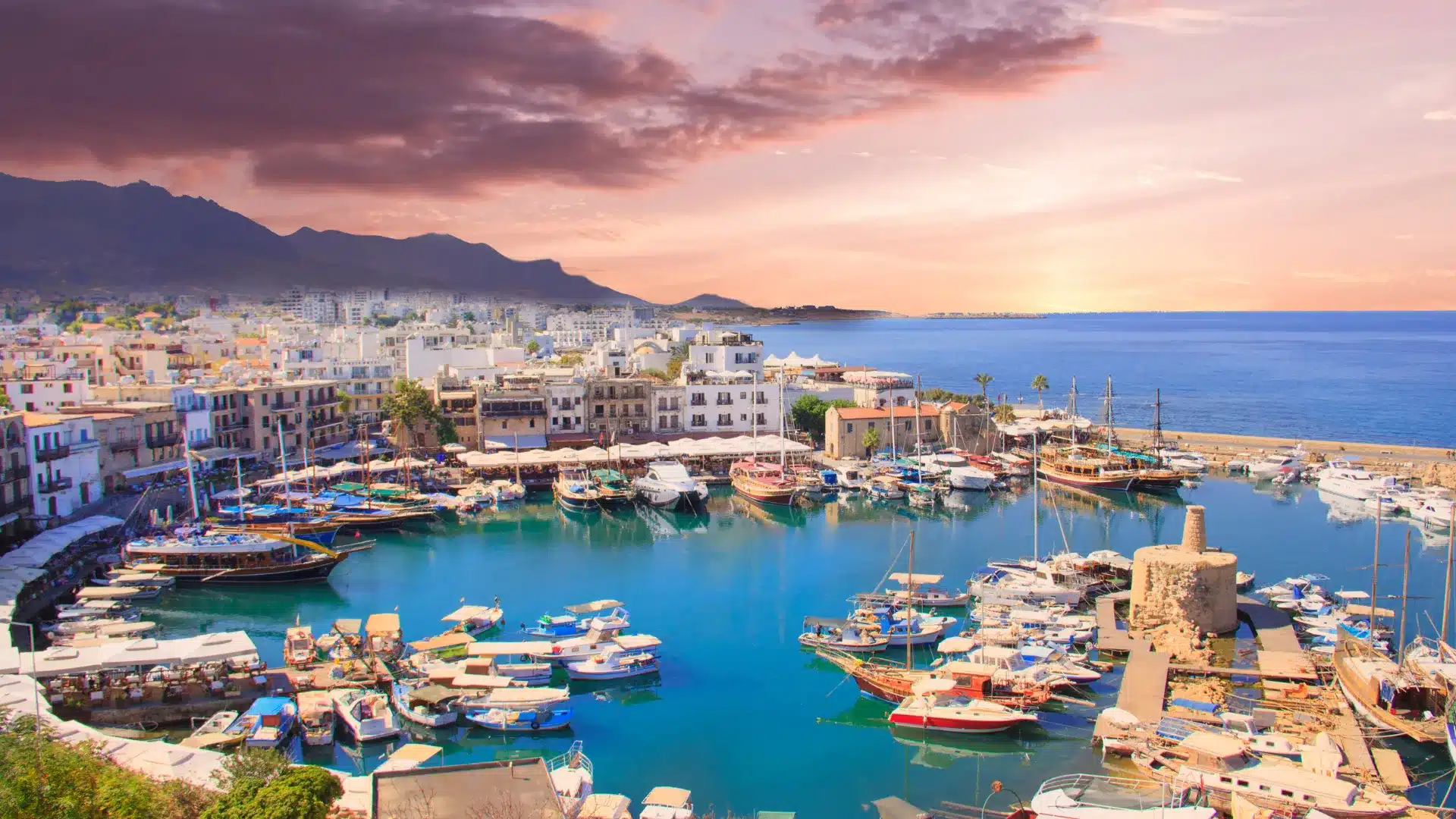
Cyprus is one of the Mediterranean’s most rewarding filming destinations, combining year-round sunshine, dramatic coastlines, mountain forests, ancient ruins, atmospheric old towns and one of the most generous film incentives in Europe. From the harbour at Paphos and the beaches of Ayia Napa to the Troodos mountains, the walled city of Nicosia and the vineyards and citrus groves of the interior, Cyprus offers an unusual spread of looks within very short driving distances, backed by a streamlined, government-supported approval process.
For international crews, Cyprus offers a rare blend of strong sunlight, varied locations and an attractive cash-rebate scheme, all on a compact island where most locations are within a couple of hours of each other. As a member of the European Union, Cyprus combines straightforward access for many nationalities with a stable, English-friendly business environment and a film commission set up specifically to bring international productions in. It sits within our wider production support across Europe.
Hoodlum provides Film Production Services in Cyprus for documentaries, commercials, factual entertainment, branded content, music videos, photography campaigns, feature films and television drama. Our team supports visa and accreditation guidance, film permits, location agreements, drone planning, customs and carnet clearance, local crew sourcing, transport, security planning and full on-ground production management throughout the island. You can see the full scope of what we do and the people behind it on our who we are page.
Cyprus rewards productions that arrive with their paperwork in order. It is a welcoming, film-friendly country, but it is not a destination for informal, undocumented shooting by foreign crews. The right entry route, the right permits, the right incentive application and the right equipment-clearance plan all need to be settled before the cameras roll, and the most efficient way to handle that is through an experienced local production partner.
Why Cyprus Works for Locations, Sunshine and Incentives
Cyprus’s biggest production strength is the combination of reliable light, diverse environments within tiny travel distances and a powerful financial incentive. In a single schedule a production can capture a sun-bleached beach, a rugged sea cliff, a pine-forested mountain, an ancient archaeological site, a medieval old town and a contemporary city street, often within an hour or two of each other. Long sunshine hours and a mild climate also extend the usable shooting day across much of the year.
Limassol and Nicosia are the operational centres, but the value sits in the route and in the rebate. A commercial might pair a turquoise coastline with a mountain village and a city street. A drama might combine an old-town interior with a beach and an archaeological backdrop. A travel or natural-history piece might move from the Troodos forests to the sea caves of the Akamas peninsula. Cyprus is strong because it can stand in for many Mediterranean and Middle Eastern settings at once, while offering one of Europe’s highest cash rebates to help fund the work.
Cyprus is especially well suited to:
- Feature films and television drama
- Commercials and branded content
- Documentary and factual series
- Reality and competition formats
- Travel, lifestyle and tourism content
- Fashion and photography campaigns
- Automotive and action sequences
- Natural-history and coastal programming
- Productions seeking a high cash rebate
Hoodlum’s production support team helps crews decide which regions are practical, what permissions each location needs and how to sequence movement between the coast, the cities and the mountains.
Limassol and the South Coast
Limassol is a natural anchor for many international productions working in Cyprus. It is a major coastal city with a marina, a regenerated seafront, a historic centre, a working port and ready access to crew, suppliers and accommodation. The surrounding south coast offers beaches, cliffs, resorts and the archaeological riches of the Kourion area.
The city itself is a versatile resource, offering contemporary towers and marina settings, old-town streets, industrial and port environments and long stretches of coastline. Crew accommodation, vehicle hire, fixers, customs agents, drone operators and security planning are all easy to coordinate from here. Hoodlum often uses Limassol as a practical hub for Film Production Services in Cyprus, particularly when a shoot combines coast, city and a quick reach into the mountains.
One planning point specific to Limassol: the Akrotiri Sovereign Base Area lies immediately to the west, and it is sovereign British territory rather than Republic of Cyprus territory. The salt lake, the Akrotiri peninsula and several stretches of coastline that appear on location lists fall inside it, on a separate permissions track. This is covered in more detail below.
Nicosia, Paphos and the Coastal Cities
Nicosia, the capital, offers a walled Venetian old town, museums, government and civic architecture, contemporary districts and a distinctive divided-city character found nowhere else in Europe. Paphos, on the west coast, brings a harbour, archaeological parks, sea caves and resort scenery, while Larnaca and Ayia Napa add palm-lined seafronts, salt lakes, beaches and lively coastal energy.
These cities suit drama, commercials, travel content and productions that need a mix of heritage texture and contemporary Mediterranean life. Each has its own permit considerations and busy tourist seasons to plan around, and Paphos in particular carries substantial archaeological protection that runs on its own approval timeline. Hoodlum handles the local permissions, access and timing so a popular seafront or a protected archaeological setting becomes a workable filming day.
The Troodos Mountains and the Interior
The Troodos mountains give Cyprus a cooler, greener register: pine forests, waterfalls, winding mountain roads, stone villages, Byzantine churches and even winter snow at altitude. The rural interior adds vineyards, citrus and olive groves, monasteries and traditional villages that feel a world away from the coastal resorts.
These environments suit drama, travel and natural-history content, automotive films and stories that need landscape variety beyond the beach. Mountain filming calls for tighter planning around winding access roads, weather at altitude, daylight and accommodation. Much of the range is state forest land, which means permissions run through the Department of Forests rather than a municipality, and the painted churches carry heritage protection of their own. Hoodlum builds the local driver, location and logistics coordination into the plan before a shoot moves inland.
The Akamas, Beaches and Coastline
Beyond the cities, Cyprus’s coastline is a major asset in its own right. The Akamas peninsula offers wild, undeveloped headlands, gorges, sea caves and the famous Blue Lagoon, while beaches around the island range from busy resort sands to remote rocky coves. The sea, the light and the cliffs give productions an exceptional natural canvas.
Coastal and marine filming should account for tides, wind, boat access, protected-area rules and seasonal crowds. Akamas and Lara Bay carry environmental protections connected to turtle nesting, which restricts access and equipment during the nesting season. Hoodlum helps productions plan the coast and the protected peninsulas as their own production environments, with the right access, permits, timing and contingency built in.
Understanding Cyprus’s Divided Geography
Cyprus has a political geography that directly shapes what a production can and cannot do, and it needs to be understood at scout stage rather than discovered on a recce.
The Republic of Cyprus controls the southern portion of the island, and that is where the film scheme, the permit authorities and Hoodlum’s operations sit. The northern portion is not under the effective control of the Republic, which means Republic permits carry no authority there, the film incentive does not apply to expenditure there, and equipment entering the island through northern ports and airports has not made a legal entry into the Republic or the EU customs territory. Productions occasionally attempt this and find their gear cannot legally move south.
Between the two runs the United Nations Buffer Zone, patrolled by UNFICYP. Filming in or adjacent to the buffer zone — including the sections that cut through Nicosia and give the old town its distinctive character — requires UNFICYP coordination in addition to any Republic permission. Lead times are longer and access is discretionary rather than assured.
Separately, the United Kingdom retains two Sovereign Base Areas, at Akrotiri and Dhekelia. These are sovereign British territory, not Republic of Cyprus territory, and filming within them requires Ministry of Defence permission on an entirely separate track. This matters practically because Akrotiri sits immediately west of Limassol and includes the salt lake, the Akrotiri peninsula and stretches of coastline that regularly appear on location lists without productions realising which jurisdiction they fall under.
None of this makes Cyprus difficult to work in. It does mean the boundaries need to be on the location plan from the beginning. Hoodlum maps each location to the correct jurisdiction before a scout goes out, and flags where a shot that looks straightforward is in fact three separate approvals.
Entry, Visas and Crew Accreditation
As an EU member, Cyprus offers straightforward access for many nationalities, but the right route still depends on each crew member’s nationality, role and length of stay.
One point catches productions out more than any other: Cyprus is a member of the European Union but is not part of the Schengen Area. A Schengen visa does not permit entry to Cyprus, and a crew member holding one still needs a Cyprus national visa if their nationality requires it. Equally, time spent in Cyprus does not count against a Schengen 90/180 allowance. Productions moving through Greece, Malta or Italy on the same trip should treat Cyprus as a separate immigration jurisdiction and plan the paperwork accordingly.
Citizens of the EU and EEA may enter and work freely. Many other nationals can enter visa-free for short stays, while visa-required nationals apply for a Cyprus national visa through the Civil Registry and Migration Department, typically with processing of around five to ten working days. Applicants generally need a passport valid for at least six months, a completed application form, a recent photograph, travel insurance and proof of the application fee. Longer engagements and certain non-EU roles may require a temporary work permit, arranged through the employer, and productions should establish which crew fall into that category early rather than at travel stage.
International crews shooting in Cyprus also coordinate accreditation and approval through the Cyprus Film Commission, supplying a completed application form, proof of the production, a script, a shooting itinerary, a crew list and proof of liability insurance. Hoodlum helps productions match each crew member to the correct route, assemble the accreditation and permit documentation, and avoid immigration becoming a late-stage problem.
Film Permits and Location Permissions
There is no single national film permit in Cyprus. The Cyprus Film Commission coordinates and advises, and is the right first call, but the permits themselves come from the authority that controls the location.
Municipalities issue permissions for filming on public streets and municipal property. The Department of Antiquities handles archaeological sites and protected monuments, which covers Kourion, the Paphos archaeological park, the Tombs of the Kings and the painted churches of Troodos. The Department of Forests handles state forest land, including much of the Troodos range. The Police handle road closures, traffic management and crowd control. The Deputy Ministry of Tourism is involved where a shoot carries tourism significance, and the Ministry of Defence where filming falls inside a Sovereign Base Area.
Applications generally require a completed film permit form, a script and storyboard, a shooting schedule and itinerary, a crew list with roles, an equipment list, proof of liability insurance and evidence of professional qualifications. Standard municipal filming with no closures generally clears in around five to ten working days once documentation is complete. Archaeological sites, forest land and anything involving road closures or crowd management take longer, and a multi-location schedule accumulates approvals rather than clearing them together.
Private locations, from villas and hotels to businesses, farms and private land, are negotiated directly with owners or managers, with a location agreement, an agreed fee and liability cover. A Hoodlum location scout can propose suitable options, after which we negotiate access, dates, crew size, vehicle movement, fees and reinstatement terms, and secure the agreement. Private permission does not replace any public-space, heritage or archaeological approvals a location also requires, and fees are quoted once the locations are confirmed.
Drone Filming and Aviation Rules
Drone operation requires prior approval from the Cyprus Department of Civil Aviation and must comply with the harmonised EU drone framework. Commercial film work generally requires a valid EU drone-pilot certificate, operator registration, adequate liability insurance and adherence to rules on altitude, distance and proximity to people, airports and sensitive sites, with specific authorisation depending on the operation and location.
Applications typically require a completed drone permit form, the operator certificate, proof of liability insurance, drone specifications, a flight plan and coordinates, and a map of the filming area, with processing often taking around ten to fifteen working days. Two Cyprus-specific restrictions matter: the airspace around the Sovereign Base Areas at Akrotiri and Dhekelia is military and effectively closed to production drones, and flight near the buffer zone is restricted. Both sit close to locations productions routinely want.
Importing a drone means meeting customs requirements as well, usually via a temporary import procedure or carnet, with the drone declared and any applicable VAT considered. For incoming productions, the most practical route is often to engage a locally licensed drone operator who already holds the right certificate, registration, insurance and familiarity with Cypriot and EU airspace rules. Importing your own drone is possible but adds customs and compliance steps and longer lead times. Hoodlum helps productions decide between a local operator and importing equipment, and builds the necessary lead time into the plan.
Equipment Customs Clearance and the ATA Carnet
Cyprus is an ATA Carnet country, which makes temporary equipment importation relatively straightforward for productions that prepare properly. An ATA Carnet acts as a single international customs document allowing professional filming gear to be temporarily imported duty-free and tax-free, on the guarantee that it will be re-exported within the validity period, typically up to one year.
Customs clearance is handled by the Cyprus Customs Department, and a clean carnet supported by a detailed equipment list, accurate values and serial numbers helps the process run smoothly. As an island, Cyprus sees gear arrive mainly by air or sea, so allowing a few days for clearance is sensible.
The distinction that saves most productions time is the EU one. For crews travelling from within the European Union, goods in free circulation move without carnet formalities at all — there is no customs frontier to cross. The carnet primarily matters for kit arriving from outside the Union, and a production shipping from London, Dubai or Los Angeles is in a different position from one driving equipment in from Greece. Note also that equipment arriving through northern ports has not entered the EU customs territory and cannot be regularised by crossing south.
Hoodlum helps productions prepare the equipment list, values, carnet documentation and clearing-agent coordination so cameras, lighting, grip and sound gear move through the airport or port with minimal delay.
The Cyprus Film Scheme: Cash Rebate and Tax Credit
Cyprus’s headline draw is the Cyprus Film Scheme, administered by the Cyprus Film Commission under Invest Cyprus, which offers one of the most competitive incentive packages in Europe. Productions choose between a cash rebate and a tax credit, and can also benefit from tax allowances on infrastructure and equipment investment and VAT refunds on qualifying expenditure.
Rate decision: the figures below are the ones published on the government portal, filmingincyprus.gov.cy — up to 40% cash rebate or up to 50% tax credit. Your current page says 45% below-the-line and 25% above-the-line, which is the figure on the older film.investcyprus.org.cy subdomain. If Dino confirms 45%/25% is current, swap the sentence marked below and nothing else changes.
The cash rebate can reach up to 40% of eligible expenditure incurred in Cyprus, with the exact figure depending on the production’s score against a cultural test. As an alternative, the tax credit offers a reduction of up to 50% in the corporate tax liability of the company responsible for the production, capped at 50% of that company’s taxable income for the year, with any unused portion carried forward for up to five years. The cash rebate and the tax credit cannot be combined, so productions select one, though either can sit alongside the VAT refund and the investment allowance of up to 20% on equipment and infrastructure.
Minimum spend thresholds are set in euros and vary by format: €200,000 for feature films, €100,000 for television drama series or self-contained drama films, €50,000 for documentaries for television or cinema broadcast, and €30,000 for other television programmes. In each case the qualifying spend must not exceed 50% of the total production budget. Productions must also promote Cypriot, European or world culture through the cultural-test criteria.
Eligible applicants must be registered in Cyprus or another EU member state and carry on business in Cyprus, directly or through a branch office. There is no restriction on foreign ownership of the eligible entity. Qualifying categories include feature films, animation, television series and mini-series, documentaries for theatrical or television release, television research programmes and natural history. The rebate is paid following a full audit of submitted expenditure, and the scheme operates under Article 54 of EU Regulation 651/2014.
The scheme was legislated to run to 31 December 2026, with an extension anticipated. Productions planning into 2027 should confirm the current position before committing, and in all cases the rates, caps and thresholds should be verified with Invest Cyprus before a budget is locked. Hoodlum can connect productions with approved auditors and advisors to navigate the application, and can compare the position against current programmes across our film incentives guide.
Safety, Security and Practical Logistics
Cyprus is generally considered a very safe and film-friendly country, with a stable environment, helpful authorities and a culture that actively supports international productions. The risk profile is low in most settings, but it still varies with location, subject matter, public exposure and crew footprint.
Controlled and private environments usually need little or no security. Filming in public areas typically involves police permits and may require crowd-control and traffic-management plans, while busy locations, valuable equipment or sensitive shoots may call for on-set security, secure storage and uniformed or plain-clothes personnel. Thorough location scouting to identify and plan around risks is the practical foundation of a smooth shoot.
Heat, sun and water are the practical variables that most affect a schedule. Summer temperatures regularly exceed 35°C inland and sun exposure is intense, which shapes crew welfare, equipment protection and the usable shooting window through July and August. Coastal and marine work needs careful planning around wind and swell, while mountain weather and shorter winter daylight shift the picture inland. Medical infrastructure is good and no special vaccinations are required for entry. Hoodlum helps productions balance sensible security with efficient movement, and builds heat, daylight and contingency thinking into the schedule from the start.
When Cyprus Is the Right Production Choice
Cyprus is the right choice when a production needs reliable Mediterranean sunshine, varied coast-to-mountain locations, ancient and old-town heritage and one of Europe’s most generous cash rebates, all on a compact, easily navigated island. It is especially strong for feature films, television drama, commercials, documentary, reality formats, travel and lifestyle content, fashion, automotive and action work, and any project that wants to combine beach, city and mountain in a single efficient schedule while accessing a strong incentive.
Cyprus may be less suitable for productions that need extensive large-scale studio infrastructure, cool or northern European looks, or that expect to arrive and shoot informally without permits or planning. It is highly workable when the entry route, accreditation, permits, drone arrangements, carnet, incentive application and location agreements are settled early.
Common Production Mistakes to Avoid
The most frequent mistakes include:
- Assuming a Schengen visa admits crew to Cyprus, which it does not
- Treating the incentive as automatic rather than a scored, application-based scheme
- Applying for the Cyprus Film Scheme too late to structure spend correctly
- Trying to combine the cash rebate and the tax credit, which is not permitted
- Approaching the Civil Registry and Migration Department for a film permit, which it does not issue
- Putting Akrotiri or Dhekelia locations on a schedule without Ministry of Defence permission
- Routing equipment through northern ports and expecting it to move south
- Underestimating drone authorisation timelines and the restricted airspace around the base areas and buffer zone
- Arriving with non-EU equipment before carnet or temporary-import preparation is complete
- Underestimating summer heat, sun exposure and the demands of coastal and marine work
Most of these problems are avoidable by aligning the crew list, accreditation, permits, drone plan, carnet, incentive application and location agreements well before the crew travels.
How Hoodlum Supports Productions in Cyprus
Hoodlum provides Film Production Services in Cyprus for international crews that need experienced local coordination from early planning through to wrap. Our support covers entry and accreditation guidance, film permits and location permissions, private location agreements, jurisdiction mapping across the Republic, buffer zone and base areas, regional coordination, drone planning, carnet and customs preparation, clearing-agent coordination, local crew sourcing, transport, accommodation, security planning and on-ground production management, plus introductions to the right advisors for the incentive scheme.
From Limassol and the south coast to Nicosia, Paphos and Larnaca, the Troodos mountains and the wild Akamas peninsula, we help productions access the strongest filming environments in Cyprus with the right permits, fixers, customs planning and logistics in place. You can read more about our work on the island in Trusted Local Support for International Productions in Cyprus and Film Production Services in Cyprus, and see delivered work in our portfolio.
Planning a shoot? Contact us to talk through permits, accreditation support, local fixers, location scouting, carnet planning, drone coordination and full on-ground production management.
Frequently Asked Questions
Do international crews need a visa to film in Cyprus?
It depends on nationality, role and length of stay — and on one point that catches productions out: Cyprus is in the European Union but not in the Schengen Area, so a Schengen visa does not admit anyone to Cyprus. EU and EEA citizens may enter and work freely. Many other nationals can enter visa-free for short stays. Visa-required nationals apply for a Cyprus national visa through the Civil Registry and Migration Department, typically five to ten working days. International crews also coordinate accreditation through the Cyprus Film Commission.
Who issues film permits in Cyprus?
There is no single national permit. The Cyprus Film Commission coordinates and is the right first contact, but permits come from whoever controls the location — municipalities for public streets, the Department of Antiquities for archaeological sites and monuments, the Department of Forests for state forest land including Troodos, and the Police for road closures and crowd control. Standard municipal filming typically clears in five to ten working days; archaeological and forest permissions take longer.
Who regulates drones in Cyprus?
The Cyprus Department of Civil Aviation regulates drone operation within the harmonised EU framework. Commercial work needs a valid EU drone-pilot certificate, operator registration, liability insurance and, depending on the operation and location, specific authorisation, with processing around ten to fifteen working days. Airspace around the Akrotiri and Dhekelia Sovereign Base Areas is military and effectively closed to production drones, and flight near the UN buffer zone is restricted. Using a locally licensed operator is usually the most practical route.
Is Cyprus an ATA Carnet country?
Yes. Temporary importation of professional filming equipment from outside the European Union is handled through the ATA Carnet system, with clearance via the Cyprus Customs Department. Crews travelling from within the EU move goods in free circulation without carnet formalities, so the carnet primarily matters for kit arriving from outside the Union. Equipment arriving through northern ports has not entered the EU customs territory and cannot be regularised by crossing south.
How does the Cyprus film incentive work?
The Cyprus Film Scheme lets productions choose between a cash rebate of up to 40% of eligible Cyprus expenditure, or a tax credit of up to 50% against corporate tax liability, with the figure depending on a cultural-test score. The two cannot be combined, though either can sit alongside VAT refunds and an investment allowance of up to 20% on equipment and infrastructure. Minimum spend is €200,000 for feature films, €100,000 for TV drama, €50,000 for documentaries and €30,000 for other TV programmes, and must not exceed 50% of the total budget. The scheme was legislated to 31 December 2026 with an extension anticipated. Applications run through Invest Cyprus.
Can productions film in northern Cyprus or the buffer zone?
Not under Republic of Cyprus permissions. The northern portion of the island is not under the effective control of the Republic, so Republic permits carry no authority there and the film incentive does not apply to expenditure there. The UN Buffer Zone requires UNFICYP coordination in addition to any Republic permission, with longer lead times and discretionary access. The British Sovereign Base Areas at Akrotiri and Dhekelia are sovereign UK territory and require Ministry of Defence permission on a separate track — which matters because Akrotiri sits immediately west of Limassol.
What are the best filming locations in Cyprus?
Popular options include Limassol and the south coast, Nicosia’s walled Venetian old town, Paphos with its harbour and archaeological parks, Larnaca and Ayia Napa on the coast, the Kourion archaeological area, the Troodos mountains and their stone villages and painted churches, and the wild Akamas peninsula with its sea caves and Blue Lagoon.
When is the best time to film in Cyprus?
Spring and autumn offer the most workable combination of light, temperature and manageable crowds. Summer brings the most reliable sunshine but inland temperatures regularly exceed 35°C, sun exposure is intense and coastal locations are busiest. Winter is mild at sea level and remains usable for most work, with snow at altitude in Troodos between roughly January and March — which is a genuine asset for productions needing snow within an hour of a beach.
Useful Authority Links
Ready to bring your production to Cyprus? Hoodlum handles the permits, accreditation guidance, location scouting, carnet and customs planning, drone coordination, local crew, incentive introductions and full on-ground production management, so you can focus on the work in front of the lens. Get in touch with our team to start planning, and tell us your locations, dates and creative brief.
Planning a shoot in Cyprus? Contact Hoodlum for Invest Cyprus and Ministry of Interior permit coordination, local fixers, archaeological-site permissions, buffer zone clearances, coastal and marine access, ATA Carnet customs planning, drone coordination, underwater-unit logistics, crew sourcing and full on-ground production management. You can also view the Hoodlum Film Fixers Cyprus Google Business Profile for local production details.