




















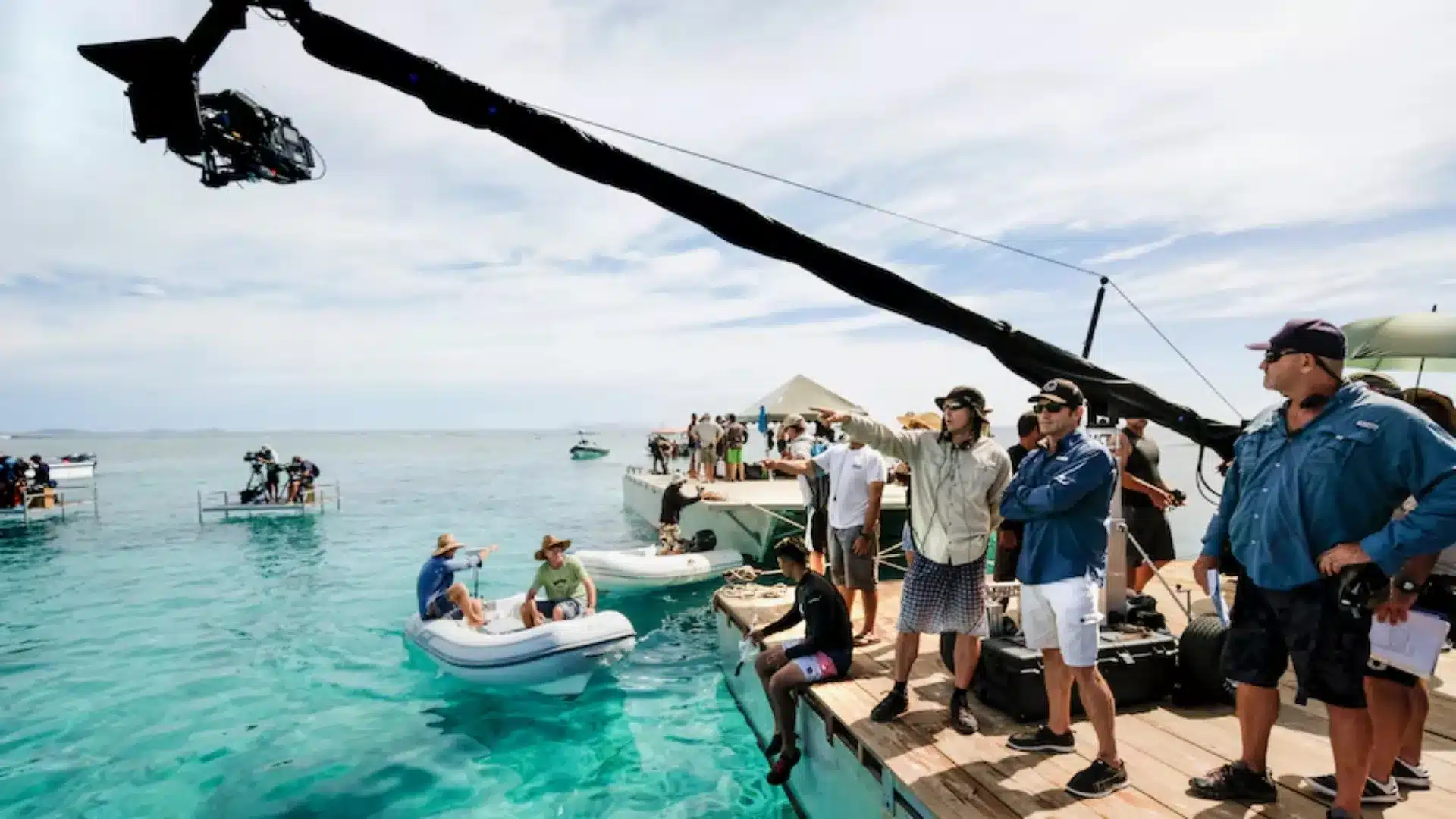
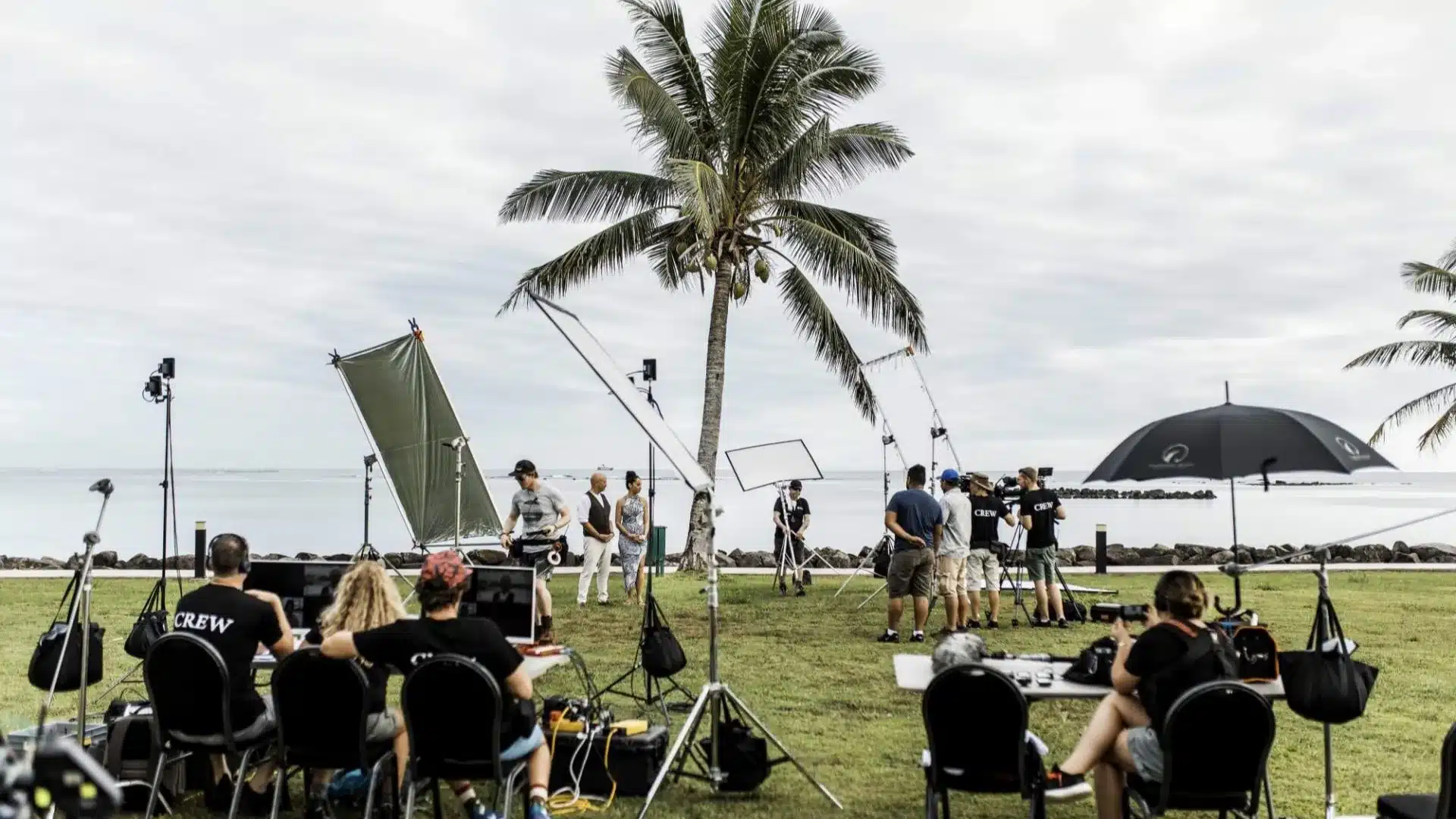
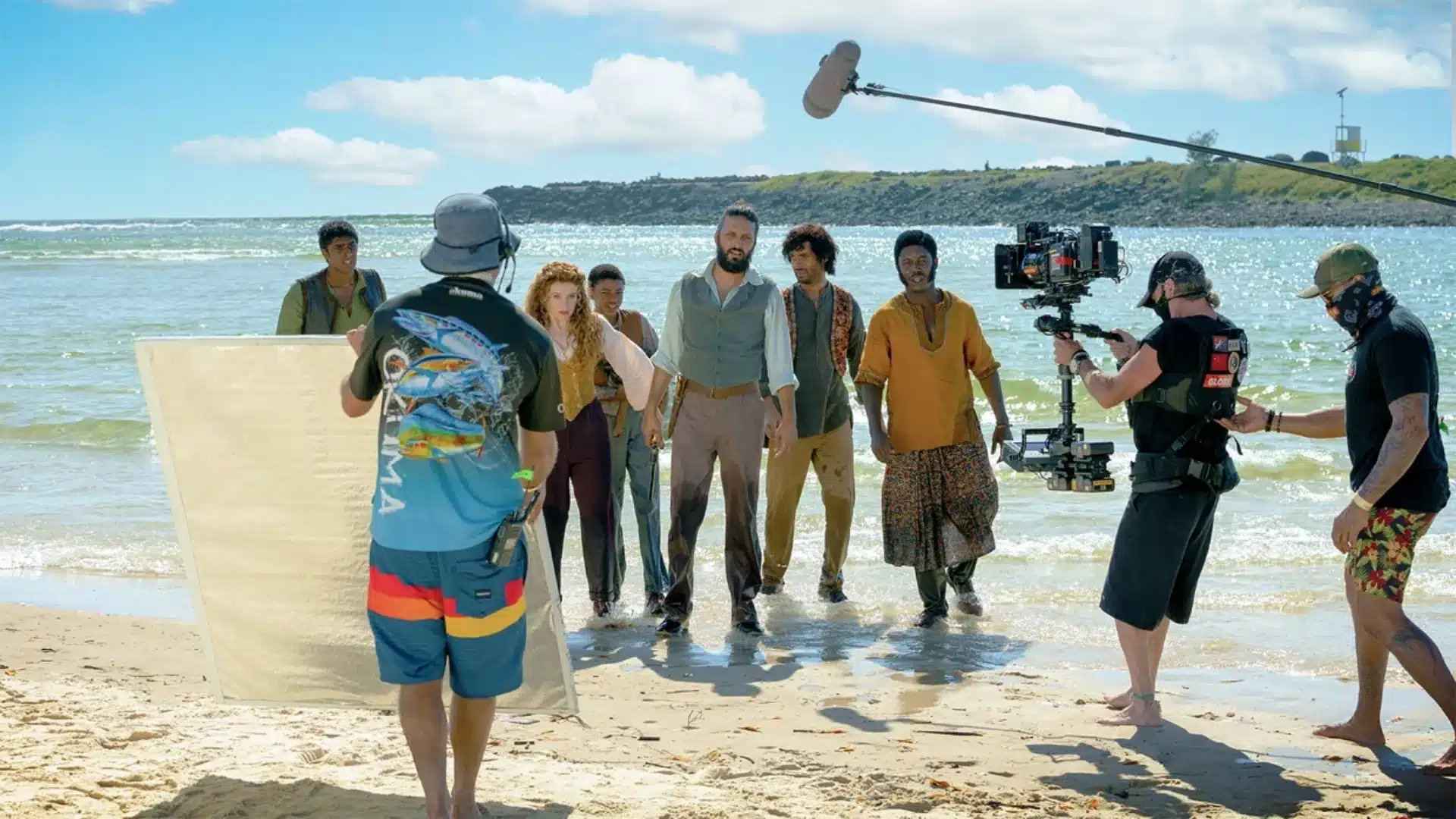
Fiji is one of the Pacific’s most established filming destinations, combining tropical islands, white-sand beaches, coral reefs, rainforests, waterfalls, volcanic landscapes and production-friendly infrastructure. It has hosted feature films, reality television franchises, travel programming, commercials and luxury tourism campaigns, and it offers international productions a rare combination of cinematic locations and a functioning permitting authority.
Hoodlum provides Film Production Services in Fiji for commercials, television productions, travel campaigns, branded content, documentaries and feature projects across Suva, Nadi, Lautoka, Labasa, the Coral Coast, the Mamanuca and Yasawa groups and remote resort locations. Our team handles Film Fiji permits, rebate documentation, customs coordination, CAAF drone authorisations, location scouting, iTaukei land consents, island logistics, local crew sourcing, marine filming support and full on-ground production management.
Fiji is one of the easier filming destinations in the Pacific, but it is not a permissionless one. Island transport, cyclone-season weather, environmental protection and customary land ownership all shape what is achievable on a given schedule. Early coordination with Film Fiji and a local production partner is what keeps a plan realistic.
Why Film in Fiji
Fiji’s visual range extends well beyond beaches. Within a compact geography, productions can reach luxury resorts, remote islands, tropical forest, rivers, waterfalls, coral lagoons, mountain terrain and traditional villages.
The destination is particularly strong for:
- Tourism and destination campaigns
- Resort and hospitality advertising
- Reality television and survival formats
- Luxury brand commercials
- Documentary and natural history production
- Marine, diving and underwater content
- Lifestyle and fashion campaigns
- Feature films and television series
Fiji can double for numerous tropical destinations while offering English-speaking crews, direct air links to Australia, New Zealand, the US west coast and Asia, and an established production support sector.
The Fiji Film Tax Rebate — 20% Cash Back on Fiji Spend
Fiji’s headline incentive is a 20% cash rebate on Total Fiji Expenditure, available to fully-funded offshore productions under Legal Notice 30 of 2022 and the Income Tax (Film-making and Audio-visual Incentives) Regulations 2016.
The numbers producers need at budget stage:
- Rebate rate: 20% of Total Fiji Expenditure
- Maximum rebate: FJD 4 million per approved Final Certificate
- Minimum spend: FJD 250,000 Total Fiji Expenditure
- Minimum shoot in Fiji: none — there is no minimum percentage of the film that must be shot in country
- What counts: goods and services purchased from and paid to Fiji residents, through a Fiji production bank account
Qualifying formats include large-format films, feature films, short films, scripted and unscripted television, reality shows, documentaries and television commercials.
The conditions are where applications most often fail. To qualify, a production must:
- Incorporate a locally registered Fiji production company
- Transfer production funds to a Fiji bank account before principal photography begins
- Engage a licensed Audio-Visual Agent — Film Fiji has licensed audio-visual agents since 2012, and applications for the Final Certificate must be lodged through a licensed agent, lawyer or accountant
- Hold public liability cover for every location used
- Pay the 1% Fiji National University levy when engaging local crew
- Demonstrate the ability to release and distribute in at least one significant international market
- Submit fortnightly cost and production reports during the shoot, and audited accounts of production expenditure at the end
- Acknowledge the Government of Fiji and Film Fiji in the film, with “Filmed on location in Fiji” in the final edited version — regardless of where the story is set
Domestic finance is handled separately. Fiji taxpayers investing in qualifying productions can claim a 150% deduction under the F1 scheme or a 125% deduction under F2, subject to minimum local spend of 40% for large-format, feature and broadcast television, 50% for direct-to-video and 55% for audio recordings. F1 carries a 60% return threshold before net income is taxed; F2 carries 50%. F1 favours projects that showcase Fiji culturally.
One point that catches producers late: the schemes do not stack. Electing the 20% rebate excludes that project from F1/F2, post-production and equipment-import deductions. The choice is made at structuring stage, not at Final Certificate stage.
Fiji also administers a non-resident employee tax waiver facility through Film Fiji, relevant where visiting crew are on production payroll.
Compare Fiji against other markets on our film incentives hub, or read the detail on the Fiji 20% film tax rebate.
Film Fiji — The Film Commission
Film Fiji is the official film commission of the Republic of Fiji. It administers the government’s audio-visual incentives, issues film permits, maintains a crew database and locations gallery, and coordinates approvals across government. It introduced the licensing regime for Audio-Visual Agents in 2012 so that only qualified, bona-fide operators work directly with foreign production companies claiming the rebate.
Address: Ground Floor, Civic House, New Town Hall Road, GPO Box 18080, Suva, Fiji Email: info@film-fiji.com Website: film-fiji.com Application forms: Film Permit application
Film Permits and Production Approval
Every production intending to film in Fiji applies to Film Fiji for a Film Permit. The application carries crew and cast biodata, a synopsis or script, an equipment list, the flight itinerary and the budget. Film Fiji states processing is fast where the full document set is submitted; plan on one to two weeks for a standard production and longer for complex projects.
The Film Permit matters beyond the right to roll. It is the document that facilitates every downstream approval, with Film Fiji naming six stakeholder bodies it supports dealings with:
- Fiji Revenue & Customs Service — equipment clearance
- Ministry of Health and Medical Services
- Department of Immigration — crew status
- Ministry of Lands & Minerals — state land
- iTaukei Land Trust Board — customary land
- Department of Environment — protected and sensitive areas
Secure the permit before filming begins. Productions on government land, in protected environments, in marine reserves or at culturally significant sites will need additional permissions on top.
Visa Requirements and Crew Status
Around 105 nationalities enter Fiji visa-free and receive a visitor permit on arrival, usually for up to four months. Nationals of non-exempt countries apply for a Single Entry Visa or Multiple Entry Visa in advance and should allow one to four weeks.
The distinction that matters for crew: entry permission is not work authorisation. A visitor permit covers travel. The Business Visitor Permit issued on arrival covers business, consultancy and research for 14 days — up to 21 days for Australian, New Zealand, Singaporean and US nationals — but not employment. Where crew are performing paid production work, the appropriate permit must be in place. Fiji issues short-term work permits of up to one year and long-term permits of three years, employer-sponsored, with processing generally running four to six weeks. Since 23 April 2025 all work permit applications are assessed strictly under the Immigration Act 2003 and its regulations; the Qualified Employers and SPEC categories are no longer accepted.
Passports must carry at least six months’ validity from the date of entry. This is a requirement, not a recommendation — airlines refuse boarding at check-in without it.
We confirm crew status with the Ministry of Immigration through the Film Permit process before travel, so that the entry route matches what the crew will actually be doing on the ground.
Location Access and Customary Land
This is the single most misunderstood part of filming in Fiji. Most land is iTaukei — customary land held by mataqali landowning units and administered by the iTaukei Land Trust Board. Consent runs through TLTB. State land is administered by the Ministry of Lands & Mineral Resources. Freehold land is a small minority.
The practical consequence: permission from the occupier of a site is not the same as permission to film on it. A resort may control its own grounds and still have no authority over the beach, the reef or the access road. Marine work adds another layer — customary fishing grounds (qoliqoli) carry rights that sit with the local community, and filming over them requires their consent.
We identify the correct rights-holders at recce stage and secure the consents in the right order. Assuming one signature covers a location is the most common way a Fiji schedule loses a day.
Filming in Suva
Suva is the capital and the largest urban production base. It offers government districts, commercial areas, offices, hotels, waterfront, educational institutions and residential neighbourhoods, and is well suited to corporate filming, documentary interviews, government-related production, news features and urban lifestyle campaigns. It is also the logistical base for productions travelling to outer islands, and the location of Film Fiji, Immigration and the main FRCS offices.
Filming in Nadi and the Coral Coast
Nadi is the international gateway and one of the busiest tourism regions, with luxury resorts, beaches, marina facilities, tourism infrastructure and coastal roads. The Coral Coast provides extensive beach and resort environments suited to tourism campaigns, commercials, lifestyle production and hotel marketing. Most productions base here for the combination of accessibility, accommodation and visual variety, and travel out for hero locations.
Filming on Outer Islands
The Mamanuca and Yasawa groups and the more remote outer islands hold Fiji’s most spectacular locations — remote beaches, coral reefs, lagoons, tropical forest, private islands and traditional communities.
They also carry the real logistical load: boat or seaplane transport, weather dependency, equipment movement over water, limited accommodation, longer medical evacuation times and patchy communications. Island shoots need materially more planning than mainland days, and a contingency day is not a luxury.
We handle transport coordination, vessel sourcing, local permissions and operational planning for remote island production.
Drone Operations
Commercial drone filming is regulated by the Civil Aviation Authority of Fiji under the Air Navigation Regulations. Commercial operations require written authorisation from CAAF before any flight — applied for on form OP 138, with RPAS Authorisation acting as the prerequisite for RPAS permission via form GS900. Recreational registration uses OP 137. Any drone used commercially must be registered with CAAF regardless of weight.
The operating envelope:
- Maximum 200 feet (61 m) above ground level unless CAAF approves higher
- No flights within 5 km of international airports
- No flights within 3 km of other airports and helipads
- Resort, community and cultural-site sensitivities apply on top of the aviation rules
Applications require a letter of intent covering the project period and area of use, drone make, model and serial number, liability and third-party insurance from a recognised aviation insurance broker, and evidence of pilot competency — a Basic sub-2kg drone certification or a Remote Pilot Licence acceptable to CAAF. Aircraft above 7 kg require maintenance records and a flight manual.
Allow two to three weeks. Unauthorised drone operation is an enforcement matter, not a paperwork oversight.
Equipment Customs Clearance
Fiji does not accept ATA Carnets. This is the correction most likely to affect a shipping plan: Fiji appears on the international lists of destinations that do not accept carnets, and a carnet presented at Nadi will not clear equipment into the country. It remains useful as your home-country registration of goods for departure and return.
Equipment enters under a temporary import arrangement with Fiji Revenue & Customs Service, covering specialised equipment not normally available in Fiji and imported solely for a specific project. FRCS or a licensed local customs agent must be engaged before the shipment arrives. Temporary admission is granted against a bond or other security acceptable to Customs, released on verified re-export within the agreed period. The entry is lodged through ASYCUDA World by a licensed agent.
Documentation runs to a detailed equipment list with serial numbers and values, a value declaration, the Film Fiji permit, the airway bill or bill of lading and the security instrument. Clearance typically takes one to five working days where pre-clearance was arranged.
Productions moving equipment onward between islands should budget separately for inter-island freight and handling — customs clearance at the port of entry does not solve the second leg.
Marine and Water-Based Filming
Fiji is exceptional for diving, sailing, marine wildlife, yacht, tourism, reality and underwater content. Marine production planning has to account for weather windows, tidal movement, dive safety and medical cover, vessel permits, environmental regulation and marine protected areas — plus qoliqoli consent where customary fishing grounds are involved.
We support marine filming with vessel sourcing, certified local dive and safety operators, permit coordination and environmental compliance.
Best Time of Year to Film
Fiji has a tropical marine climate with two clear seasons.
Dry season (May to October) is the preferred filming window: lower humidity, less rainfall, more predictable weather, better marine visibility, easier inter-island transport.
Wet season (November to April) brings higher temperatures and humidity, tropical rainfall, cyclone risk and variable marine conditions. Filming remains possible, but contingency days and flexible location plans stop being optional.
How the Main Approvals Fit Together
One approval does not cover the rest.
- Entry permission allows travel — it does not authorise work or filming
- The Film Fiji permit authorises production activity — it does not grant private location access, drone authorisation, marine permits, customary land consent or environmental clearance
- Customs clearance allows equipment in — it does not authorise its use in restricted areas
- Resort or occupier consent covers their property — it does not cover the beach, reef or customary land beyond it
A workable Fiji plan combines entry route, Film Fiji approval, TLTB or Ministry of Lands consent, private location agreements, CAAF authorisation, FRCS temporary import, marine permissions, transport logistics and weather contingency — sequenced so that each one is in place before the one that depends on it.
Common Mistakes to Avoid
- Assuming a carnet will clear equipment into Fiji
- Assuming the 20% rebate can be combined with F1 or F2 on the same project
- Budgeting the rebate without an incorporated Fiji entity, a Fiji bank account and a licensed Audio-Visual Agent
- Treating visa-free entry as authorisation to work
- Treating resort permission as covering the beach, reef or access route
- Leaving TLTB consent to the week of the shoot
- Filming a drone shot on recreational registration rather than an OP 138 commercial authorisation
- Scheduling cyclone-season island days without contingency
- Underestimating inter-island transport and equipment handling
- Missing the fortnightly cost reports required during production, then failing the Final Certificate
How Hoodlum Supports Film Production in Fiji
We provide practical film production services in Fiji for international productions:
- Film Fiji permit coordination
- Rebate structuring, eligibility assessment and Final Certificate documentation
- Licensed Audio-Visual Agent liaison
- Location scouting and TLTB / customary land consent
- Resort and private island access
- Local fixers and crew sourcing
- FRCS temporary import and customs coordination
- CAAF drone authorisation
- Marine filming, vessel and dive safety coordination
- Transport, accommodation and island logistics
- On-set production management
From luxury resort campaigns and underwater production to reality television and features, we handle the permissions layer so the schedule and the creative survive contact with island logistics.
Frequently Asked Questions
Does Fiji accept ATA Carnets?
No. Fiji does not accept ATA Carnets. Production equipment enters under a temporary import arrangement with Fiji Revenue & Customs Service, against a bond or security that is released on verified re-export. A carnet can still serve as your home-country registration of goods, but it will not clear equipment into Fiji. Engage FRCS or a licensed local customs agent before the shipment arrives.
What is the film rebate in Fiji?
Fiji offers a 20% cash rebate on Total Fiji Expenditure to fully-funded offshore productions, capped at FJD 4 million per approved Final Certificate, with a minimum qualifying spend of FJD 250,000. There is no minimum percentage of the film that must be shot in Fiji.
What counts as Total Fiji Expenditure?
Production expenditure on goods and services purchased from and paid to Fiji residents, routed through a Fiji production bank account. Spend paid to non-resident suppliers does not count.
Can a production claim both the 20% rebate and the F1 or F2 deduction?
No. Electing the 20% Film Tax Rebate excludes that project from the F1/F2 schemes, post-production deductions and equipment-import deductions. The structure is chosen up front.
What is the difference between F1 and F2 in Fiji?
Both allow Fiji taxpayers to claim enhanced deductions on investment in qualifying productions. F1 gives a 150% deduction with net income tax-exempt until the investor recovers a 60% return. F2 gives 125% with a 50% threshold. F1 favours projects that showcase Fiji — written by or based on the creative idea of a Fiji citizen or resident, or portraying Fiji, its history, people, flora and fauna.
Who issues film permits in Fiji?
Film Fiji, the national film commission. The application requires crew and cast biodata, a synopsis or script, an equipment list, flight itinerary and budget. Allow one to two weeks for a standard production.
Do foreign crew need a visa to film in Fiji?
Around 105 nationalities enter visa-free and receive a visitor permit on arrival, typically up to four months. Entry permission is not work authorisation. The Business Visitor Permit issued on arrival covers business activity for 14 days — 21 for Australian, New Zealand, Singaporean and US nationals — but not employment. Where crew perform paid production work, the appropriate work permit must be in place; processing generally takes four to six weeks.
How long does a Fiji work permit take?
Generally four to six weeks. Short-term permits run up to one year and long-term permits to three years, both employer-sponsored. Since 23 April 2025 all applications are assessed strictly under the Immigration Act 2003.
Do I need a permit to fly a drone in Fiji?
Yes. Commercial drone filming requires written authorisation from the Civil Aviation Authority of Fiji before any flight, applied for on form OP 138, with RPAS permission via form GS900. Commercial drones must be registered with CAAF regardless of weight. Flights are limited to 200 feet (61 m) above ground level unless CAAF approves higher, and are prohibited within 5 km of international airports and 3 km of other airports and helipads.
Who owns filming locations in Fiji?
Most land is iTaukei customary land administered by the iTaukei Land Trust Board. State land sits with the Ministry of Lands & Mineral Resources. Freehold is a minority. Consent from a site’s occupier — including a resort — does not replace TLTB or state consent, and marine filming over customary fishing grounds requires the rights-holders’ consent.
When is the best time to film in Fiji?
May to October, the dry season — lower humidity, less rain, more predictable weather, better marine visibility and easier inter-island transport. November to April carries cyclone risk and variable marine conditions, and needs contingency built into the schedule.
Is Fiji safe for film crews?
Yes. Fiji is politically stable and production-friendly, and the primary risks are environmental rather than security-related — cyclone season, marine conditions, remote island logistics and medical access outside Suva and Lautoka. Public liability cover for every location is a condition of the rebate as well as good practice.
External Authority Links
- Film Fiji — film commission, permits and incentives
- Film Permit application
- 20% Film Tax Rebate
- F1/F2 Incentives
- Civil Aviation Authority of Fiji (CAAF) — Drones
- Fiji Ministry of Immigration
- Fiji Revenue & Customs Service
- iTaukei Land Trust Board (TLTB)
- Ministry of Lands & Mineral Resources
- Ministry of Trade, Co-operatives, SMEs and Communications
- Income Tax (Film-making and Audio-visual Incentives) Regulations 2016
- Tourism Fiji
Planning a shoot in Fiji? Contact Hoodlum for Film Fiji permits, rebate guidance, local fixers, island logistics, resort access, customs coordination, drone approvals and marine filming support. You can also view the Hoodlum Film Fixers Fiji Google Business Profile.