
Film Fixers in
Pacific Islands
Hoodlum Film Fixers provides expert film production services across the Pacific Islands, with permanent local offices and experienced crews throughout the region. We have people on the ground in the territories where we work — managing permits, local crew, equipment logistics and location access for international productions of every scale and format.
FILM FIXERS IN PACIFIC ISLANDS
Hoodlum Film Fixers has Production Service offices
Hoodlum Film Fixers provides expert film production services across the Pacific Islands — from Fiji, Papua New Guinea and Vanuatu to the Solomon Islands, Samoa, Tonga and beyond. With permanent local offices and experienced crews throughout the region, we deliver end-to-end production support for international broadcasters, streaming platforms and commercial productions working across some of the most remote and visually extraordinary filming environments on earth.
The Pacific Islands offer a filming landscape unlike anywhere else — pristine coral reef systems, volcanic archipelagos, ancient indigenous cultures, untouched jungle interiors and coastlines that have never appeared on screen. But producing in the Pacific requires genuine local knowledge. Each island group operates under its own government permit framework, customs procedures, aviation rules and community access protocols. Marine filming, drone operations, inter-island logistics and weather windows all demand careful planning and established relationships with local authorities to manage effectively.
Click on the region below to view full Comprehensive Production Support Guide
WHY HOODLUM FILM FIXERS IN PACIFIC ISLANDS
Why Film in the Pacific Islands with Hoodlum Film Fixers
The Pacific Islands represent one of the last truly untouched filming frontiers on earth. Across more than 20,000 islands spanning the South Pacific, Melanesia, Micronesia and Polynesia, productions find environments that exist nowhere else — ancient volcanic calderas rising from the ocean, world-record coral reef systems, indigenous cultures maintaining traditions unchanged for centuries, and coastlines and jungle interiors that have rarely if ever appeared on an international screen.
For productions seeking genuine visual distinction, the Pacific delivers what no other region can replicate.
But the Pacific Islands are also one of the most logistically complex filming environments in the world. Island access frequently depends on small aircraft and boat charters operating on weather-dependent schedules. Government permit systems, customs procedures and community access protocols vary not just between countries but between individual island groups within the same nation.
Drone operations are governed by civil aviation authorities whose frameworks differ significantly across the region. Marine filming — reef systems, open ocean, underwater environments — requires safety planning, equipment management and local marine expertise that cannot be improvised on arrival. Inter-island logistics, equipment freight and crew movement all require careful advance coordination with established local contacts.
The Pacific is not a region you navigate alone. Hoodlum’s permanent in-country teams are already there — with the permits, the relationships and the operational experience to make your production work in one of the world’s most extraordinary and logistically demanding filming environments.
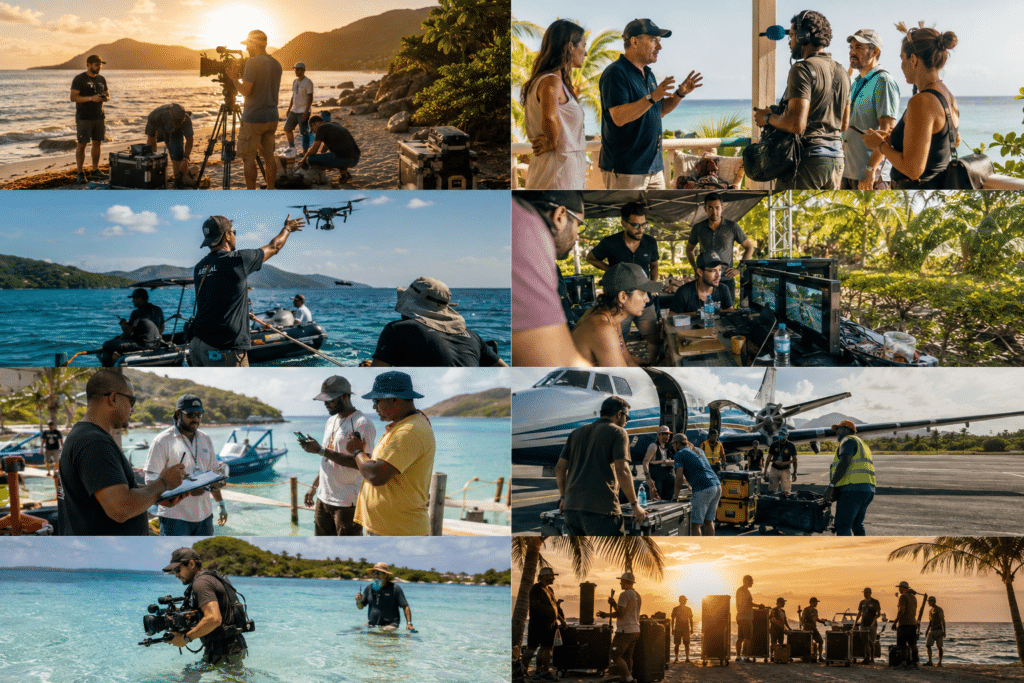
Hoodlum has permanent offices and full-time local teams across the Pacific. We have supported productions for international broadcasters and streaming platforms across Fiji, Papua New Guinea, Vanuatu, the Solomon Islands, Samoa, Tonga and beyond — managing government and community permit processes, inter-island logistics, marine coordination, local crew and equipment, customs clearance and full on-the-ground production management from first recce through to final wrap.
For further information on filming regulations and support in key Pacific territories, the following official resources are useful starting points: the Fiji Audio Visual Commission manages permits and production support for international productions filming in Fiji.
The Papua New Guinea Film Commission oversees approvals and local facilitation for productions in PNG; Film Vanuatu provides permit processing and location support across the Vanuatu archipelago; and Screen Pacific, the regional screen industry body, provides broader Pacific-wide guidance on filming across the island groups.
FILM FIXERS IN PACIFIC ISLANDS: FULL PRODUCTION SERVICES GUIDE
Every Service. Every Detail.
Every Production Covered.
Pacific Islands production depends on practical logistics as much as permits. The remoteness of the region means that nothing can be improvised on arrival. Hoodlum coordinates inter-island charter flights and boat transfers, marine vessel hire, reef and underwater filming logistics, community and landowner access agreements, equipment freight across island groups and customs clearance alongside all standard production services.
Our services across the Pacific cover film permits and government applications; local crew sourcing, fixers, coordinators and specialist technicians; location scouting, recce planning and community-access permissions; licensed drone operators and civil aviation authority compliance per island group; marine support including vessel coordination, dive teams, water safety and underwater filming logistics; camera, lighting, grip and sound equipment with import and customs support; inter-island transport and charter flight coordination; weather window planning and contingency scheduling.
Rrisk assessments, medical support and remote location emergency planning; cultural liaison, indigenous community protocols and contributor management; equipment carnets and temporary imports; and crew visas, work permits and immigration compliance across all Pacific territories.

Risk Management

Airport Protocol & On-Ground Support

Locations / RECCE’s

Rebates & Incentives

Research

Logistics

Crew Sourcing

Set Dressing / Production Design
Line Producers & Production Management

Casting & Talent

Security

Transport & Vehicles

Catering

Equipment Rentals

Film Permits

Local Film Fixers
Customs Clearance

Visas & Work Permits

Drone & Drone Operator

Accommodation
Drone & Aerial Permits
FAQ SECTION
Frequently Asked Questions
Pacific Islands production raises questions that only on-the-ground experience can answer. Below are the most common queries our teams receive from international productions planning shoots across the region.
The Pacific Islands do not currently operate formal film rebate programmes in the way that territories like the Dominican Republic or Jordan do. However, several island nations offer production facilitation, permit fee waivers and in some cases financial support negotiated directly with their national film commissions or tourism authorities.
Fiji's Audio Visual Commission provides the most structured support framework in the region, including assistance with government approvals and in some cases financial facilitation for qualifying international productions. Productions choosing the Pacific Islands do so primarily for their unmatched visual environments rather than financial incentives — though the competitive cost of local crew and services across many island groups can represent a significant practical advantage over comparable locations elsewhere.
Yes, in most cases. Permit requirements in the Pacific operate at multiple levels — national government permits, provincial or island-level permits, and in many cases separate community or landowner permissions for specific locations. A production filming across multiple islands within the same country — such as the main islands and outer islands of Fiji, or multiple island groups in Vanuatu — will typically need separate approvals for each location.
Productions moving between countries — for example from Fiji to the Solomon Islands or Papua New Guinea — will need to go through each country's permit process independently. Hoodlum manages the full permit process across all territories and island groups.
The process varies by territory. In Fiji, permits are managed through the Fiji Audio Visual Commission, which acts as the central coordination point for international productions. In Papua New Guinea, applications go through the Papua New Guinea Film Commission. In Vanuatu, Film Vanuatu manages the permit process.
Across smaller island nations — Samoa, Tonga, the Solomon Islands — permits are typically handled through a combination of the national tourism authority and relevant government ministries, often without a dedicated film commission. Lead times, documentation requirements and fees vary significantly between territories.
As a general rule, a minimum of six to eight weeks lead time is recommended for straightforward single-island permits in the more developed Pacific filming territories such as Fiji.
For productions involving restricted locations, national parks, marine protected areas, heritage sites or indigenous community land, twelve weeks or more is advisable. Productions involving multiple island groups or countries should begin the permit process as early as possible — ideally three to four months before the intended shoot date — to allow for the sequential approvals process that multi-territory Pacific shoots require.
Yes, and this is one of the most important aspects of Pacific Islands production. Land ownership and community rights are deeply embedded in Pacific Island cultures, and filming on community land, in villages, at cultural sites or on privately owned coastal land requires direct negotiation and formal agreement with landowners and community leaders. In many Pacific nations, land is communally owned under customary tenure, meaning there is no single title holder — agreement must be reached with the relevant community through proper protocols.
Hoodlum's local teams have established relationships across communities in the territories where we operate and manage all community liaison and landowner agreements as part of the production process.
Yes. Drone regulations in the Pacific are governed by each country's civil aviation authority and vary significantly across the region. In Fiji, drone operations are regulated by the Civil Aviation Authority of Fiji. Papua New Guinea, Vanuatu, Samoa and other island nations each have their own civil aviation frameworks. Restricted airspace, national park no-fly zones, proximity to airports and cultural sensitivity around sacred sites all affect where drones can be operated.
Permits must be obtained in-country before any drone flights take place, and in some territories operators must hold locally recognised qualifications or work alongside a licensed local operator.
Documentation requirements vary by territory but typically include proof of drone registration, operator certification or licence, public liability insurance with appropriate coverage levels, a flight operations plan detailing intended locations and altitudes, and the overarching film permit covering the shoot. Some territories require the drone to be registered with the local civil aviation authority on arrival. For productions carrying drones as checked baggage, customs documentation and in some cases temporary import permits will be required.
Hoodlum manages all drone permit applications and civil aviation authority processes as part of our standard production service.
An ATA Carnet is the standard method for temporarily importing professional production equipment into Pacific Island countries that are members of the ATA Carnet system. Fiji, Papua New Guinea and several other Pacific nations accept ATA Carnets, which allow equipment to enter and exit without payment of import duties, provided it is re-exported within the carnet's validity period.
For territories that do not participate in the ATA Carnet system, temporary import permits must be arranged directly with the local customs authority before arrival. Hoodlum manages all carnet documentation and customs clearance processes and can advise on the specific requirements for each territory in advance of travel.
ATA Carnets are accepted in Fiji, Papua New Guinea and a number of other Pacific territories. However, not all Pacific Island nations participate in the ATA Carnet system, and requirements can change. For smaller island nations — particularly across Micronesia, parts of Polynesia and some Melanesian territories — alternative temporary import arrangements must be made directly with local customs authorities.
It is essential to confirm the specific customs requirements for each territory before equipment is shipped or carried, as incorrect documentation on arrival can result in significant delays and costs.
Inter-island transport in the Pacific relies primarily on small charter aircraft and boat transfers, both of which operate on schedules that are heavily weather-dependent. Charter aircraft weight limits must be factored into equipment planning from the outset — heavy or oversized equipment that travels easily on a commercial flight may require a dedicated charter or freight service to reach outer islands.
Boat transfers for equipment require waterproofing, careful loading procedures and attention to sea conditions and tidal windows. Hoodlum coordinates all inter-island transport logistics as part of our production service, including charter bookings, freight planning, weather monitoring and contingency scheduling for weather-related delays.
The primary challenges are logistical rather than regulatory. Equipment access to remote islands requires advance planning around charter availability, weight limits and weather windows.
Communication infrastructure is limited or absent across many outer island locations, requiring satellite communication equipment for productions working away from main island centres. Medical facilities are limited outside of main urban centres — Suva in Fiji, Port Moresby in Papua New Guinea, Port Vila in Vanuatu — and remote location medical planning and evacuation procedures are an essential part of pre-production for any shoot venturing beyond established tourist areas. Power supply, accommodation availability and catering all require advance arrangement on outer islands. Hoodlum's teams are experienced in managing all of these factors and build remote location contingency planning into every Pacific production from the outset.
Hoodlum Film Fixers has permanent local offices and full-time in-country teams across the Pacific Islands. We are not a remote coordination service or an agency that subcontracts to local fixers — we have people who live and work in the territories where we operate, with established relationships across government permit authorities, community leaders, local crew networks and logistics providers.
Our Pacific teams are embedded in the region and bring the kind of operational knowledge that only comes from being permanently present on the ground.
Film Fixers in the Pacific Islands: The Complete Guide to Filming Across the South Pacific
The Pacific Islands represent one of the last great untapped filming frontiers on earth. For international productions seeking environments that have never been overexposed, cultures that remain genuinely intact and landscapes that exist nowhere else on the planet, the South Pacific delivers what no other region can offer. But accessing those environments requires more than a plane ticket and a camera. Film fixers in Pacific Islands are not a luxury — they are the operational backbone that makes Pacific production possible.
What Do Film Fixers in the Pacific Islands Actually Do?
Film fixers in Pacific Islands manage the full spectrum of on-the-ground production logistics that international crews cannot navigate alone. In a region where permit systems operate at national, provincial and community level simultaneously, where inter-island transport depends on charter aircraft and weather windows, and where community access to filming locations requires direct negotiation with landowners and village elders, a local fixer is the difference between a production that moves and one that stalls on arrival.
The core responsibilities of Pacific Islands film fixers include government permit applications and ministry liaison, civil aviation authority approvals for drone operations, community and landowner access negotiations, local crew sourcing and coordination, equipment customs clearance and carnet management, inter-island charter flight and boat transfer logistics, marine filming coordination, weather monitoring and contingency planning, and cultural protocol guidance across indigenous communities.
Why the Pacific Islands Require Specialist Fixers
The Pacific Islands present a set of logistical challenges that are genuinely distinct from other filming regions. Understanding why specialist film fixers in the Pacific Islands are essential — rather than optional — requires understanding what makes the region operationally unique.
Geographic fragmentation. The Pacific spans more than 30 million square kilometres of ocean, with individual island nations consisting of dozens or hundreds of separate islands. Fiji alone has over 330 islands. Papua New Guinea has over 600. Each island may require separate permits, separate community agreements and separate logistics arrangements. A production that moves between outer islands is not simply changing location — it is navigating a new set of access requirements at every stop.
Permit complexity at multiple levels. Pacific Islands permit systems operate simultaneously at national government level, provincial or island government level, and community or landowner level. A film fixer who understands only the national permit process will not be able to deliver location access — community permission must be negotiated separately and directly, through established relationships with local leaders and landowners.
Civil aviation and drone regulations. Every Pacific Island nation has its own civil aviation authority and its own drone regulation framework. Fiji’s drone operations are regulated by the Civil Aviation Authority of Fiji. Papua New Guinea, Vanuatu, Samoa and other island nations each have distinct frameworks. Operating a drone without the correct in-country approvals is a serious regulatory breach. Pacific Islands film fixers who work within these systems daily know exactly what is required in each territory and ensure productions are compliant before equipment leaves the case.
Equipment logistics and customs. Getting professional production equipment to Pacific Island filming locations requires advance planning around ATA Carnets, temporary import permits, customs clearance procedures and freight routing. Not all Pacific Island nations are ATA Carnet members. For those that are not, temporary import arrangements must be made directly with local customs authorities before arrival. Equipment that arrives without the correct documentation can be held at customs for days — a critical risk for productions operating on tight schedules in remote locations.
Remote location challenges. Productions venturing beyond the main islands of Fiji, Papua New Guinea or Vanuatu into outer island or genuinely remote locations face infrastructure limitations that require careful advance planning. Communication relies on satellite equipment. Power supply must be self-sufficient. Medical evacuation planning is not optional — it is a production necessity. Film fixers in the Pacific Islands with genuine remote location experience build these contingencies into the production from the outset, not as an afterthought.
Key Pacific Island Filming Territories
Film Fixers in Fiji
Fiji is the most developed and internationally experienced filming destination in the Pacific Islands. The Fiji Audio Visual Commission manages permit applications and production support for international productions, providing a structured entry point that most other Pacific territories lack. The country’s visual range is exceptional — the main island of Viti Levu offers jungle interior, mountain terrain, rivers, beaches and the urban environment of Suva, while the outer islands of the Mamanuca and Yasawa groups provide the kind of pristine coral-fringed island environments that define the Pacific in the international imagination.
Fiji has hosted major international feature films, reality television series and commercial productions over many years, which means there is an established local crew base with genuine international experience. Equipment can be imported using an ATA Carnet. Inter-island access to the outer islands is managed through a combination of light aircraft services and fast ferry connections.
Papua New Guinea
Papua New Guinea is one of the most visually extraordinary and logistically demanding filming destinations in the Pacific. The Papua New Guinea Film Commission manages permits and local production support for international projects. The country’s diversity is unmatched — over 800 distinct languages, ancient indigenous cultures maintaining traditions unchanged for centuries, highland landscapes, river systems, coral reef coastlines, active volcanoes and dense jungle cover an area roughly the size of California.
Productions in Papua New Guinea require experienced local fixers with established government and community relationships. Many of the most compelling filming environments are accessible only by small aircraft or boat, and community permission for filming in villages, at traditional ceremonies and on customary land is an essential part of the permit process. Hoodlum’s PNG team manages all Film Commission applications, community liaison, inter-island logistics and full production support in-country.
Vanuatu
Vanuatu’s 80-plus islands offer one of the most diverse filming environments in the Pacific — active volcanoes including Mount Yasur on Tanna island, traditional kastom villages maintaining ancient Melanesian cultural practices, pristine marine environments and a French-English colonial heritage visible in the architecture and culture of Port Vila. Film Vanuatu manages permit applications and provides production coordination support for international shoots.
Vanuatu’s small size relative to Fiji and Papua New Guinea means that a significant variety of environments can be accessed within a compact shooting schedule, making it efficient for productions that need visual diversity without the logistics of a multi-country trip.
Solomon Islands
The Solomon Islands offer perhaps the most untouched filming environments in the entire Pacific. World War II battlefield and wreck diving sites, traditional island cultures, extraordinary marine biodiversity and jungle-covered island interiors that have hosted very few international productions make the Solomons genuinely distinctive. Permit processes are managed through the relevant government ministries and in all cases require community liaison for location access beyond Port Honiara.
Samoa, Tonga and Polynesia
Samoa and Tonga offer the cultural depth of Polynesia — traditional fa’a Samoa and Tongan cultural practices, dramatic coastal scenery, blowholes, ancient coral limestone formations and a warmth of community access that makes genuine cultural filming possible with the right local relationships. Both countries require government permits for commercial filming and community permission for filming in villages and on customary land.
Film Production Incentives in the Pacific Islands
The Pacific Islands do not currently operate formal film rebate programmes comparable to those available in the Caribbean or the Middle East. There is no cash rebate or transferable tax credit structure in Fiji, Papua New Guinea or Vanuatu equivalent to Jordan’s 25% rebate or the Dominican Republic’s 25% transferable tax credit.
However, several practical financial advantages make the Pacific Islands competitive for the right type of production. Local crew rates across most Pacific territories are significantly lower than equivalent rates in Australia, New Zealand or Europe. Location fees, accommodation and ground transport in Fiji and Vanuatu can be arranged at rates that represent strong value relative to comparable visual environments elsewhere. The Fiji Audio Visual Commission provides production support and in some cases facilitation that reduces the administrative cost of getting a production into the country.
Productions considering the Pacific Islands should factor the cost of inter-island logistics, remote location infrastructure and the additional pre-production time required for multi-territory Pacific shoots into their budget planning from the outset — these are the variables that most significantly affect Pacific Islands production economics.
How Hoodlum’s Film Fixers in the Pacific Islands Work
Hoodlum Film Fixers has permanent offices and full-time local teams across the Pacific Islands. Our Pacific fixers are not occasional contacts or subcontracted local guides — they are professional production staff who work within Pacific permit systems, government relationships and community networks every day.
When a production engages Hoodlum for Pacific Islands filming, the process begins with a thorough assessment of the production brief, the intended territories and the specific location requirements. Our teams identify the permit pathway in each territory, begin community liaison processes that require time to complete properly, assess equipment logistics and customs requirements for each island nation, and build a production plan that accounts for inter-island transport, weather contingencies and remote location requirements before any commitment to specific shoot dates is made.
During production, our local teams are present on the ground throughout — not available by phone from another country. When a permit needs following up, a community agreement needs renegotiating or weather forces a logistics change, our people are already there.
For productions considering the Pacific Islands for the first time, we strongly recommend beginning the conversation with our teams as early in the development process as possible. The Pacific rewards thorough preparation. Productions that arrive well-prepared access environments and experiences that no other region on earth can provide.
You Navigate Alone
Hoodlum's permanent in-country teams are already there — with the permits, the relationships and the operational experience to make your production work in one of the world's most extraordinary and logistically demanding filming environments.